How to Set Up a Personal AI Tutor in 20 Minutes
A Harvard University trial found that undergraduate physics students tutored by an AI achieved higher mastery in less time than their classroom-instructed peers. Kestin et al., Science, 2025 A private human tutor costs $30 to $150 per hour. HelloThinkster, 2026 The setup that produced those results takes about twenty minutes and costs nothing. Here is exactly how to do it.
- The default way most students use AI produces the illusion of learning: they read a polished answer, feel comprehension, and forget it within hours.
- A personal AI tutor works the opposite way: it refuses to give answers and forces the student to produce the reasoning themselves.
- Three tools, three jobs: Gemini for large document loads, Claude for logic and coding, ChatGPT for voice and data work.
- The full setup takes twenty minutes. The Socratic control prompt is the critical piece. It is in this post, ready to copy and paste.
Why the Default Setup Fails
Ask an unmodified AI tool to explain the economic causes of the French Revolution and it will produce a polished, well-structured essay in seconds. The student reads it. They feel a brief, satisfying sense of understanding. They close the tab and move on.
Within hours, most of it is gone.
The OECD categorises this as "Fast AI": an academic workflow where the technology acts purely as an answer engine, prioritising immediate task completion over cognitive retention. Thesify / OECD, 2026 What happens cognitively is that passive reading is mistaken for active mastery. The student absorbed words. They did not build understanding. Those are different processes and they produce different results on an exam.
The issue is not the tool. It is the configuration. A language model's default directive is to resolve queries as completely as possible. Left to its own design, it fills in every gap, answers every question, writes every outline. The student gets the output without doing the cognitive work that builds the knowledge.
Overriding that default is the entire skill of AI tutoring. It is not complicated. It takes about three minutes once you know what to paste. The rest of this post is how to get there.
For a deeper look at the Fast AI versus Slow AI distinction and the neuroscience behind why productive struggle matters, see Fast AI vs Slow AI: Why the Way You Study Matters More Than the Tool.
Which Tool for Which Job
The most capable students in 2026 do not use one AI tool for everything. They match the tool to the task. The three platforms have distinct structural advantages for tutoring, and picking the right one before starting a session saves significant friction.
| Task type | Best tool | Why |
|---|---|---|
| Uploading and working through a full semester of course materials | Gemini | 2-million token context window. An entire semester of notes, textbook chapters, and lecture transcripts can be uploaded at once. Gurusup, 2026 |
| Mathematics, formal logic, coding, legal reasoning, and other precision-dependent subjects | Claude | Higher resistance to breaking Socratic constraints under pressure. When a frustrated student types "just tell me the answer," Claude holds the line more reliably than competitors. Codeble, 2026 |
| Voice-based conversation, language practice, data analysis, general study sessions | ChatGPT | Native Study Mode enforces Socratic constraints without a custom prompt. Advanced Voice Mode offers near-zero-latency spoken dialogue for language practice or verbal exam prep. r/studytips, 2026 |
For a full comparison of these tools including cost, student safety, and classroom applications, see The 5 AI Tools I Use in My Classroom and the dedicated cost comparison at AI Tutor vs Human Tutor: An Honest Comparison.
How to digitise textbook materials and ingest them into a language model to create an interactive study session. Source: Learning and Technology with Frank, 2026.
The Five-Step Setup
This framework works with any of the three platforms. The steps are the same. What changes is the tool you open and how much material you upload in Step 2.
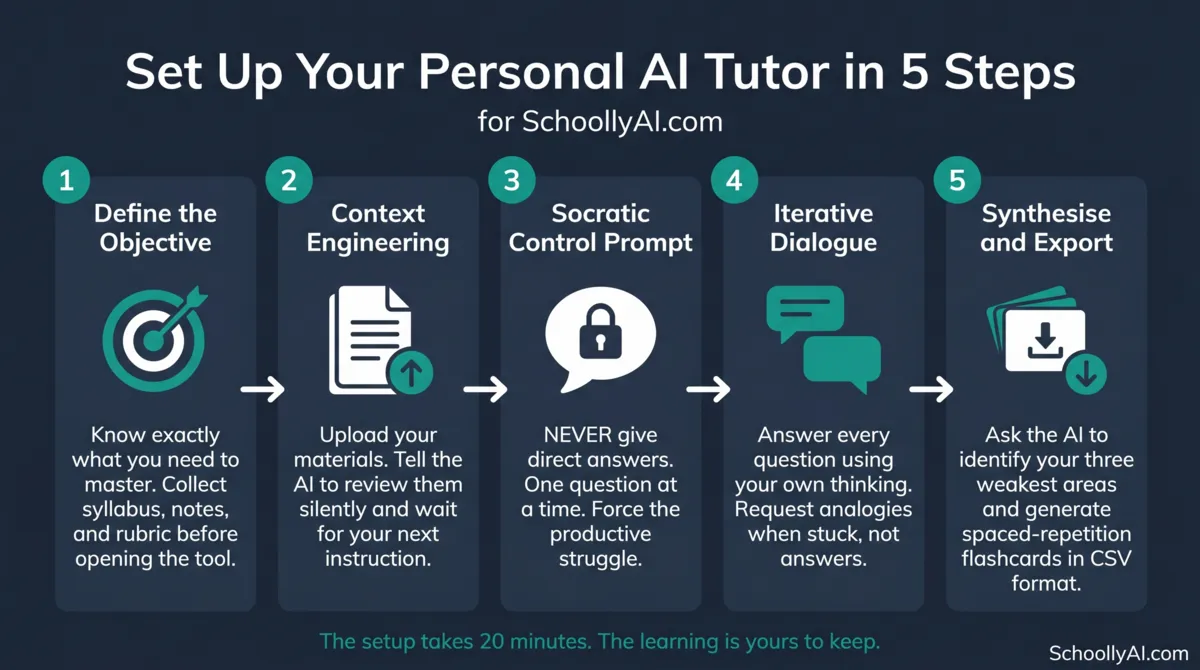
Step 1: Define the Objective and Gather Materials
Before opening any AI tool, be specific about what you need to learn. "Study for my exam" is not a workable directive. "Understand how to apply the chain rule in calculus to composite trigonometric functions" is.
The specificity matters because it determines what materials you need and what the tutor will focus on. Vague objectives produce vague sessions.
Collect everything relevant before you start: the course syllabus, the sections of the textbook covering the target topic, the grading rubric if you have one, and your own lecture notes. Language models are susceptible to hallucination when they have no grounding material to work from. Apporto, 2026 Uploading your actual course materials anchors the session to the specific content you are being assessed on, rather than the model's general training data.
This step takes five minutes. It is the most skipped step and it is why most AI study sessions produce generic output.
Step 2: Context Engineering and Upload
Select your tool based on the task type from the table above. Open a new, clean session. Upload your materials. Then give the model this instruction before you ask it anything substantive:
"Attached are my lecture notes, the relevant textbook sections, and the grading rubric for [specific topic]. Review these documents silently. Acknowledge when you have processed them, but do not summarise them yet. Wait for my next instruction."
This instruction does two things. It prevents the model from immediately producing a summary you did not ask for. It forces the model to reference your specific materials rather than its general training data when it answers subsequent questions.
This process is called context engineering. The model now has a localised knowledge base. When it generates study questions or challenges your reasoning, it will draw from your actual course content rather than a generalised internet-scale version of the subject. r/ChatGPTPromptGenius, 2026
For Gemini specifically, you can upload entire PDF textbooks, full semester lecture note folders, and multiple supplementary documents simultaneously. The 2-million token context window handles what would crash any other platform.
Step 3: Inject the Socratic Control Prompt
This is the step that separates a personal AI tutor from an answer machine. Copy the prompt below and paste it into the chat after the model has acknowledged your materials.
"Act as an expert university tutor specialising in [subject]. Your objective is to help me achieve genuine mastery of the uploaded materials through active recall and critical thinking.
You are bound by the following strict rules:
1. NEVER give me the direct answer to a question, solve a problem for me, or write text on my behalf.
2. Use the Socratic method exclusively. Guide me toward the correct answer by asking probing, step-by-step questions.
3. If I give an incorrect answer, do not correct me directly. Point out the logical flaw and ask a question that forces me to identify the error myself.
4. Keep your responses brief and conversational. Ask only one question at a time.
5. If my request is vague, ask up to three clarifying questions before proceeding. Do not guess my intent.
Begin by asking me which specific concept from the uploaded materials I am struggling with most."
That final line is critical. It forces the student to articulate their exact point of confusion before the session begins, rather than starting with a vague "help me study for my test."
A few things to know about this prompt in practice. Claude holds these constraints most reliably under pressure. When a frustrated student types "just give me the answer," Claude will typically redirect with another question. ChatGPT is slightly more likely to capitulate after repeated demands. ChatGPT's built-in Study Mode provides similar constraints natively if you prefer not to use a custom prompt.
For the full mechanics of why this prompt works neurologically, and alternate versions for specific subject types, see The Socratic AI Tutor Prompt: How to Build One That Works.
How to use Gemini's 2-million token context window with semester-long course materials for a full AI study session. Source: Paul J Lipsky, 2026.
Step 4: Engage in Iterative Dialogue
Once the prompt is set and the model has asked its opening question, the session begins. The rule for this phase is simple: answer every question using your own thinking before consulting anything else.
This is where most students abandon the process. The tutor asks a question you cannot immediately answer. The instinct is to open a new tab, search for the answer, and paste it back. Do not do that. The inability to answer is information about where your knowledge gap actually is. Sitting with that discomfort for sixty seconds is more educational than finding the answer immediately.
If you have genuinely hit a wall after trying, there is a productive way to request help without bypassing the learning:
"I am still confused after several attempts. Please give me a real-world analogy that compares this concept to something a high school student would encounter in daily life, then ask me a new question to test whether the analogy helped."
That instruction gets you a scaffold without getting you the answer. The analogy helps you build a mental model. The follow-up question confirms whether it worked.
The frustration in this process is not a sign something is wrong. It is the signal that genuine learning is happening. As one computer science student described it after working with a Socratic AI tutor: "Getting roasted by an AI tutor for 15 minutes is worth 3 hours of re-reading your own highlights." r/studytips, 2026 The friction is the mechanism. That discomfort is what forces the retrieval from memory that produces durable knowledge.
Step 5: Synthesise and Export
At the end of the session, formalise what you learned and convert it into study materials you can use later. Paste this instruction:
"Based on our dialogue today, identify the three concepts I struggled with most. Then generate a set of 10 spaced-repetition flashcards in CSV format, targeting specifically those weak points, so I can import them into Anki or a similar flashcard app."
The CSV format is importable directly into Anki, Quizlet, and most spaced-repetition apps. You leave the session with a targeted study set built around your specific gaps, not a generic overview of the subject.
This step closes a loop that most students miss: the session produces data about where you are weak, and that data immediately converts into your next study tool. The tutor session generates the flashcards. The flashcards generate the next tutor session. The cycle builds on itself.
For a complete walkthrough of running a full exam-preparation session using this method, with subject-specific variations, see How to Use AI to Study for Exams.
Where It Goes Wrong
Three failure modes account for most unsuccessful AI tutoring attempts.
Skipping the Socratic prompt. Without behavioral constraints, the model defaults to Fast AI: complete answers, polished summaries, finished work. The student gets output without doing the cognitive work. This feels productive in the moment and produces very little retention. The prompt is not optional.
Trusting unverified output. Language models are prediction engines, not fact databases. They will occasionally generate plausible-sounding but incorrect explanations of mathematical concepts, fabricate citations, or produce subtly wrong logical chains stated with complete confidence. Any factual claim the model makes that is material to your understanding should be verified against your textbook or a reliable source before you internalise it.
Demanding the answer under pressure. The Socratic constraint will frustrate you. That frustration is the mechanism. Students who type "just tell me" and receive a capitulated answer have not saved time. They have wasted the session. If the constraint is breaking, switch to Claude, which holds the line more reliably, or restart the prompt.
A fourth issue worth naming is time poverty. Research into university students who use AI for bypass rather than learning consistently finds a structural explanation: they are working jobs, managing caregiving responsibilities, and carrying reading loads that are genuinely unsustainable. Wonkhe, 2026 The Socratic tutor setup requires time and sustained effort. For students in genuine crisis, that is a real barrier, not a moral failing. The AI tutor works for students who have the conditions to use it correctly.
What the Research Shows
The evidence for structured AI tutoring, as distinct from casual AI use, is strong and growing.
A Harvard University trial evaluating undergraduate physics instruction found that students working with an AI tutor achieved higher mastery in less time than their classroom-instructed peers. Kestin et al., Science, 2025 The study noted that the advantage was specific to interactive, question-based AI use, not passive AI consumption.
A meta-analysis from the Brookings Institution reviewed multiple randomised controlled trials across different demographics and concluded that properly configured platforms deliver "substantial learning gains across all studies, greater knowledge transfer, and improved motivation." Brookings Institution, 2026 The word "properly configured" is doing a lot of work in that conclusion. Improperly configured platforms do the opposite.
The Stanford "Tutor CoPilot" trial, involving 900 human tutors and 1,800 K-12 students, found that human tutors supported by an AI assistant achieved higher student mastery rates than unsupported tutors. The largest improvements were among the least experienced human tutors. Stanford HAI, 2026 The AI did not replace the human element. It made the human tutor more effective by handling repetitive scaffolding tasks.
The common thread across every study that shows positive results is the same: structured, active, question-based AI interaction outperforms passive AI consumption. The Socratic control prompt is what creates that condition.
For more on the Bloom's 2 Sigma Problem and what the research says about personalised tutoring at scale, see AI Tutor vs Human Tutor: An Honest Comparison.
A practical demonstration of programming a Socratic AI system that refuses to provide direct answers and forces students to reason independently. Source: AI Theory Guy, 2026.
Build Your Socratic Prompt
The interactive below generates a customised Socratic tutor prompt based on your subject and level. Fill in the fields and copy the result directly into your AI tool after uploading your materials in Step 2.
Generate Your Socratic Tutor Prompt
Fill in the three fields below. Copy the generated prompt and paste it into your AI tool after uploading your course materials.
FAQ
Use a five-step process: define your learning objective, gather and upload your course materials, inject a Socratic control prompt that explicitly prohibits direct answers, engage in iterative dialogue using your own thinking, and finish by asking the tutor to identify your weak areas and generate flashcards. The setup takes about twenty minutes and costs nothing on free tiers.
It depends on the task. Gemini for uploading large volumes of course material: its 2-million token context window can hold an entire semester's notes. Claude for logic-heavy subjects where strict instruction-following matters. ChatGPT for voice-based dialogue, language practice, and data analysis tasks. Its Study Mode enforces Socratic constraints natively.
A set of behavioral instructions that prevents the AI from giving direct answers. It commands the model to guide the student through questions rather than providing solutions. A properly written Socratic prompt includes a specific tutor persona, a strict prohibition on direct answers, an instruction to respond with one question at a time, and a directive to identify logical errors rather than correct them outright. The generator above produces one customised to your subject.
On specific dimensions, yes. AI tutors are available 24 hours a day, cost nothing or very little, have infinite patience, and can cover any subject. A Harvard University trial found that AI-guided undergraduate physics students achieved higher mastery in less time than classroom-instructed peers. Human tutors have advantages AI cannot replicate: genuine emotional intelligence, social accountability, and the capacity to read physical cues of distress or motivation. See the full breakdown at AI Tutor vs Human Tutor: An Honest Comparison.
Fast AI is using an AI tool as an answer engine: paste a question, receive a complete answer, move on. The student feels brief comprehension and retains almost nothing. Slow AI is using the same tool as a Socratic tutor: it refuses to give answers and forces the student to work through the reasoning. Slow AI produces genuine cognitive load and durable learning. Full explanation at Fast AI vs Slow AI: Why the Way You Study Matters More Than the Tool.
Use a Socratic control prompt that explicitly prohibits direct answers. Include the instruction: NEVER give me the direct answer to a question, solve a problem for me, or write text on my behalf. Claude holds this constraint most reliably under pressure. ChatGPT's Study Mode enforces similar constraints natively. The prompt generator above produces a complete version customised to your subject.
Yes. The free tiers of Claude, ChatGPT, and Gemini are all capable of functioning as effective Socratic tutors. ChatGPT's Study Mode is available on the free tier. Gemini handles substantial document uploads. Claude maintains strict instructional constraints reliably. A private human tutor in 2026 costs between $30 and $150 per hour. The AI costs nothing.
Sources
- Kestin, G. et al. AI Tutoring Outperforms Active Learning. Science, 2025. science.org
- HelloThinkster. AI Math Tutors vs Human Tutors. 2026. hellothinkster.com
- Thesify / OECD. Impact of Generative AI on Student Learning. 2026. thesify.ai
- Brookings Institution. AI Tutors: Reviewing the Evidence. 2026. brookings.edu
- Stanford HAI. Tutor CoPilot: Human-AI Collaboration in Tutoring. 2025. hai.stanford.edu
- Towards AI. The Socratic Prompt. January 2026. towardsai.net
- Apporto. How to Get an AI Tutor. 2026. apporto.com
- Codeble. ChatGPT vs Claude vs Gemini 2026. 2026. codeble.com
- Wonkhe. Trained to Stop Learning. 2026. wonkhe.com
- r/studytips. The Study Tips for 2026. 2026. reddit.com
- r/ChatGPTPromptGenius. Context Engineering for Study Sessions. 2026. reddit.com
- Khan, S. Brave New Words. 2024. gatesnotes.com
Want the AI literacy foundation first?
Understanding why AI produces plausible-sounding answers without actually knowing anything is the key to using it as a tutor rather than an answer machine. The AI Literacy mini-course covers this in three free sections. No email required.
Start the AI Literacy Course →