AI Tutor vs Human Tutor: An Honest Comparison
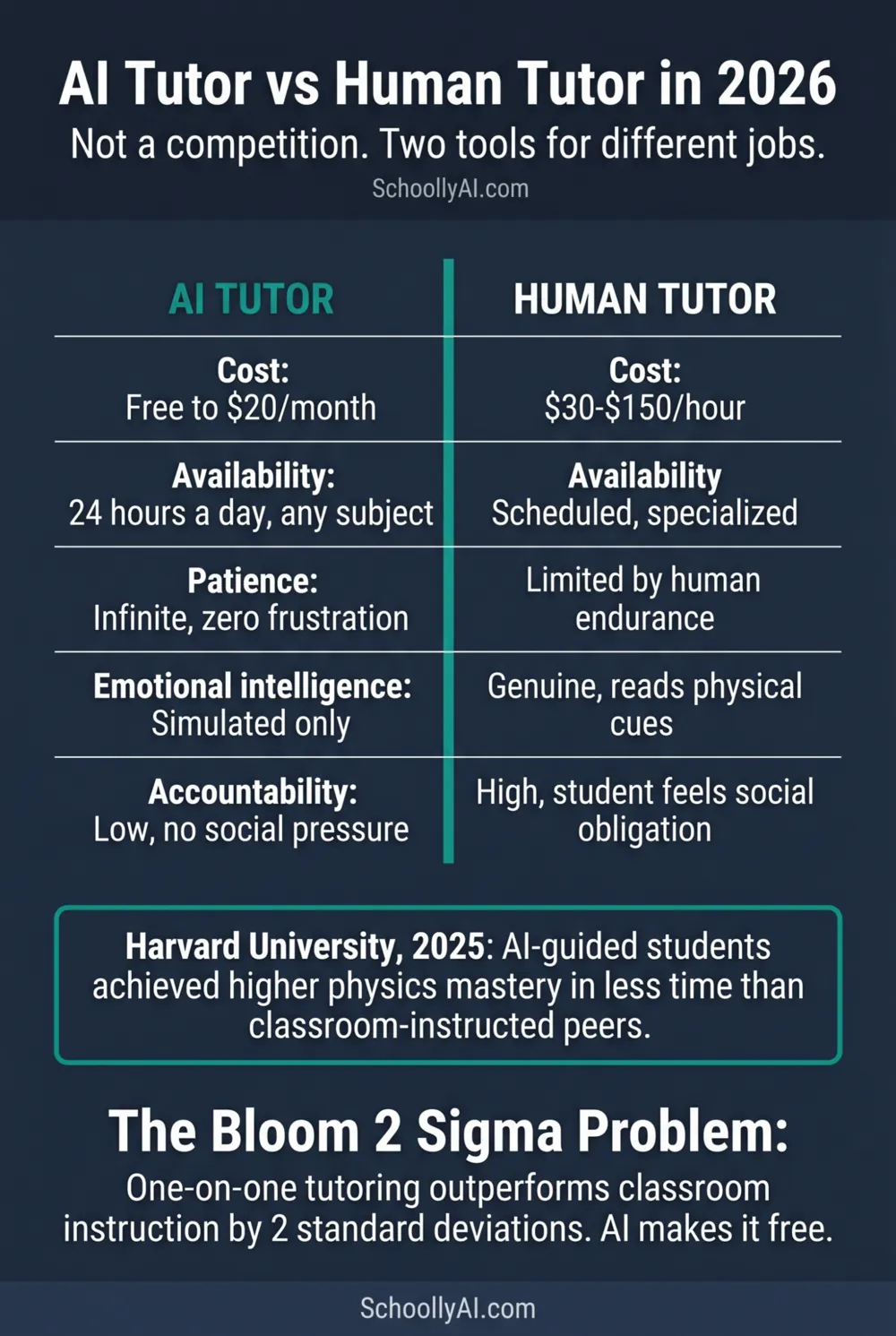
A qualified human tutor for advanced secondary or university subjects costs between $30 and $150 per hour in 2026. HelloThinkster, 2026 A Harvard University trial found that properly configured AI tutoring produced higher student mastery than conventional classroom instruction in less time. Kestin et al., Science, 2025 This is not a comparison between equals. It is a comparison between two tools with different strengths for different jobs.
- AI tutors cost nothing to very little. Human tutors cost $30 to $150 per hour. Sustained daily tutoring from a human is inaccessible for most families.
- AI tutors are better at: infinite patience, 24-hour availability, broad subject coverage, and never showing frustration.
- Human tutors are better at: reading emotional states, building accountability, providing genuine motivation, and noticing when a student needs something other than more explanation.
- The research-backed optimal model is not either-or. It is AI handling repetitive scaffolding so the human can focus on the work only humans can do.
The Cost Gap
The most straightforward argument for AI tutoring is financial. A qualified human tutor for advanced mathematics, science, or writing costs between $30 and $150 per hour in 2026 depending on subject, location, and the tutor's credentials. HelloThinkster, 2026 Sustained daily tutoring at the lower end of that range costs over $5,000 per school year. At the upper end, it costs more than $25,000.
The free tiers of Claude, ChatGPT, and Gemini cost nothing. Paid tiers cost $10 to $20 per month. A student anywhere in the world with internet access can open a session, upload their course materials, paste a Socratic control prompt, and receive one-on-one tutoring in any subject at any hour of the day.
Salman Khan framed the economic reality clearly when discussing global education in 2025: "Getting every student a dedicated on-call human tutor is cost prohibitive." Gates Notes, 2024 The cost constraint is not marginal. For most families, sustained private tutoring is simply not an option. AI tutoring is.
What AI Does Better
Infinite patience. A human tutor who has explained the same concept eight times in one hour will show fatigue. Their voice changes. Their explanations get shorter. The student notices and starts pretending to understand before they actually do. An AI tutor does not fatigue. It will rephrase a concept thirty times with a different analogy each time without any signal of frustration or judgment.
Psychological safety for anxious students. A significant proportion of students refuse to ask clarifying questions in class or to a human tutor because they fear appearing unintelligent in front of someone whose opinion matters to them. In a text-based AI interface, that social pressure disappears. Students report asking questions they would never ask a human tutor, making obvious errors without self-consciousness, and trying again after failing without embarrassment. BOTI, 2026
Subject breadth. A human tutor who specialises in AP Chemistry may struggle to pivot to advanced Latin or multivariable calculus in the same session. A capable AI model moves between organic chemistry, formal logic, and literary analysis without any reduction in the quality of engagement.
Availability. Human tutors schedule sessions in advance during business hours. AI tutors are available at midnight before an exam, at 6am before a class, and on public holidays. The availability is unconditional.
What Humans Do Better
Reading physical and emotional cues. A human tutor notices when a student's body language signals shutdown rather than confusion. They can tell the difference between a student who needs a different explanation and a student who needs to take a break. They can tell when academic struggle is actually anxiety, fatigue, or something happening outside the classroom. AI has no access to any of this.
Social accountability. Students feel something when they disappoint a human tutor who has invested time in them. That social pressure is a genuine motivational force that AI cannot replicate. A student who skips an AI session has no one to explain themselves to. A student who skips a session with a human they know will remember it.
Genuine motivation. A human tutor who has taught a student for months knows what they are capable of and can draw on that knowledge to push past resistance in ways that are specific to that student. AI cannot provide this. It has no memory of the student's history, no investment in their success, and no genuine stake in the outcome.
Noticing what the student does not say. A skilled human tutor pays attention to what a student avoids, deflects, or seems to not understand without being able to articulate why. That kind of diagnostic perception requires a human who is watching, not a model that is reading text.
The Bloom 2 Sigma Problem
In 1984, educational psychologist Benjamin Bloom published research showing that students receiving one-on-one human tutoring outperformed classroom-instructed peers by two standard deviations. This placed the average tutored student above 98% of students in a conventional classroom setting.
The finding was simultaneously exciting and useless. One-on-one human tutoring at that quality and consistency was economically impossible to scale. Most students would never have access to it. Bloom called this the "2 Sigma Problem": the educational gap was documented and the solution was financially out of reach.
AI tutoring is the first plausible response to Bloom's problem at scale. A Brookings Institution meta-analysis of AI tutoring trials across multiple demographics concluded that properly configured AI platforms deliver "substantial learning gains across all studies, greater knowledge transfer, and improved motivation." Brookings Institution, 2026 The Harvard physics trial found AI-tutored students achieved higher mastery in less time than classroom-instructed peers. Kestin et al., Science, 2025
The caveat in both findings is the same: "properly configured." An AI tool running in Fast AI mode, answering every question completely and immediately, produces none of these gains. The configuration is the intervention.
The Combined Model
The Stanford "Tutor CoPilot" trial found that human tutors supported by an AI assistant achieved higher student mastery rates than unsupported human tutors, with the largest improvements among the least experienced tutors. Stanford HAI, 2026
The interpretation is not that AI replaced the human. It is that AI handled the repetitive scaffolding work: generating practice problems, providing explanations of foundational concepts, tracking what the student had and had not mastered. This freed the human tutor to focus on motivation, emotional support, and the relational work that AI cannot do.
For families who can access a human tutor at any frequency, the combined model is the most effective structure: AI handles daily practice, the human handles weekly strategic sessions focused on what the AI cannot address. For families who cannot afford a human tutor at all, a properly configured AI tutor is a genuinely powerful substitute for most academic support needs.
For the full setup guide, see How to Set Up a Personal AI Tutor in 20 Minutes.
FAQ
On specific dimensions, yes. A Harvard trial found that AI-guided physics students achieved higher mastery in less time than classroom-instructed peers. AI tutors are available 24 hours a day, cost nothing, and have infinite patience. Human tutors have advantages AI cannot replicate: genuine emotional intelligence, social accountability, and the ability to read physical cues of distress or motivation.
A qualified human tutor for advanced subjects costs between $30 and $150 per hour. Sustained daily tutoring at those rates is inaccessible for most families. Free AI tutoring tools provide continuous, on-demand academic support at no cost.
Benjamin Bloom's 1984 research found that one-on-one human tutoring placed the average student above 98% of classroom-instructed peers. The problem was that individualised tutoring was economically impossible to scale. AI tutoring is now providing that level of individual attention at near-zero cost to any student with internet access.
For specific academic support tasks, AI performs at or above human tutor level: infinite patience, 24-hour availability, zero cost, and coverage across all subjects. For motivation, emotional support, and managing a student's distress or disengagement, human tutors have genuine advantages AI cannot replicate. The strongest model combines both.
Sources
- HelloThinkster. AI Math Tutors vs Human Tutors. 2026. hellothinkster.com
- Kestin, G. et al. AI Tutoring Outperforms Active Learning. Science, 2025. science.org
- Khan, S. Brave New Words. 2024. gatesnotes.com
- Brookings Institution. AI Tutors: Reviewing the Evidence. 2026. brookings.edu
- Stanford HAI. Tutor CoPilot: Human-AI Collaboration in Tutoring. 2025. hai.stanford.edu
- BOTI. Using AI for Self-Directed Learning. 2026. boti.co.za