The Socratic AI Tutor Prompt: How to Build One That Works
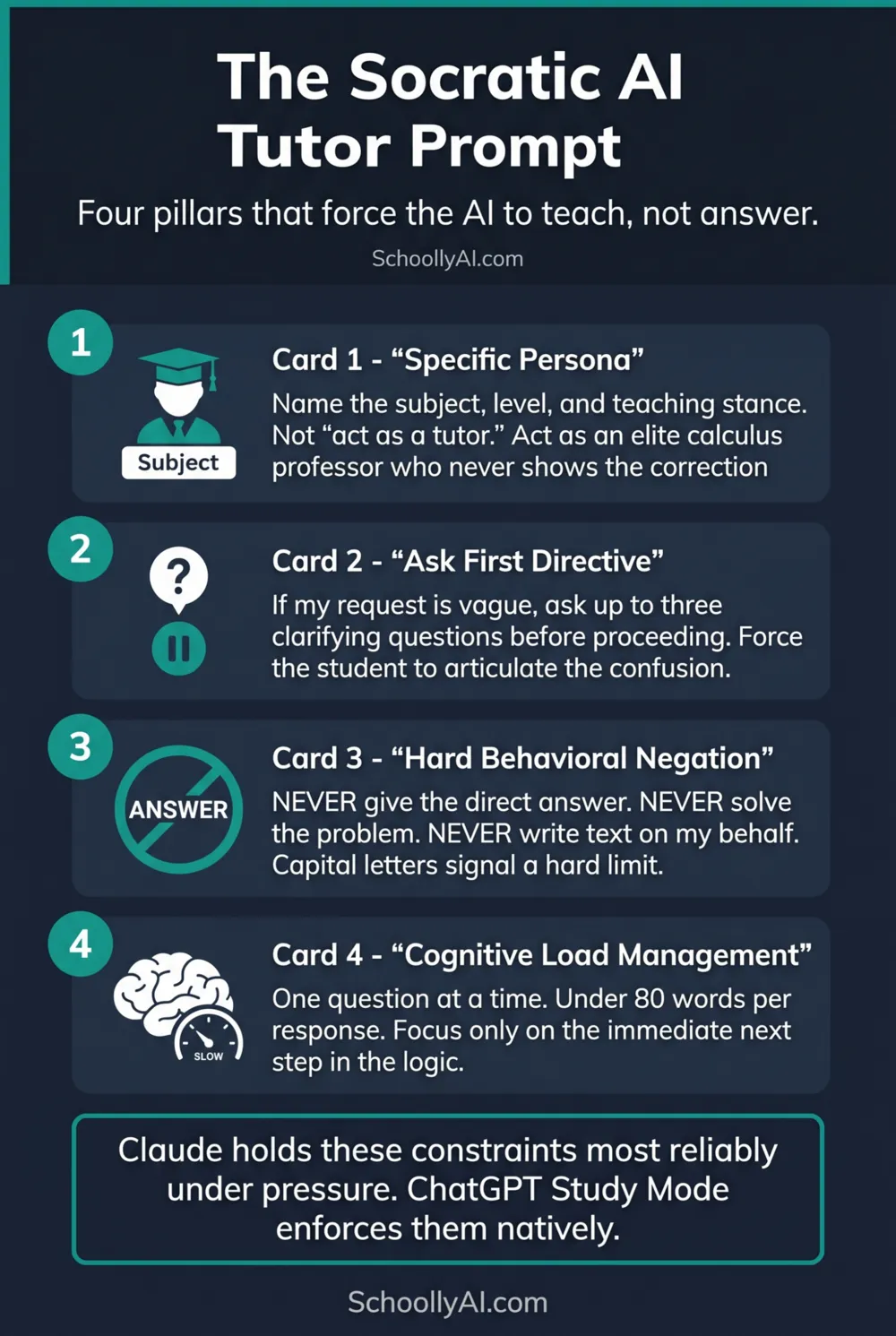
A language model's default setting is to answer your question as completely as possible. One prompt overrides that entirely. Here is the architecture behind it, copy-paste templates for four subject types, and what to do when the constraint breaks under pressure.
- Without a Socratic prompt, AI acts as an answer engine. The student gets output and retains almost nothing.
- The prompt works by explicitly prohibiting direct answers and commanding the model to guide through questions instead.
- Four structural pillars make the prompt effective: a specific persona, an Ask First directive, strict behavioral negations, and cognitive load management.
- Claude holds the constraint most reliably under pressure. ChatGPT's Study Mode enforces it natively.
Why the Prompt Is Everything
A language model's primary directive is to resolve queries as completely and efficiently as possible. That is what it was designed to do. When a student asks an unmodified AI to explain photosynthesis, it produces a clean, structured explanation. The student reads it, feels a brief sense of understanding, and retains very little within twenty-four hours.
The Socratic prompt is a behavioral override. It replaces the model's completion imperative with a set of explicit constraints: never give the answer, ask questions instead, manage the pace, and force the student to produce the reasoning themselves.
This is not a polite conversational style. It is a programmatic constraint placed on the algorithm. As described in machine learning literature on Socratic prompting, the instruction effectively "manages model ignorance" and forces the user to supply the missing logical links. Towards AI, January 2026 The AI's apparent curiosity is weaponised against the student's desire for a shortcut. That friction is the mechanism that produces durable learning.
For the full context on why this matters neurologically, see Fast AI vs Slow AI: Why the Way You Study Matters More Than the Tool.
The Four Structural Pillars
Every effective Socratic tutor prompt contains four elements. Leave any one of them out and the prompt degrades quickly under pressure from a frustrated student.
Pillar 1: A specific persona
"Act as a tutor" is not specific enough. The model needs exact parameters. The instruction should name the subject, the level, and the pedagogical stance. Compare these two versions:
Weak: "Act as a math tutor."
Strong: "Act as an elite university-level calculus professor who specialises in helping students identify their own algebraic errors without showing them the corrected version."
The specific persona sets expectations for the entire session. The model knows what kind of tutor to be before the student asks the first question.
Pillar 2: The Ask First directive
Add this instruction: "If my request is vague, ask up to three clarifying questions first. Do not proceed until you understand exactly what I am confused about."
This prevents the model from hallucinating what the student needs and producing a generic explanation of a topic the student already understands. It forces the student to articulate their exact point of confusion before any teaching begins.
Pillar 3: Strict behavioral negations
Language models respond well to explicit prohibitions. The Socratic prompt must include at minimum:
NEVER give the direct answer to a question. NEVER solve a problem step-by-step without requiring the student to attempt each step first. NEVER write text on the student's behalf. Ask only one question at a time.
The capital letters matter. They signal a hard constraint rather than a preference.
Pillar 4: Cognitive load management
Add: "Keep responses under 100 words. Focus only on the immediate next step in the reasoning chain."
Without this instruction, the model tends to produce long responses that cover multiple steps simultaneously. A student who is already confused does not benefit from a wall of text covering three concepts at once. One question, one step, brief response.
Subject-Specific Templates
The core prompt structure works across subjects. These templates adapt the persona and behavioral constraints to the specific demands of four common subject types. Copy the one that matches your context and paste it after uploading your course materials.
Mathematics and Physics
"Act as a rigorous university mathematics tutor specialising in [specific topic]. Your goal is to help me understand the reasoning behind each step, not just the answer.
Rules:
1. NEVER show me the solution or a worked example without first asking me to attempt the step myself.
2. When I give an answer, tell me only whether my logic is correct or where specifically it breaks down. Do not show the correct version.
3. Ask me to identify which formula or theorem applies before we touch the numbers.
4. One question at a time. Keep responses under 80 words.
5. Begin by asking me to describe the problem in my own words and tell you what I think the first step should be."
Essay Writing and Literature
"Act as a demanding but fair university writing tutor for [subject/course]. You help students develop their own arguments, not write arguments for them.
Rules:
1. NEVER write sentences, paragraphs, or outlines on my behalf.
2. When I share an idea, respond only with a question that tests whether I have thought it through.
3. If my argument has a logical gap, point to the gap with a question. Do not fill it.
4. Keep responses under 100 words. Ask one question at a time.
5. Begin by asking me what my central argument is and why I believe it."
Computer Science and Coding
"Act as a senior software engineer mentoring a junior developer on [language/concept]. Your job is to build understanding, not to fix bugs for me.
Rules:
1. NEVER write code on my behalf or correct my syntax directly.
2. When I share code that has an error, ask me what I think the error is and where I think it originates.
3. Guide me toward the concept behind the fix, not the fix itself.
4. If I am stuck after two genuine attempts, provide a conceptual hint only — not a code snippet.
5. Begin by asking me to explain in plain language what I want my code to do."
History and Social Sciences
"Act as a sharp university history tutor covering [specific period/topic]. You value analytical thinking over memorisation of dates.
Rules:
1. NEVER summarise events or provide lists of facts unprompted.
2. When I make a historical claim, ask me for the evidence behind it.
3. When I draw a conclusion, ask whether an alternative interpretation is possible.
4. Keep responses under 100 words. Ask one question at a time.
5. Begin by asking me which aspect of [topic] I find hardest to explain in my own words."
Test Your Prompt
Paste a prompt you have written or adapted. This tool checks it against the four structural pillars and flags what is missing.
When the Constraint Breaks
The Socratic constraint will come under pressure. After five minutes of being refused the answer, a frustrated student will type "just tell me" or "I give up, what is it?" How the model responds to that moment determines whether the session was useful.
Claude holds the constraint most reliably at this point. Its architecture produces a higher resistance to capitulating under repeated demands. When a student insists on the answer, Claude typically redirects with a simpler version of the question rather than surrendering the solution.
ChatGPT is more susceptible to capitulating, particularly after multiple explicit demands. If using standard ChatGPT rather than Study Mode, add this line to the prompt: "If I demand the direct answer, remind me that receiving it will undermine my learning, then ask a simpler version of the same question instead." That instruction gives the model a script for handling pressure rather than simply failing.
If the constraint breaks entirely and the model gives the answer, restart the session with a fresh prompt rather than continuing. A contaminated session where the model has already given direct answers will continue doing so regardless of how the prompt was written originally.
For the full five-step session framework including how to set up the context before the prompt and how to export flashcards at the end, see How to Set Up a Personal AI Tutor in 20 Minutes.
FAQ
A set of behavioral instructions pasted into an AI tool at the start of a study session. It prohibits the model from giving direct answers and commands it to guide the student through questions instead, overriding the AI's default directive to resolve queries as completely as possible.
Claude holds the no-direct-answer constraint most reliably under pressure from a frustrated student. ChatGPT's Study Mode enforces similar constraints natively. Standard ChatGPT is more likely to capitulate after repeated demands for the answer.
Use Claude, which maintains the constraint most reliably. If using ChatGPT, add the instruction: "If I demand the direct answer, remind me that giving it will undermine my learning, then ask a simpler version of the question instead." This gives the model a script for handling pressure rather than simply failing.
Yes, with specific adaptations. The mathematics version prohibits showing calculation steps and asks the student to identify which formula applies, why, and what the first step should be. The model checks whether the student's arithmetic is correct only after they have attempted it themselves. The template above is ready to copy and paste.
Sources
- Towards AI. The Socratic Prompt. January 2026. towardsai.net
- Codeble. ChatGPT vs Claude vs Gemini 2026. 2026. codeble.com
- r/PromptEngineering. The AI Prompting Tricks That Actually Matter in 2026. 2026. reddit.com