What Is AI Literacy for Teachers? The 2026 Guide
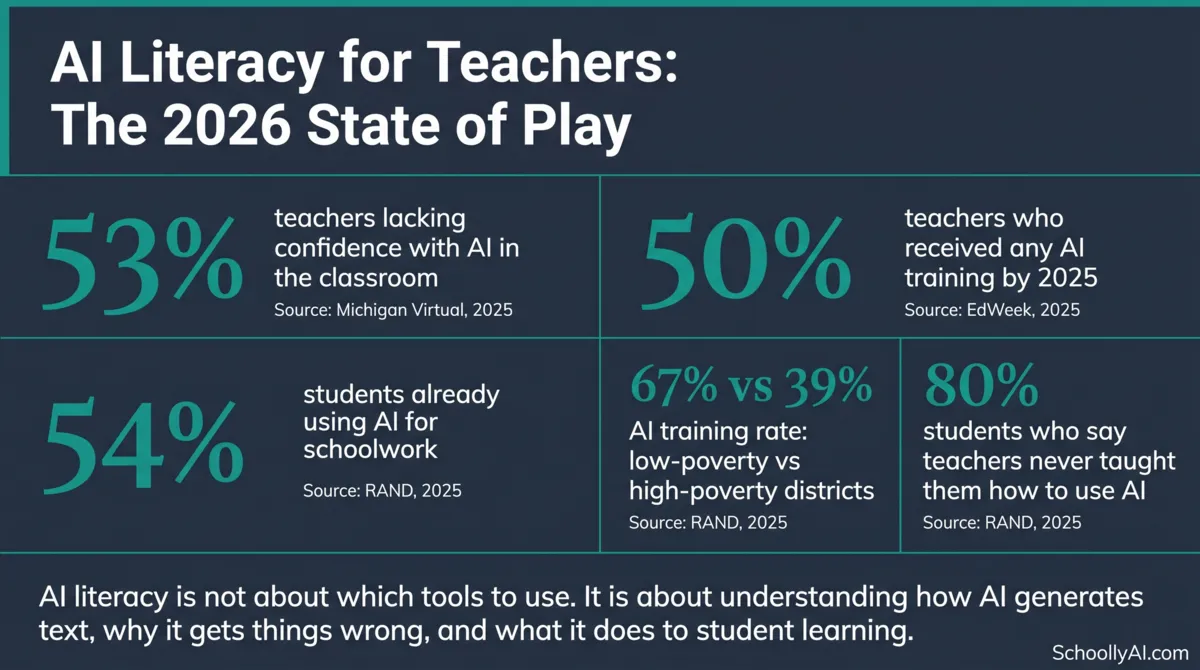
AI literacy for teachers is not about knowing which tools to use. Most teachers already know the names. ChatGPT. MagicSchool. Diffit. The problem is that 53% of teachers lack confidence using AI in the classroom, while 54% of their students are already using it for schoolwork. Michigan Virtual, 2025 That gap is not a tool problem. It is a knowledge problem. This post covers what AI literacy for teachers actually means, the eight things every teacher needs to understand, and how to build it without spending a weekend on a vendor webinar.
- AI literacy is not the same as digital literacy. A teacher can be fully proficient with technology and still have no foundation for evaluating how AI generates text or why it gets things wrong.
- Between 2024 and 2025, teacher AI adoption doubled to 53%, but training did not keep pace. Half of those who use AI taught themselves, and 53% still report lacking confidence.
- There is a 28-percentage-point gap in AI training between high-poverty and low-poverty school districts. The students who most need AI literacy education are least likely to get it.
- Building AI literacy starts with one conceptual shift: AI does not know things. It predicts text. Everything else follows from understanding that.
What AI Literacy for Teachers Actually Means
The term gets used loosely. Vendors use it to mean "comfortable with our product." Administrators use it to mean "attended one training session." Researchers use it to mean something more specific and more useful.
Digital Promise's June 2024 framework defines AI literacy as "the knowledge and skills that enable humans to critically understand, evaluate, and use AI systems and tools to safely and ethically participate in an increasingly digital world." Digital Promise, 2024 Three words in that definition carry the weight: understand, evaluate, use. In that order. Not "use, then maybe understand later."
For classroom teachers specifically, AI literacy covers four things: understanding how AI systems generate outputs, evaluating those outputs critically before using or sharing them, making good decisions about when AI helps students learn and when it gets in the way, and teaching students to do the same.
UNESCO drew a sharper line in its September 2024 AI Competency Framework for Teachers, noting that "AI is distinct from other digital technologies due to its potential to profoundly reshape societies, economies and education systems" and that it "poses unique ethical and social challenges" that existing technology frameworks do not address. UNESCO, 2024 That is not promotional language. It is a structural observation about why AI requires its own framework rather than an extension of what teachers already know.
Why Digital Literacy Is Not Enough
Most teachers working today went through some version of digital literacy training. How to evaluate websites. How to spot misinformation. How to use productivity software. How to keep students safe online. That training is worth having. It is also not enough for 2026.
Digital literacy assumes the human is always the decision-maker and the technology is the tool. A calculator does arithmetic. A search engine retrieves pages. A word processor formats text. The human decides what to do with the output.
AI breaks that assumption. A language model does not retrieve information. It generates text by predicting what words should come next, based on statistical patterns learned from billions of documents. The output sounds authoritative. It may or may not be accurate. The system has no way to know the difference.
A teacher can be excellent at evaluating whether a website is credible and have no framework at all for evaluating whether an AI-generated paragraph about plate tectonics contains hallucinated citations. Those are different skills, built on different mental models of how information is produced.
As Xingjian Gu and Barbara Ericson at the University of Michigan found in their March 2025 integrative review, "AI literacy extends beyond general computing skills by introducing specific AI concepts such as training a model and recognizing bias in algorithms." Gu & Ericson, University of Michigan, March 2025 The distinction is not semantic. It changes what teachers need to know and how they need to teach.
For a deeper look at exactly where the line falls between these two domains, see AI Literacy vs Digital Literacy: What Teachers Actually Need to Know.
8 Things Every Teacher Needs to Know About AI
Eight areas show up across every major AI literacy framework for teachers, from UNESCO to AI4K12 to Digital Promise. Not all of them require technical depth. Most require a clear mental model.
1. AI generates text, it does not retrieve facts
This is the one that changes everything. Language models predict what words should come next, token by token, based on statistical patterns. They do not consult a database of verified facts. Tom Hammond, Professor of Education at Lehigh University, puts it plainly: "AI doesn't actually know anything. Its outputs are the result of calculated probabilities." A confident-sounding response and an accurate response are two completely different things.
2. Hallucination is structural, not a bug
AI hallucinates when it generates information that sounds plausible but is false or fabricated. This happens because the system bridges gaps in its training data by generating what statistically fits, not what is actually true. Even the best models in 2026 have hallucination rates of 3 to 5% depending on the task. Descript, 2026 That rate will keep falling. It will not reach zero. Every AI output on a factual topic requires independent verification.
3. Training data cutoffs matter in the classroom
Most AI systems have a knowledge cutoff date somewhere between 2023 and early 2026. Without web search access, they do not know what happened after that point. They may generate confident, plausible, and entirely outdated information about recent science, policy changes, or current events. This matters every time a student treats AI as a live reference.
4. Fast AI versus Slow AI is the most important distinction for student learning
Students who use AI to get quick answers learn less than students who use AI to think harder. A Wharton School study in October 2025 found students with structured AI guidance improved by approximately 64%, while students with unrestricted access improved by only 30%. Wharton School, October 2025 The tool is the same. The mode of use produces completely different outcomes. See the full breakdown of Fast AI versus Slow AI in the cluster post on AI literacy distinctions.
5. Teacher involvement is what makes AI work for learning
A 2025 meta-analysis covering 19 studies found that AI produced a learning effect size of 1.426 with teacher support and 0.077 without it. Gu & Yan, SAGE Journals, 2025 AI without teachers achieves essentially nothing educationally. AI with a skilled teacher is where the genuine gains live. The teacher is not a barrier to AI-assisted learning. The teacher is the mechanism.
6. Training data carries bias, and that bias shows up in outputs
Language models learn from whatever text they were trained on, including the biases, errors, and gaps present in that text. A 2021 analysis found 80% of AI systems in education showed measurable bias when audited. This matters when AI is generating differentiated materials, suggesting resources, or responding to student questions in ways that reflect skewed training data.
7. AI literacy for students is now part of the teacher's job
Over 80% of students report their teachers never explicitly taught them how to use AI for schoolwork. RAND, 2025 Students are using it anyway. The gap between student use and student understanding is the specific risk that AI literacy instruction addresses. For practical activities and grade-level approaches, see How to Teach AI Literacy to Your Students.
8. The ethics of AI are not separate from the practice of using it
Data privacy, algorithmic bias, environmental cost, and academic integrity are not add-on topics for an ethics class. They are embedded in every AI decision a teacher makes. Which tools get access to student data. Which outputs get shared as authoritative. Which assignments AI can reasonably help with and which it cannot. These are instructional decisions with ethical dimensions, and they happen daily.
Where Teachers Are Right Now
Most teachers I talk to are not afraid of AI. They are afraid of being wrong about it in front of students. That tracks with the data. Between 2024 and 2025, the share of K-12 teachers using AI for instruction doubled from 25% to 53%, according to RAND. RAND Corporation, April 2025 But adoption without foundation is exactly the problem.
A Gallup and Walton Family Foundation survey of 2,232 teachers in spring 2025 found that 60% of teachers used AI tools during the 2024 to 2025 school year, with 32% using it at least weekly. Gallup/Walton Family Foundation, 2025 Those weekly users save an average of 5.9 hours per week. That is approximately six extra weeks per school year.
The confidence picture is more complicated. The University of Michigan found that 53% of teachers lack confidence using AI in the classroom, while 79% feel confident they could learn. Michigan Virtual, 2025 There is appetite. There is not enough substance behind the training that has been delivered.
Pat Yongpradit, Chief Academic Officer at Code.org and lead of the TeachAI initiative, described the pace honestly: "We're still at the beginning of all this stuff. A third of teachers have only gone to one one-time session, and that one-time session could've been really basic." Education Week, November 2025 A single introductory session is not AI literacy. It is a starting point that most teachers are not getting much further than.
Only 20% of teachers received instruction on AI risks including bias, misinformation, and over-reliance, according to the Center for Democracy and Technology. CDT, 2025 The training that is happening focuses on tool adoption. The training teachers actually need focuses on understanding. For a specific breakdown of what is missing from most teacher AI training, see Why Most Teacher AI Training Misses the Point.
The Equity Problem Inside the Training Numbers
The headline number on teacher AI training looks reasonable. About half of teachers have received at least one session. The breakdown by school poverty level is where the story changes.
In fall 2024, 67% of low-poverty districts had trained teachers on AI. In high-poverty districts, that figure was 39%. RAND Corporation, April 2025 A 28-percentage-point gap. The schools with the fewest resources are doing the least AI literacy training for their teachers. Their students are using the same AI tools as students in more affluent districts. They are just doing it with less guidance.
Robin Lake, Director of the Center on Reinventing Public Education at Arizona State University, described what the RAND data shows directly: "The AI divide is starting to show up. Suburban, majority-white and low-poverty school districts are about twice as likely to provide AI training to teachers as are urban, rural or high-poverty districts." NPR, August 2025
The infrastructure gap compounds this. Only 57% of households earning under $30,000 per year have broadband at home, compared to 95% of households earning over $100,000. Pew Research, 2024 Students who cannot access AI tools at home cannot build AI fluency at home. AI literacy delivered only at school, only for some students, compounds over time into a skills gap that arrives in the workforce already built.
For a full treatment of this issue including the specific programs working to close it, see The AI Literacy Equity Gap Schools Are Ignoring.
How to Build Your AI Literacy as a Teacher
The sequence matters. Most AI professional development starts with tools. It should start with mental models.
A teacher who understands that AI generates probabilistic text, not verified facts, brings a different kind of skepticism to every AI output they encounter. A teacher who understands the Fast AI versus Slow AI distinction makes different decisions about when to let students use AI and how. The tools are easier to learn once the foundation is in place.
INTERACTIVE
Where Are You on AI Literacy Right Now?
Five quick questions across the five dimensions that matter most. No score saved. Honest answers only.
Once the foundation is in place, the practical entry point is one use case, not five tools. Pick the task that costs you the most time each week. Draft a parent email. Adapt a reading passage to two different levels. Generate a rubric. These are the activities working teachers consistently identify as their first genuine time savings with AI.
The 80/20 rule from NC State frames the professional standard well: let AI generate the draft, then review and refine the final 20% with your own judgment. The review step is not optional. It is where your professional knowledge protects students from AI errors, outdated information, and misaligned content.
The Free AI Literacy Mini-Course for Teachers
The SchoollyAI AI Literacy mini-course is three sections, about 90 minutes total, completely free, and requires no email or account to access.
FREE MINI-COURSE
AI Literacy for Teachers
How AI Actually Works
Tokens, hallucination, context windows, training data. The mental model every teacher needs before using any tool.
Fast AI vs Slow AI
The cognitive science of AI and learning. Why quick answers reduce understanding and what to do about it.
AI in Your Classroom: Where to Start
The tools worth your time, the 80/20 rule, five first-week activities, and how to talk to students about AI.
Each section has an interactive element and a short quiz. The course does not require any prior knowledge of AI or computer science. It does require about 30 minutes per section and the willingness to think about how these tools actually work before reaching for them in the classroom.
Frequently Asked Questions
What is AI literacy for teachers?
AI literacy for teachers is the knowledge and skills needed to understand how AI systems work, evaluate AI outputs critically, use AI tools appropriately in educational contexts, and help students develop the same capabilities. It goes beyond knowing which tools to use. It covers how AI generates text, why it hallucinates, what training data means, how to spot AI-specific biases, and how AI use affects student learning and cognition.
How is AI literacy different from digital literacy?
Digital literacy teaches people to use technology effectively. AI literacy addresses a different problem: technology that now generates, predicts, and decides. A teacher can be fully digitally literate and still have no framework for evaluating whether an AI-generated paragraph about photosynthesis contains hallucinated citations. Those are different skills, built on different mental models of how information is produced.
What percentage of teachers have received AI literacy training?
By fall 2025, approximately 50% of teachers had received at least one AI professional development session, up from 13% in 2023. But half of those single sessions were basic introductions. Only 31% of AI-using teachers received district-provided training. 52% taught themselves. Among teachers who use AI, 53% still report lacking confidence.
Is AI literacy training equal across different types of schools?
No. RAND found that in fall 2024, 67% of low-poverty districts had provided AI training to teachers compared to only 39% of high-poverty districts. That 28-percentage-point gap has existed since the beginning of AI adoption in schools and is not closing at the same rate across income levels.
What do teachers most commonly get wrong about AI?
The most common misconception is treating AI as a knowledge retrieval system. AI does not retrieve stored facts. It generates text by predicting what words should come next based on statistical patterns. This means a confident-sounding AI response and an accurate AI response are completely independent things. Teachers who do not understand this cannot evaluate AI outputs or teach students to evaluate them.
Where can teachers start building AI literacy without spending money?
The SchoollyAI AI Literacy mini-course is free, requires no email or account, and takes about 90 minutes across three sections. It covers how AI actually works, the research on Fast AI versus Slow AI, and practical first steps for classroom implementation. Written by a working classroom teacher.
Check out the free AI Literacy mini-course that gives teachers a better undertsaning on how to bring AI conversations into the classroom.
Sources
- Digital Promise. AI Literacy: A Framework to Understand, Evaluate, and Use Emerging Technology. June 2024. digitalpromise.org
- UNESCO. AI Competency Frameworks for Teachers and Students. September 2024. unesco.org
- Gu & Ericson, University of Michigan. AI Literacy in K-12 and Higher Education: An Integrative Review. March 2025. arxiv.org
- RAND Corporation. More Districts Are Training Teachers on AI. April 2025. rand.org
- RAND Corporation. AI Use in Schools Is Quickly Increasing but Guidance Lags Behind. 2025. rand.org
- Gallup / Walton Family Foundation. The AI Dividend. 2025. waltonfamilyfoundation.org
- Michigan Virtual. AI in Education: A 2025 Snapshot of Trust, Use, and Emerging Practices. 2025. michiganvirtual.org
- Wharton School. When Does AI Assistance Undermine Learning? October 2025. knowledge.wharton.upenn.edu
- Gu & Yan. Effects of GenAI Interventions on Student Academic Performance: A Meta-Analysis. 2025. journals.sagepub.com
- Center for Democracy and Technology. AI in K-12 Schools. 2025. cdt.org
- Education Week. Teacher AI Training Is Rising Fast, But Still Has a Long Way to Go. November 2025. edweek.org
- NPR. An AI Divide Is Growing in Schools. August 2025. npr.org
- Pew Research Center. Americans' Use of Mobile Technology and Home Broadband. 2024. pewresearch.org
- Descript. AI Hallucinations: The Real Reasons Explained. 2026. descript.com
- Digital Promise. AI Literacy: Insights and Opportunities. March 2026. digitalpromise.org
Building Your AI Foundation
The AI Literacy mini-course walks through the practical steps for building an AI-literate classroom culture: what to teach, how to assess it, and how to talk with students and parents about where the lines are. Free. No email required.
Start the AI Literacy Course →