The AI Literacy Equity Gap Schools Are Ignoring
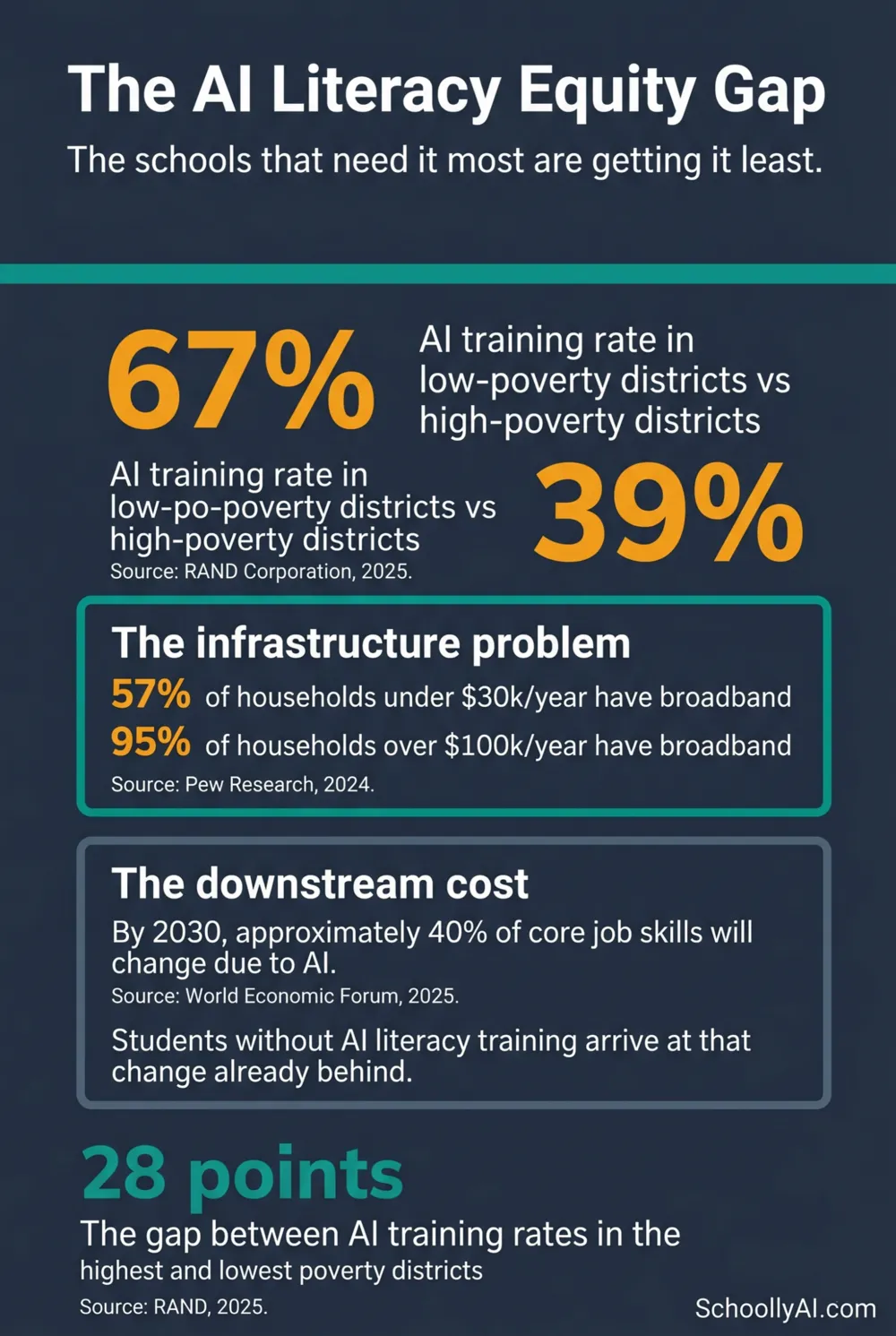
Schools in the wealthiest districts are twice as likely to train teachers on AI as schools in the poorest districts. That is not a projection. It is the current state, documented by RAND in April 2025. RAND Corporation, April 2025 The students who most need AI literacy education to compete in an AI-shaped workforce are receiving the least of it. The gap is real, it is measurable, and it is not closing at the same rate across income levels.
The Gap in Numbers
RAND's April 2025 report, based on nationally representative survey data, from approximately 300 K-12 public school districts. It found that in fall 2024, 67% of low-poverty districts had provided AI training to teachers, compared to 39% of high-poverty districts. A 28-percentage-point difference. RAND Corporation, RR-A956-31, April 2025
The trajectory is not reassuring. In fall 2023, the gap was even wider: 43% of low-poverty districts had trained teachers on AI versus just 6% of high-poverty districts. A 37-percentage-point gap. Both numbers rose substantially by fall 2024, but the proportional gap did not close. The schools with more resources are adopting AI literacy faster, and they started from a much higher baseline.
A companion RAND study from February 2025 found that principals in the highest-poverty schools were about half as likely as those in the lowest-poverty schools to report receiving any AI guidance from their districts: 13% versus 25%. RAND Corporation, February 2025 The gap is not just in teacher training. It is in leadership orientation too.
Robin Lake, Director of the Center on Reinventing Public Education at Arizona State University, described the pattern directly: "The AI divide is starting to show up. Suburban, majority-white and low-poverty school districts are about twice as likely to provide AI training to teachers as are urban, rural or high-poverty districts." NPR, August 2025 The RAND data bears this out.
What Compounds the Gap
The AI literacy training gap sits on top of pre-existing inequities that make the problem structurally worse in under-resourced schools.
Broadband access. Only 57% of households earning under $30,000 per year have home broadband, compared to 95% of households earning over $100,000. Pew Research Center, 2024 Students who cannot access AI tools at home cannot build AI fluency at home. Students in high-poverty schools are more likely to have broadband only at school, if at all. AI literacy delivered only during school hours, for students who cannot practise after hours, compounds more slowly.
Professional development access. Most initial AI training that happened was district-initiated. RAND found that 52% of AI-using teachers taught themselves, while only 31% received district-provided training. Gallup/Walton Family Foundation, 2025 Self-directed professional development requires time, access to quality resources, and institutional support. Teachers in under-resourced schools typically have less of all three.
The self-reinforcing cycle. Schools with fewer resources adopt AI more slowly. Slower adoption reduces demand for guidance and training. Reduced demand means less institutional investment. Less investment widens the gap further. The structure of how AI adoption is spreading through education actively reinforces existing inequality.
The U.S. Commission on Civil Rights flagged this directly in its December 2024 report, noting that students of color are often concentrated in schools with fewer resources and have less access to advanced courses and technology infrastructure. USCCR, December 2024 AI literacy is the new layer on top of an existing stratification.
The Downstream Cost
The workforce implications are not hypothetical. The World Economic Forum's Future of Jobs Report 2025 projects that AI will displace approximately 92 million jobs while creating 170 million new ones by 2030. The new jobs require AI skills. World Economic Forum, 2025 About 40% of core skills demanded by employers will change by 2030, and 66% of leaders say they would not hire someone without AI skills.
Students in schools where teachers have not been trained on AI literacy are less likely to develop the AI literacy skills that employers are already screening for. The Education Trust made this connection explicitly in March 2024: Forrester Research projects generative AI may replace 2.5 million jobs by 2030, "highlighting the need to prepare students, especially historically underserved students, for the future workplace." Education Trust, March 2024
This is also a civic literacy problem, not just a workforce one. Syracuse University's Emerging Insights Lab found in 2025 that without AI literacy, individuals "may struggle to distinguish authentic content from synthetic media and may lack the ability to critically evaluate AI-generated outputs." That is a democracy problem as much as an employment one.
The equity gap in AI literacy training is not a future risk. It is a current condition that is producing a skills gap that will arrive fully formed in the workforce in four to eight years.
What Is Being Done About It
Several programs are specifically targeting the equity gap, with varying levels of scale and evidence.
aiEDU (The AI Education Project) offers free AI curriculum for K-12 and has reached over 230,000 students across all 50 states. In August 2025, aiEDU launched its Rural and Indigenous Community Catalyst Program with over $1 million in grants across 14 states, partnering with tribal education departments and rural nonprofits. aiEDU, August 2025
AI4All, based at Princeton University, runs free three-week summer programs for approximately 30 high school students from low-income families per cohort. The program was co-founded by Professor Olga Russakovsky after she observed the homogeneity of AI research communities during her doctoral work. NPR, August 2025
NSF's EducateAI program has invested nearly $8 million in awards focused on broadening participation in K-12 AI education, including Cornell Tech's Break Through Tech AI program for underserved undergraduates, and the AI Youth Challenge offering up to $25,000 per project for K-12 AI teams in underserved regions. NSF, 2024-2025
These programs matter. They are also not at the scale the problem requires. The gap between what these initiatives reach and what the equity problem demands is substantial. Closing it requires district-level and state-level commitment to AI literacy training as a professional development priority, not an optional enrichment activity.
For teachers who want to build their own AI literacy foundation regardless of what their district provides, the SchoollyAI AI Literacy mini-course is free, takes about 90 minutes, and requires no email or account. The full guide covers where teachers are on the training spectrum and what the research says about the most effective paths forward.
Frequently Asked Questions
Is the AI literacy equity gap the same as the digital divide?
Related but distinct. The digital divide is about access to devices and broadband. The AI literacy equity gap is about access to training and instruction on how AI works. Schools can have adequate device access and still have a significant AI literacy gap if professional development has not followed. In high-poverty schools, both gaps typically exist together and compound each other.
What can individual teachers do if their district is not providing AI training?
Start with free resources that do not require district approval or budget. The SchoollyAI AI Literacy mini-course takes 90 minutes. AI4K12.org provides free curriculum resources. Common Sense Education offers free AI literacy lessons. Building your own foundation independently is both possible and worth doing regardless of what institutional support looks like.
Why are high-poverty districts slower to adopt AI training?
RAND's research points to a structural explanation rather than a motivational one. The pace of AI adoption drives demand for guidance and training. Schools with more resources adopt AI faster, which creates more internal pressure to provide training. Schools with fewer resources adopt more slowly, creating less internal demand. The gap is self-reinforcing rather than driven by deliberate choice.
What does the equity gap mean for students specifically?
Students in schools where teachers lack AI literacy are less likely to receive structured guidance on how to use AI for learning rather than as a shortcut, less likely to develop the critical evaluation skills needed to verify AI outputs, and less likely to build the AI fluency that employers are already screening for. The gap in teacher training translates directly into a gap in student preparation.
Check out the free AI Literacy mini-course that gives teachers a better undertsaning on how to bring AI conversations into the classroom.
Sources
- RAND Corporation. More Districts Are Training Teachers on AI. April 2025. rand.org
- RAND Corporation. Uneven Adoption of AI Tools Among Teachers and Principals. February 2025. rand.org
- NPR. An AI Divide Is Growing in Schools. August 2025. npr.org
- Pew Research Center. Americans' Use of Mobile Technology and Home Broadband. 2024. pewresearch.org
- Gallup / Walton Family Foundation. The AI Dividend. 2025. waltonfamilyfoundation.org
- U.S. Commission on Civil Rights. AI in K-12 Education. December 2024. usccr.gov
- World Economic Forum. Future of Jobs Report 2025. 2025. weforum.org
- Education Trust. Navigating the Promise and Peril of AI for Students of Color. March 2024. edtrust.org
Closing the AI Literacy Gap
The AI Literacy mini-course walks through the practical steps for building an AI-literate classroom culture: what to teach, how to assess it, and how to talk with students and parents about where the lines are. Free. No email required.
Start the AI Literacy Course →