AI Literacy vs Digital Literacy: What Teachers Actually Need
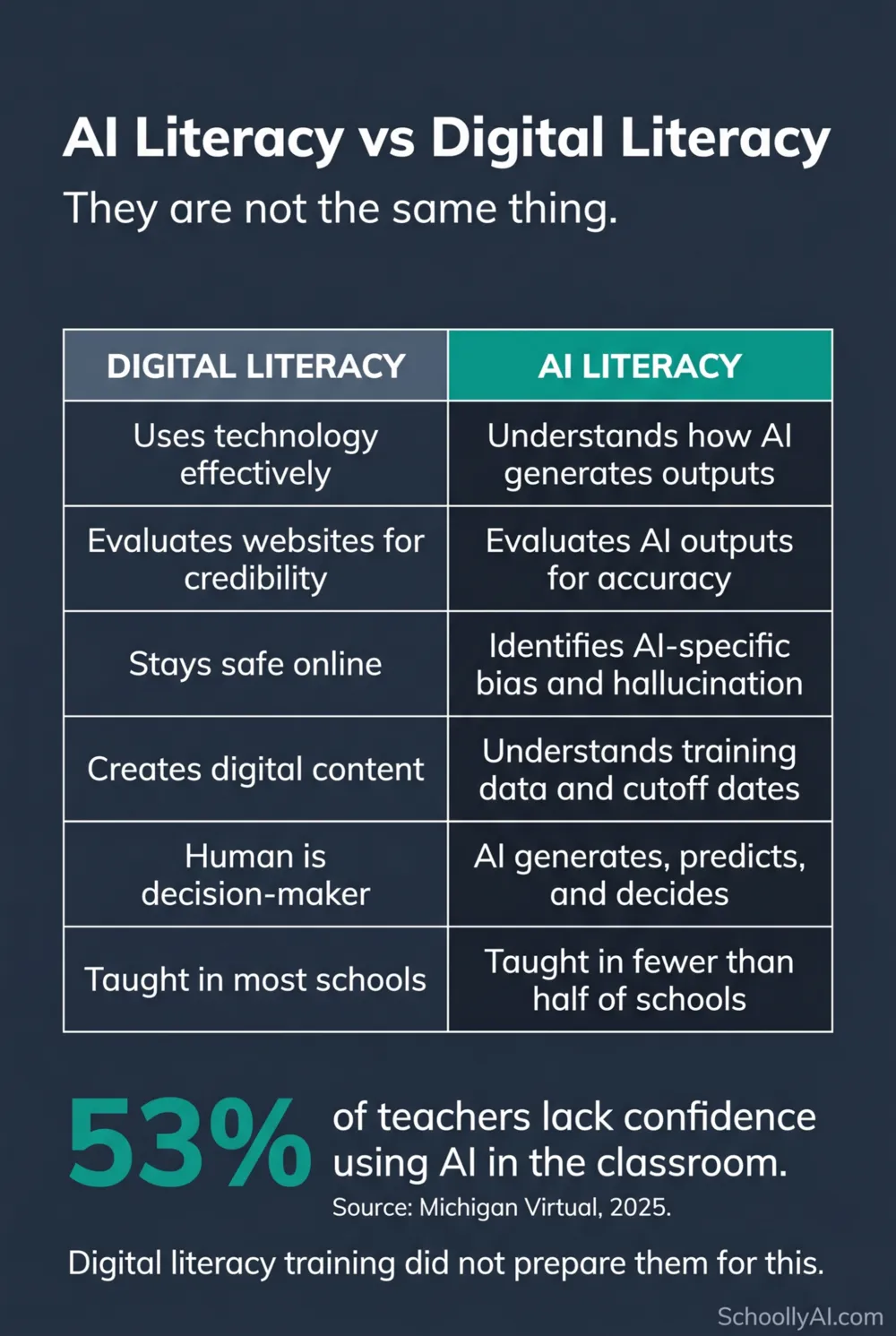
Most teachers working today have been through some version of digital literacy training. Website evaluation. Online safety. Productivity tools. Spotting misinformation. All of it is worth having. None of it is enough for what is happening in classrooms right now. AI literacy and digital literacy are related. They are not the same thing. Understanding exactly where the line falls is what determines whether you can actually evaluate AI output, or just use AI tools on faith.
The Assumption That Breaks With AI
Digital literacy is built on one assumption: the human is always the decision-maker. Technology is the tool. A spreadsheet calculates what you tell it to calculate. A search engine retrieves pages matching your query. A word processor formats your words. The human decides what to do with the output.
AI breaks that assumption. A language model does not retrieve information or follow instructions in the same way. It generates text by predicting what words should come next, based on statistical patterns learned from billions of documents. The human provides a prompt. The AI produces an output. That output may be accurate, partially accurate, or entirely fabricated, and the system has no reliable way to distinguish between these outcomes.
A teacher who is excellent at evaluating whether a website is credible has no automatic framework for evaluating whether an AI paragraph about cellular respiration contains a hallucinated citation to a study that does not exist. Those are different cognitive tasks, requiring different background knowledge about how the information was produced.
As Xingjian Gu and Barbara Ericson at the University of Michigan wrote in their March 2025 integrative review: "AI literacy extends beyond general computing skills by introducing specific AI concepts such as training a model and recognizing bias in algorithms." Gu & Ericson, University of Michigan, March 2025 The distinction is not about complexity. It is about the nature of what is being produced.
What Separates AI Literacy From Digital Literacy
Digital literacy teaches people how to use technology effectively and safely. AI literacy addresses what happens when the technology itself generates, predicts, and decides. Eight specific competencies belong to AI literacy and have no equivalent in digital literacy training.
Understanding probabilistic outputs. AI produces outputs based on statistical probability, not factual lookup. The fluency of a response is not evidence of its accuracy. Digital literacy teaches source evaluation. AI literacy teaches that the source of an AI response is the training distribution, not a database of verified facts.
Recognizing hallucination. When a student cites a study that does not exist, the problem is not that they found a bad website. The problem is that AI generated a plausible-looking citation from statistical patterns. The evaluation skill required is entirely different from website credibility checking.
Understanding training data and bias. AI outputs reflect the biases present in the data the model was trained on. A 2021 analysis found 80% of AI systems in education showed measurable bias when audited. Digital literacy covers media bias. AI literacy covers how bias is baked into model outputs at the structural level, not just at the editorial level.
Knowledge cutoff dates. Most AI systems do not know what happened after their training cutoff, which is typically 12 to 24 months before the current date. Without web search access, they generate confident, plausible, and potentially outdated information about recent events. No digital literacy framework covers this because no prior technology had this limitation.
Context windows and memory limits. AI cannot hold an entire long document in view simultaneously. When a conversation exceeds the model's context window, earlier content becomes invisible to it. The model does not flag this. It proceeds as if everything is fine. Teachers and students who do not know this will misread AI behaviour in long working sessions.
The cognitive effects of AI use on learning. Digital literacy does not address what happens to a student's learning when AI does their thinking for them. AI literacy does. The research here is specific and consequential, and it changes how a teacher should structure AI use in assignments. The full AI literacy guide covers the Wharton chess study and the PNAS math findings in detail.
Side by Side: What Each Domain Actually Covers
| Skill area | Digital literacy covers | AI literacy adds |
|---|---|---|
| Source evaluation | Is this website credible? Who published it? | AI does not have a source. It generates text from statistical patterns. Verification requires checking the claim itself, not the origin. |
| Misinformation | Spotting deliberately false content created by people | AI hallucination is not deliberate. It is structural. Fluent, confident text can be entirely fabricated without any intent to deceive. |
| Bias | Editorial and political bias in media | AI bias is embedded in training data and surfaces in outputs. 80% of AI systems in education showed measurable bias when audited. |
| Currency of information | Check when the article was published | AI has a hard knowledge cutoff. It may confidently generate outdated information about events after that date without flagging it. |
| Privacy and data | Online safety, personal data, cookies | What student data AI tools collect, how it is used for training, which tools are FERPA-compliant, and what teachers should never paste into a public AI tool. |
| Learning outcomes | Not covered | Passive AI use reduces retention and concept understanding. Active, Socratic AI use can support learning. The mode matters as much as the tool. |
Why This Distinction Matters Right Now
The gap between what digital literacy training covers and what AI literacy requires is exactly what 53% of teachers are experiencing as a confidence gap. Michigan Virtual, 2025 They know how to use technology. They do not know how to evaluate text that was generated statistically rather than retrieved or created by a person. That is a knowledge problem, and digital literacy training does not solve it.
New America's 2025 report on digital literacy in the age of AI found that most experts view AI literacy as a core component within digital literacy, not a separate competing domain. But the same report was explicit that digital literacy is incomplete if it does not include AI. New America, 2025 Amy Huffman, Policy Director of the National Digital Inclusion Alliance, stated it directly: "AI literacy is a natural extension of digital literacy. Digital literacy is incomplete if it doesn't include AI."
The practical question for teachers is not whether to keep their existing digital literacy skills. They should. The question is what specific AI literacy knowledge needs to sit on top of them. The answer is the six competencies above, starting with one foundational shift: AI generates probable text, it does not retrieve verified facts. Everything else follows from understanding that.
The full AI literacy for teachers guide covers all eight competencies, where teachers currently are on the training spectrum, and the equity gap between high-poverty and low-poverty schools in AI literacy access. The free AI Literacy mini-course takes about 90 minutes and requires no email or account to access.
Frequently Asked Questions
Can I just call it all "digital literacy" and move on?
You can, but you will be missing the specific knowledge that changes how you evaluate AI outputs. The term matters less than the underlying competencies. If your digital literacy training covers how probabilistic text generation works, how hallucination happens structurally, and how AI use affects student cognition, then the label is fine. Most digital literacy training does not cover any of those things.
Does AI literacy replace media literacy?
No. Media literacy skills (evaluating sources, spotting bias, checking publication dates) all transfer and all still apply. AI literacy adds a specific layer on top: the skills needed when the content itself was generated statistically rather than written or published by a person with an identifiable agenda.
What is the single most important AI literacy concept for teachers?
AI does not know things. It generates text by predicting what words should come next based on statistical patterns in training data. A confident response and a correct response are completely independent. That one mental shift changes how a teacher reads every AI output they encounter, and how they teach students to read them.
Where can I start building AI literacy without spending a full weekend on it?
The first section of the AI Literacy mini-course covers the core mental model in about 30 minutes. No email required, no account, completely free. It is the fastest path from digital literacy to the AI-specific foundation that Section 1 builds.
Check out the free AI Literacy mini-course that gives teachers a better undertsaning on how to bring AI conversations into the classroom.
Sources
- Gu & Ericson, University of Michigan. AI Literacy in K-12: An Integrative Review. March 2025. arxiv.org
- New America. Digital Literacy in the Age of AI. 2025. newamerica.org
- Michigan Virtual. AI in Education: A 2025 Snapshot. 2025. michiganvirtual.org
- Digital Promise. AI Literacy Framework. June 2024. digitalpromise.org
- Brookings Institution. Why AI Readiness Requires Digital Literacy. 2025. brookings.edu
From Digital to AI Literacy
The AI Literacy mini-course walks through the practical steps for building an AI-literate classroom culture: what to teach, how to assess it, and how to talk with students and parents about where the lines are. Free. No email required.
Start the AI Literacy Course →