The AI Equity Gap in Schools: Who Gets Left Behind
The ai equity gap in schools is no longer a hardware story. Every student has a phone. The gap now runs through subscription tiers, data privacy, training quality, and something most equity conversations have not caught up with yet: whose legally protected student data is being fed into unregulated AI platforms without anyone's knowledge or consent.
- A 28-percentage-point gap in AI training provision exists between Title I schools and affluent districts. RAND Corporation, March 2026.
- 57% of special education teachers used AI to develop IEPs or 504 plans during 2024-2025, up 18 points from the prior year. Most did so without a FERPA-compliant vendor agreement in place. Center for Democracy and Technology, October 2025.
- 50% of students agree that AI use in class makes them feel less connected to their teacher. Center for Democracy and Technology, October 2025.
- Only 31% of U.S. public schools had a formally written AI policy as of December 2024. U.S. Department of Education, 2025.
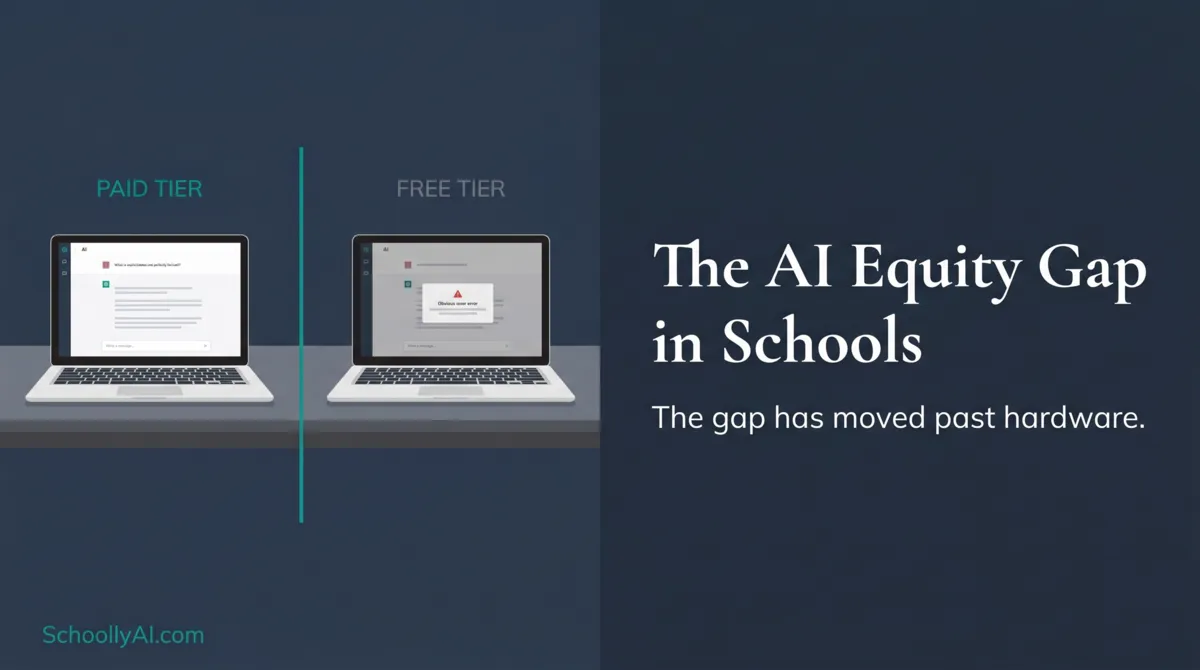
The equity gap is no longer visible in the hardware. It shows up in the output quality, the training coverage, and the data privacy protections that depend on which district a student happens to attend.
The Gap Has Moved Past Hardware
The original digital divide conversation was about broadband and devices. That problem is not solved, but it has been partially absorbed into the background of daily school life. Students in Title I schools have phones. They have Chromebooks. They have some version of access.
The problem has moved. The divide now runs through two tiers of access that are invisible from the outside. A student using a paid AI subscription and a student using a free model are not using the same tool. The paid model reasons more carefully, retrieves more accurately, handles complex tasks without fabricating sources, and produces output that requires genuine engagement to use well. The free model halluccinates more frequently, exhibits greater algorithmic bias, and fills reasoning gaps with plausible-sounding fiction.
A student in an affluent household whose parents have purchased a premium AI subscription is receiving categorically different cognitive support from a student relying on free-tier tools. That difference does not show up in any device inventory a district has ever taken.
What the Numbers Show
The equity patterns that teachers notice in their classrooms map precisely to what the 2025-2026 research is documenting at scale.
| Observation | Confirming Statistic | Source |
|---|---|---|
| Training on AI varies wildly by district wealth | 28-percentage-point gap in AI training between Title I schools and affluent districts | RAND Corporation, March 2026 |
| AI is being used for sensitive student documentation without oversight | 57% of special education teachers used AI to develop IEPs or 504 plans in 2024-2025, up 18 points from the prior year | Center for Democracy and Technology, October 2025 |
| AI in the classroom is affecting student-teacher relationships | 50% of students agree AI use in class makes them feel less connected to their teacher | Center for Democracy and Technology, October 2025 |
| Most schools are operating without any formal policy to govern this | Only 31% of U.S. public schools had a formally written AI policy as of December 2024 | U.S. Department of Education, 2025 |
| Students in underfunded areas are restricted from the tools their peers use | Students in low-income and rural areas are the least likely to have AI integrated into their curriculum | OECD Digital Education Outlook, 2026 |
These numbers do not tell a story of neutral adoption. They describe a system where the students who most need scaffolding are least likely to receive it in a structured, safe form, and where the teachers serving those students are receiving less training while bearing more risk.
The IEP Problem Nobody Is Talking About
Here is a number worth stopping on. 57% of special education teachers are now using generative AI to draft IEPs and 504 plans. That is not a minor adoption trend. IEPs contain some of the most legally protected student information in the building: diagnosis details, behavioral assessment data, medical history, family contact information, therapy notes.
FERPA governs that data. It requires that third parties who access student educational records have a formal agreement in place with the school. Most public generative AI platforms are not operating under FERPA-compliant vendor agreements with school districts. When a teacher pastes a student's IEP content into a general-purpose language model, they are likely violating federal privacy law without knowing it.
Elizabeth Laird, Director of the Equity in Civic Technology Project at the Center for Democracy and Technology, named the stakes plainly in 2025: "As many hype up the possibilities for AI to transform education, we cannot let the negative impact on students get lost in the shuffle. Acknowledging those risks enables education leaders to mount prevention and response efforts so that the positive uses of AI are not overshadowed by harm to students."
The equity dimension here is specific. Students in underfunded schools are more likely to be in classrooms where teachers are using AI tools without institutional guidance or compliant vendor agreements, because those schools have less legal and technology infrastructure to govern adoption. The students most likely to have their sensitive data exposed are the students who were already most vulnerable. For parents of students with IEPs, this is exactly the kind of concern that drives parental anxiety. It deserves a direct answer rather than reassurance.
The broader access picture that puts these students in this position is covered in the post on low-income students and the subscription tier gap.
Who Is Actually Getting Left Behind
Low-income students. But not only them. Rural students are restricted from curriculum-integrated AI at rates comparable to urban Title I schools, according to the OECD Digital Education Outlook 2026. Rural schools face the combination of lower device quality, weaker broadband, smaller budgets, and an absence of formal AI policy simultaneously. The access problems compound rather than offset each other.
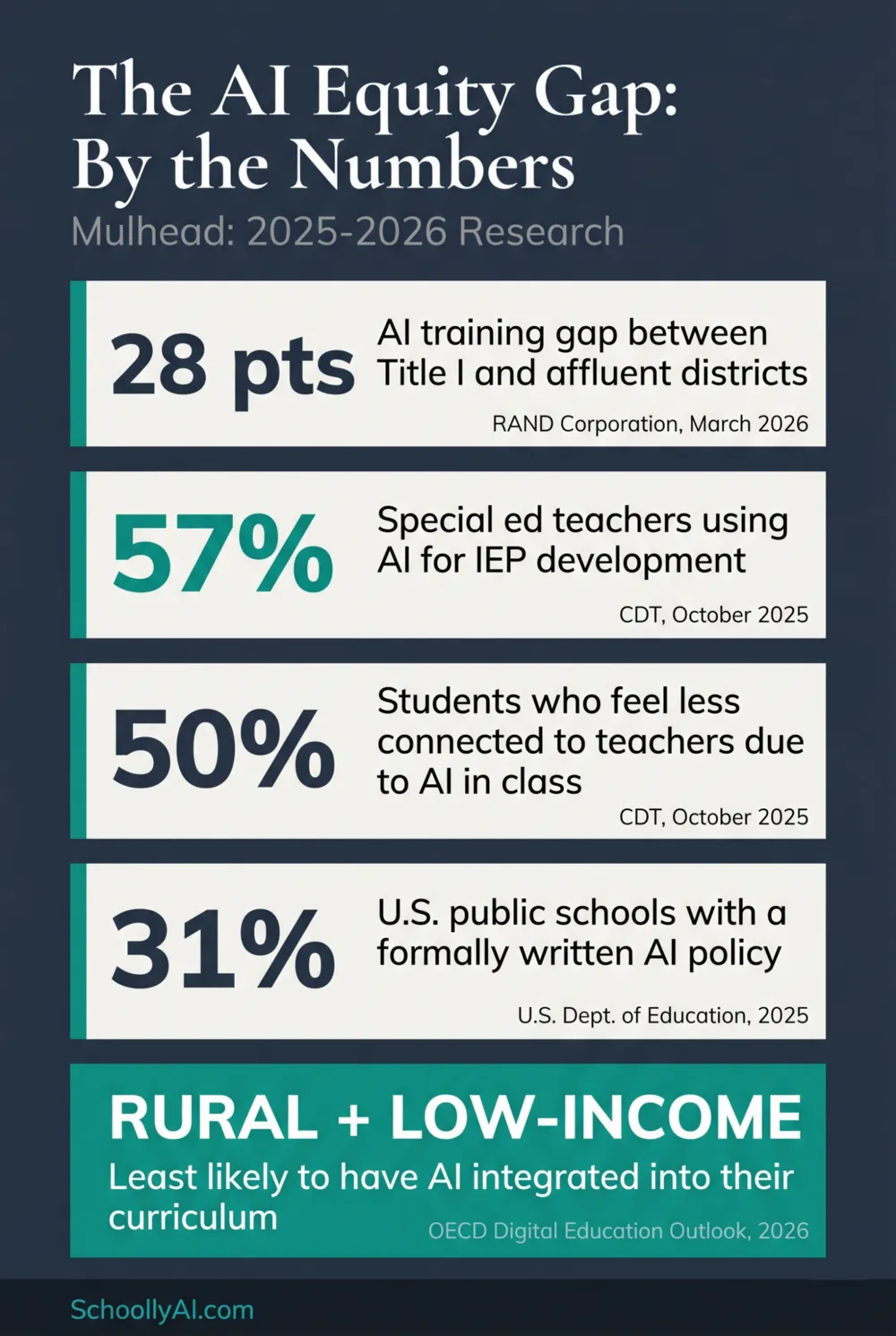
The three-layer equity gap: training provision disparities, data privacy exposure for the most vulnerable students, and curricular restriction in rural and low-income schools.
Neurodivergent students represent a third population with a specific AI equity risk. The CDT research on IEP documentation is the visible end of it. The less visible end is that AI models trained on dominant internet text patterns perform poorly on non-standard communication styles, dialectal variation, and non-Western cultural frames. A neurodivergent student whose writing voice does not match the dominant register the model was trained on receives lower-quality output and, if the model is being used for assessment purposes, worse outcomes.
Students without foundational literacy face a fourth compounding problem. They cannot engineer effective prompts, cannot evaluate AI outputs critically, and cannot synthesise machine-generated text into actual learning. AI is not a tutor. It is a multiplier. For students who already have strong foundational skills, it multiplies their capacity. For students who don't, it provides an illusion of competence while the underlying gap gets wider.
The Equalizer Myth
The dominant vendor narrative is that AI levels the playing field. Every student gets a personal tutor. Every teacher gets an instructional assistant. The gap narrows.
The classroom evidence runs in the other direction. AI amplifies the capabilities of students who already have foundational literacy, parental support, and access to accurate, capable tools. It provides an illusion of participation for students who don't. A student with an engaged parent using AI to iteratively refine their argument and strengthen their sources is building a real skill. A student with no external support using AI to generate their entire assignment in one unedited prompt is learning nothing except how to submit something that looks like work.
Stefania Giannini, UNESCO's Assistant Director-General for Education, described the promise in clear terms in 2025: "The promise of 'AI for all' must be that everyone can take advantage of the technological revolution under way and access its fruits, to ensure AI does not widen the technological divides within and between countries."
That is the aspiration. The current data describes something different. The adoption data by district wealth shows the practical pattern: high-poverty districts are less likely to have AI training, less likely to have formal policy, and less likely to have walled-garden tools that protect student data. The gap between the aspiration and the current reality is not small.
What Teachers Can Do This Week
Three moves that require no budget, no district approval, and no new software.
First, run your last three major homework assignments through a free-tier AI model. Read the output. If it would earn a B or higher without any student input, the assignment has an equity problem. You are not testing academic proficiency. You are testing which student has better tools at home. The fix is to add a process requirement (version history link, verbal check) or to move the task in-class where tool quality is not the determining variable.
Second, stop inputting personally identifiable student information into any generative AI platform that your district has not formally vetted. That includes student names, diagnosis details, behavioral notes, family contacts, and medical history. If you are using AI to support IEP documentation and you do not know whether your district has a FERPA-compliant vendor agreement with the tool you're using, the safest assumption is that it does not.
Third, when introducing AI tools to students, build the evaluation step into the lesson rather than treating it as optional. Collect AI output publicly, project it, and have students identify what it got wrong, what it missed, and what it would take to verify the claims it makes. That is not additional content. It is the content. Building this habit requires content-specific training, not a generic software demo, which is the gap most professional development is currently failing to close.
AI Equity Audit Tool
Ten questions covering device access, subscription tiers, digital literacy scaffolding, and data privacy compliance. The result gives you a picture of where your school's equity gaps are most acute and which ones you can address at the classroom level without waiting for district action.
AI Equity Audit Tool
Rate each statement from 1 (strongly disagree) to 4 (strongly agree) based on your school's current situation.
1. All students in my school have reliable access to a working device during class time.
2. Students have equitable access to the same quality AI tools at home, not just at school.
3. My school has a formally written AI policy that teachers and students can reference.
4. Teachers in my building have received content-specific AI training, not just general software demos.
5. My school uses only AI tools that have documented FERPA-compliant vendor agreements.
6. Students in my classes are taught to evaluate AI output critically, not just accept it.
7. AI tools used for special education documentation meet legal data privacy requirements.
8. My school's AI curriculum reaches students in low-income and rural households at the same rate as others.
9. Teachers understand the difference between premium and free AI tiers and what that means for equity.
10. Administrators support teachers in experimenting with AI, including providing time and resources to do so.
FAQ
The AI equity gap in schools describes the unequal access to capable AI tools and training across different student and teacher populations. In 2026, the gap has moved past hardware access. The clearest divides are between students using paid AI tiers versus free, hallucination-prone models; between high-poverty and affluent districts receiving AI training; and between schools with formal AI policies and those operating without them.
Free AI models hallucinate more frequently, exhibit greater algorithmic bias, and handle complex reasoning tasks less reliably than paid tiers. A student using a free model for research is more likely to receive fabricated citations and lower-quality output than a student using a premium subscription. The tools are not equivalent, and the difference shows up in homework quality and academic integrity patterns.
It depends on the vendor agreement. If a district has a FERPA-compliant contract with the AI provider, there may be a legal basis for using the tool in IEP documentation. If no such agreement exists, inputting personally identifiable student information into a public generative AI platform constitutes a serious data privacy breach under FERPA. The Center for Democracy and Technology found in October 2025 that 57% of special education teachers were using AI for IEP development, and most were not operating under compliant vendor agreements.
RAND research from March 2026 found a 28-percentage-point gap in AI training provision between Title I schools and affluent districts. Low-income schools also receive less subject-specific training, less administrative support for AI experimentation, and lower-quality tools. AI amplifies existing capabilities rather than building new ones from scratch, which means the students who benefit most are those who already have foundational literacy, engaged parental support, and access to premium tools.
Three immediate steps. First, audit recent homework assignments by running them through a free-tier AI model to see if the output would earn a passing grade without any student input. If it would, the assignment has an equity problem. Second, stop inputting personally identifiable student information into unvetted generative AI platforms, particularly for IEP documentation. Third, build the AI output evaluation step into lessons rather than treating it as optional content.
Yes. Rural students are among the least likely to have AI integrated into their curriculum at all, according to the OECD Digital Education Outlook 2026. The problem is compounded by lower device quality, weaker broadband infrastructure, and smaller school budgets that make premium AI subscriptions less viable. Rural Title I schools often face the combination of restricted access and absent policy simultaneously.
Sources
- Center for Democracy and Technology. From Personalized to Programmed: The Use of Generative AI to Develop Individualized Education Programs for Students with Disabilities. October 2025. cdt.org
- Center for Democracy and Technology. Hand in Hand: Schools' Embrace of AI Connected to Increased Risks to Students. October 2025. cdt.org
- RAND Corporation. Student Use of AI for Homework Rises as Concerns Grow About Critical Thinking Skills. March 2026. rand.org
- Pew Research Center. Key findings about how Americans view artificial intelligence. March 2026. pewresearch.org
- OECD. Digital Education Outlook. 2026. oecd.org
- UNESCO. Artificial intelligence in education. 2025. unesco.org
- U.S. Department of Education / Engageli. 25 AI in Education Statistics to Guide Your Learning Strategy in 2026. 2025. engageli.com
- College Board. New Research: Majority of High School Students Use Generative AI for Schoolwork. October 2025. newsroom.collegeboard.org
- EdTrust. Navigating the Promise and Peril of AI for Students of Color. 2024/2025. edtrust.org
- Stanford Law School. How will AI Impact Racial Disparities in Education? June 2024. law.stanford.edu
The AI Literacy mini-course covers how to build critical evaluation habits into your classroom regardless of which tools students are using. Three free sections. No email required.
Start the AI Literacy Course →