The Teacher Confidence Paradox: Why AI Training Doesn't Stick
Teacher confidence in AI adoption does not track with training volume. 50% of teachers received AI training in 2025. Only 38% reported satisfaction with how AI was being implemented at their school. And 63% of math teachers rate their AI ability as either nonexistent or poor, despite math being a subject where AI tools are widely available and aggressively marketed. More training is not the solution. The wrong kind of training is the problem.
- 50% of teachers received AI training in 2025. Only 38% reported satisfaction with AI implementation at their schools. Imagine Learning/EdWeek, 2024-2025.
- English and language arts teachers are nearly twice as likely to use AI as math teachers. Nearly 70% of math teachers received no professional development on using AI in their subject. EdWeek Research Center, April 2025.
- 84% of educators say training sessions are the most valuable resource, yet cite insufficient training as their primary source of dissatisfaction. Imagine Learning, 2024-2025.
- Over 50% of math teachers report receiving no encouragement from supervisors to experiment with AI tools. EdWeek Research Center, April 2025.
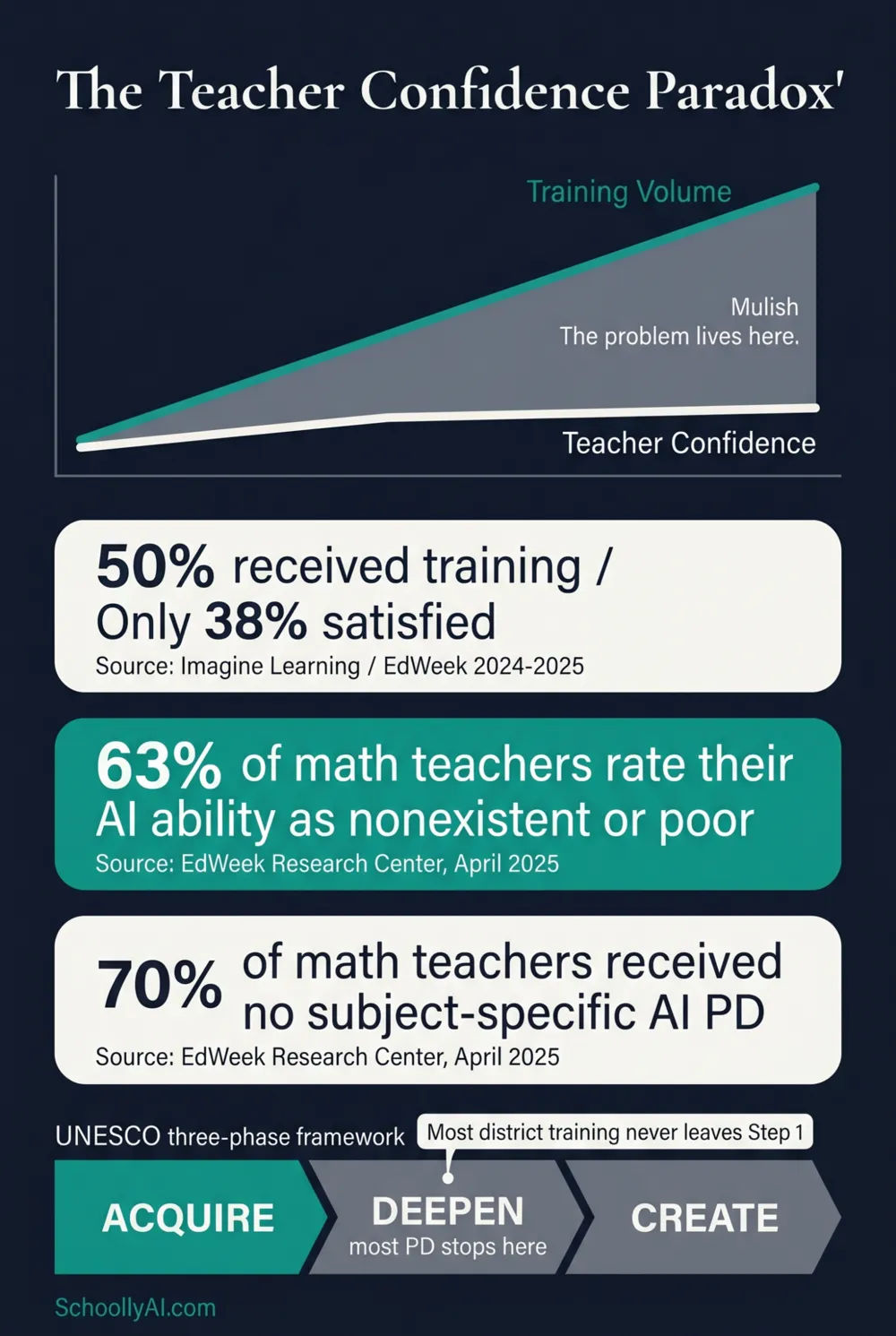
Training volume has increased. Confidence has not followed. The gap between those two lines is where the problem lives, and it is a format and content problem, not a quantity problem.
More Training, Less Confidence
The paradox is not subtle. Districts are running more AI professional development than ever. Teachers are reporting less satisfaction with AI implementation than the training volume would predict. The two lines are moving in the wrong directions relative to each other.
This training gap is part of what creates the AI equity gap at the institutional level. Underfunded districts receive less training, and the training they do receive is more likely to be vendor-led and software-focused rather than content-specific and pedagogically grounded. The teachers who most need genuine confidence-building professional development are getting the least of it.
The 84% figure is the one that deserves particular attention. 84% of educators say training sessions are the most valuable resource available to them. And those same educators cite insufficient training as their top source of dissatisfaction. They want more training. They want different training. Both things are true simultaneously, and conflating them produces a professional development response that increases volume without changing anything about confidence or adoption.
The Math Teacher Problem
63% of math teachers rate their ability to use AI in instruction as either nonexistent or poor. That figure comes from the EdWeek Research Center's April 2025 research and it points at something specific about how current AI training is designed.
Most AI professional development is built around language-based tasks: drafting emails, writing lesson outlines, generating rubric language. These tasks translate naturally for English and language arts teachers. They translate poorly for math teachers, whose subject requires precision, verifiable accuracy, and step-by-step reasoning that AI models handle inconsistently.
A math teacher who attends a general AI training session learns that AI can draft a parent email. That information is not irrelevant. But it does not address their core concern: that AI confidently produces wrong answers to mathematical problems and that students cannot reliably distinguish a correct AI-generated solution from an incorrect one. Latrenda Knighten, President of the National Council of Teachers of Mathematics, argued in 2025 that math teachers need professional development that specifically demonstrates how to integrate AI into content-focused lessons, not generic demonstrations of software features.
Over 50% of math teachers report receiving no encouragement from supervisors to experiment with AI at all. That absence of support, combined with training that does not speak to their subject, produces the 63% nonexistent or poor confidence figure. It is not that math teachers are resistant. They have been given no reason to trust the tool in their specific context.
Why Vendor-Led PD Fails
The majority of AI professional development currently delivered to K-12 teachers is organised by the companies whose products the training covers. The structural conflict of interest in that arrangement is straightforward: the goal of the session is software adoption. Pedagogical transformation is not the vendor's objective. It is at best a secondary benefit.
Vendor sessions teach teachers which buttons to press. They do not model how to integrate the tool into a specific unit that the teacher is actually teaching next week. They do not address how AI changes the cognitive demands of a research assignment. They do not give teachers time to stress-test their own assessments against the tools and discover where a student could complete the work without any original thinking.
The PMC research on AI-induced educational anxiety from 2026 adds a layer that vendor sessions are structurally unable to address. Teachers carry specific psychological fears about AI adoption: that traditional teaching methods are becoming obsolete, that their classroom data is being monitored by AI systems measuring their effectiveness, that admitting uncertainty about the technology signals incompetence. Those fears are not irrational. They are documented responses to how institutional AI deployment is being handled in many districts. A vendor session that skips past them produces anxiety rather than confidence, because the teacher knows the demo worked but still does not feel safe using the tool.
The Three-Phase Framework Schools Are Skipping
The UNESCO AI Competency Framework for Teachers structures the development of teacher AI literacy into three sequential phases. Acquire: basic skills and awareness of what AI is and how it works. Deepen: pedagogical integration into specific subject areas and curriculum. Create: innovative application, student-centred design, and ethical stewardship.
The research across 2024 and 2026 consistently finds that most district training never moves past Acquire. Teachers learn to prompt a chatbot. They do not learn how to use a language model to differentiate instruction for a class with four reading levels, or how to design an assignment that requires students to audit AI output as the core assessment task. They complete the first phase and stop there.
Miao Fengchun, co-author of the UNESCO framework, notes that the traditional classroom has shifted to a teacher-AI-student dynamic that requires teachers to build knowledge specifically to protect human agency, promote sustainability, and ensure the ethical application of algorithms in learning. That is a Deepen and Create level competency. It requires time, subject-specific application, and iteration. It cannot be delivered in a half-day session.
The Psychological Barrier Nobody Addresses
Teachers who have attended AI training and still don't use the tools are often carrying one or more of three specific fears that training programs consistently fail to name or address.
The first is fear of obsolescence. If AI can generate a lesson plan in thirty seconds, what does that mean for the professional knowledge and experience that went into building that lesson plan over fifteen years? That fear is real and it deserves a real answer, not reassurance that "teachers will always be needed."
The second is fear of surveillance. AI tools embedded in school systems can log teacher behaviour, flag low engagement, and feed data into administrative dashboards that teachers did not consent to be measured by. A teacher who suspects the AI tool their district is deploying is also a performance monitoring system is not being paranoid. They are being attentive.
The third is fear of visible incompetence. Demonstrating uncertainty about new technology in front of students carries professional risk in ways that uncertainty about other topics does not. Teachers are expected to be authoritative. AI removes that authority in a highly visible way. Training that does not give teachers a framework for explaining their own learning process to students ("I'm figuring this out alongside you and here's what I know so far") leaves them with no professional script for the moment when the tool fails in front of a class.
None of those fears disappear with more button-clicking tutorials. They require honest institutional acknowledgment and a different kind of professional support.
What Good PD Actually Looks Like
Content-specific. Not software-specific. A math teacher's AI training session should involve opening a real upcoming math unit and working through which parts of it AI can assist with, which parts it cannot handle accurately, and how to design the student experience around those constraints. That is useful. A demo of how to ask ChatGPT to write a math quiz is not.
Small and immediately applicable. A teacher who leaves a session with one thing they can do on Monday is more likely to build a practice than a teacher who leaves with ten things they might theoretically try eventually. The dose matters. Sustained small exposures build more durable habits than intensive single-day workshops.
Non-commercial delivery. The teacher who runs a session built around workshopping real curriculum against current AI models, with no vendor present, has a different experience from the teacher who watches a company representative demonstrate their product. Both are called professional development. They are not the same thing.
Teachers with genuine AI confidence are substantially better equipped to address parental anxiety directly. A teacher who can explain clearly why they permit AI on one assignment and restrict it on another, and what they are assessing in each case, removes the ambiguity that most parental concern about AI grows from. The communication problem and the training problem are the same problem. Solving one makes significant progress on the other.
AI Readiness Checklist
Before adopting any new AI tool into your classroom, run it through this checklist. The goal is not to find perfect tools. It is to identify whether a tool reduces your existing cognitive load or adds new friction, and whether you can defend your use of it to a parent, student, or administrator.
AI Tool Readiness Checklist
Check every statement that is true for the specific AI tool you are considering.
FAQ
Most AI professional development stops at the Acquire stage: showing teachers how to use the tool. It never moves into how to integrate the tool into specific curriculum or how to create new learning experiences around it. Vendor-led training has a structural conflict of interest. The goal is software adoption, not pedagogical change. Without content-specific application and time to experiment, technical training produces anxiety rather than confidence.
No. English and language arts teachers are nearly twice as likely to use AI as math teachers, according to RAND research from April 2025. 63% of math teachers rate their AI ability as nonexistent or poor, and nearly 70% have received no professional development on using AI in their subject. The hallucination risk in a fact-based subject makes AI tools feel like a liability rather than an asset for teachers who have not been shown how to manage that risk.
It is a global reference that outlines 15 competencies teachers need in the AI era, structured in three progression levels: Acquire (basic skills and awareness), Deepen (pedagogical integration into subject areas), and Create (innovative application and student-centred design). Most district AI training never moves past Acquire. Teachers who only complete the Acquire stage know how to operate the tools but not how to teach with them.
Content-specific rather than software-specific. Built around the teacher's actual upcoming lesson plans and curriculum, not generic future use cases. Delivered in small, immediately applicable doses rather than single-day workshops. Focused on having teachers stress-test their real assignments against current AI models to find the vulnerabilities. And it must address the psychological fears around obsolescence and monitoring. Without that, even good technical training does not stick.
Sources
- EdWeek Research Center. Math Teachers Have Little Confidence in Their AI Abilities. April 2025. edweek.org
- Imagine Learning. Teachers' Perceptions of AI in the Classroom. 2024-2025. imaginelearning.com
- RAND Corporation. Student Use of AI for Homework Rises as Concerns Grow About Critical Thinking Skills. April 2025. rand.org
- UNESCO. AI Competency Framework for Teachers. August 2024 / Updated January 2026. unesco.org
- PMC. From digital disruption to mental health: the impact of AI-induced educational anxiety on teacher well-being in the era of smart education. 2026. pmc.ncbi.nlm.nih.gov
- arXiv. AI Adoption Among Teachers: Insights on Concerns, Support, Confidence, and Attitudes. 2026. arxiv.org
- Gallup / Youngstown State University. From Homework to Higher Ed: AI Usage, Ethics and Impact in Today's Classrooms. 2024-2025. ysu.edu
The AI Literacy mini-course is built around content-first pedagogy, not software tutorials. Three free sections. No email required.
Start the AI Literacy Course →