Parental AI Anxiety: Real Concerns vs. Doomism
The public conversation about parental anxiety around AI in education centres on safety, cheating, and cognitive harm. The research shows something different is actually driving the anxiety. A University of Chicago study from December 2025 found that parents' willingness to pay for premium educational AI increased by over 60% when they believed their child's peers were using it, even after researchers explicitly told them the tools may cause long-term cognitive harm. The concern about the technology itself is being overridden by fear of being left behind.
- 62% of parents discussed AI and the future of work in the previous two weeks, with one-third doing so weekly. Education Next, Spring 2024.
- Only 24% of U.S. adults believe AI will have a positive impact on education over the next 20 years. Pew Research Center, March 2026.
- Nearly 60% of parents agree it is better for students to use generative AI for schoolwork than not to. College Board, October 2025.
- 10% of parents with children aged 5 to 12 say their child already uses AI chatbots regularly. Pew Research Center, March 2026.
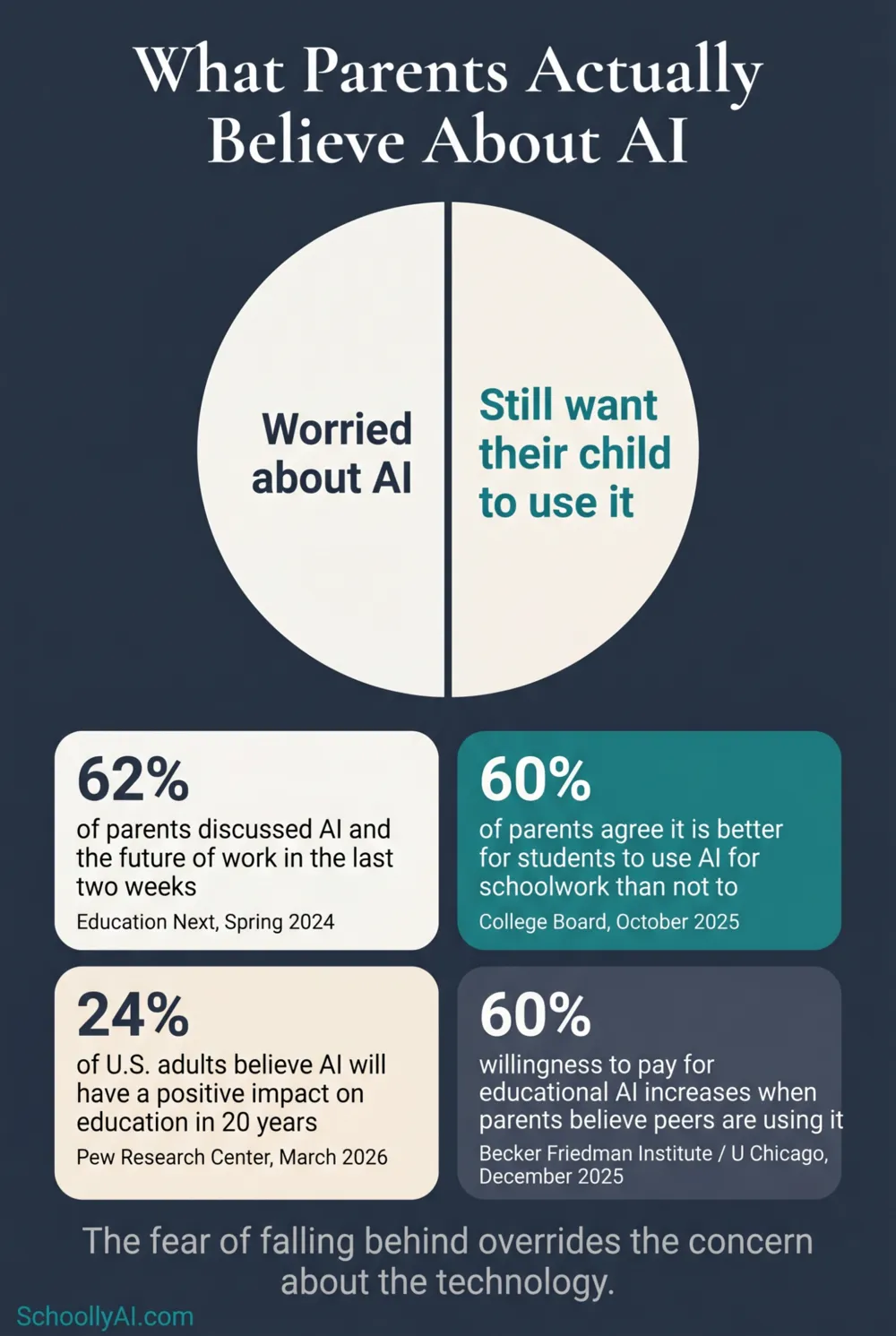
Parents hold contradictory positions on AI simultaneously. The research explains why: the fear of their child falling behind peers consistently overrides the concern about what the tools might do.
Fear of Falling Behind Has Replaced Fear of the Technology
The same inequities that run through the AI equity gap at the district level play out inside individual families. Parents who cannot afford premium AI subscriptions for their children watch other parents purchase them. The concern is not abstract. It is visible in the neighbourhood, in after-school programs, in which kids arrive at school having already had AI help with their homework.
The University of Chicago research captures this dynamic precisely. When parents were told their child's peers were using AI tools, their willingness to pay increased by over 60%, regardless of what they had just been told about cognitive risks. The information about harm changed their beliefs. It did not change their behaviour. Leonardo Bursztyn, the economist who led the study, described what he observed: the threat of falling behind creates a trap that individual families cannot escape on their own. Only institutional action, a school-wide policy that applies to everyone, breaks the cycle.
Teachers are standing in the middle of that trap. They have no school-wide policy in most cases. They have parents pushing from one direction and their own classroom judgment pulling from another.
What Parents Actually Believe
The data on parental attitudes toward AI in education is full of contradictions that are not irrational once you understand the pressure parents are under.
74% of U.S. adults support banning middle and high school students from using cellphones during class, according to Pew Research Center data from January 2025. Nearly 60% of the same parent population agree that it is better for students to use generative AI for schoolwork than not to. 10% of parents with children aged 5 to 12 report their child already uses AI chatbots regularly. And only 24% of U.S. adults believe AI will have a positive impact on education over the next 20 years.
Those positions are not logically consistent. Parents want AI banned from phones during class. They also want their children using AI for homework. They are worried about AI's long-term effects. They are still subscribing to the tools. The incoherence is not a character flaw. It is the rational response of a person navigating genuine uncertainty under competitive pressure. There is no clearly correct position here. Different experts are saying different things. The responsible thing, from a parent's perspective, looks different depending on which piece of research they have read most recently.
Teachers who understand this are better positioned to communicate with parents about AI in a way that does not feel adversarial. The parent who questions your AI assignment policy is not necessarily anti-technology. They are probably anxious, uncertain, and looking for a framework that makes sense of what their child is experiencing.
The Rat Race Dynamic
Bursztyn's research names a specific mechanism that makes parental AI anxiety particularly hard to address through information alone. He calls it the rat race: when peer adoption creates pressure that overrides individual concern. Once a parent believes other children in the class are using AI, the rational response from that parent's perspective is to provide the same tools to their child, regardless of their personal views on the technology.
The research found that even when parents were explicitly told the tools may harm long-term cognitive development, informing them of this fact changed their beliefs but did nothing to reduce their demand. They updated their views on safety. They continued purchasing. The competitive pressure was simply stronger than the safety concern.
Bursztyn observed something worth noting for school leaders: parents who understood the trap showed an increased preference for institution-wide bans precisely because they could not achieve restraint individually at home. They wanted the school to create the level playing field they could not create on their own. A clear, consistent, school-wide AI policy is not just an administrative document. For many parents, it is a relief.
Cindy Blackburn of the School Leaders Project describes the counterweight to this dynamic: shifting from punitive, reactive AI policies to value-based approaches that keep "relationships, critical thinking, and student agency at the centre of teaching and learning." That framing gives parents something substantive to evaluate rather than just a rule to comply with or resist.
Where Parental Anxiety Becomes a Classroom Problem
Parental anxiety around AI lands on teachers in specific and exhausting ways. Parents are now drafting emails using AI assistants, which produces messages that are longer, more formally structured, and more escalatory in tone than the same concern would be if written by hand. A parent who would have sent a three-sentence note now sends a six-paragraph analysis of the assignment's pedagogical shortcomings. Teachers receive these at 11pm.
A second pattern: parents justifying their child's AI use at home while simultaneously demanding the school exercise greater control over AI in the building. The logical conflict is real, but it makes sense through the rat race lens. The parent wants the competitive advantage at home and a level playing field at school. From their position, both positions are defensible.
Teachers are bearing the institutional weight of a cultural panic they did not create and cannot resolve alone. They are being asked to police a boundary their school has not formally defined, using tools their school has not provided, in situations their training did not cover. That is not a solvable classroom problem. It is a policy problem that schools are passing down to individual teachers.
What the Research Says Is a Legitimate Concern
Not all parental anxiety about AI is doomism. Some of it is grounded in real research findings that deserve a serious response rather than reassurance.
Cognitive offloading is a documented concern. When AI performs the reasoning step consistently, students stop practising the reasoning. Research on productive struggle shows that removing difficulty from learning tasks does not increase understanding. It reduces it. Parents who worry that their child is not developing independent thinking because AI is completing the thinking-heavy parts of assignments are pointing at something real.
Data privacy is a legitimate concern, particularly for parents of students with disabilities. The CDT research from October 2025 found that 57% of special education teachers were using AI for IEP documentation, most without FERPA-compliant vendor agreements. Parents of students with IEPs who do not know whether their child's sensitive data is being input into public AI platforms have a well-founded reason to ask.
The absence of foundational literacy is a legitimate concern. A student who cannot read well and cannot evaluate sources critically cannot use AI tools in any meaningful way. AI does not compensate for foundational skill gaps. It amplifies existing capability. A student who cannot assess whether a source is credible has no basis for evaluating whether an AI-produced citation is real.
The doomism concerns, specifically AI making children unemployable, AI replacing human relationships at scale, and AI causing a generation-wide cognitive collapse, are speculative and unsupported by the 2024-2026 research base. Distinguishing those concerns from the grounded ones is part of the communication work that schools are not yet doing consistently.
How to Get Ahead of It
Three communication moves that cost nothing and prevent a significant portion of the adversarial conversations that happen after an incident.
Send a written AI use statement in the first week. Not a policy document. One paragraph. It tells parents which assignments permit AI assistance, which restrict it, and what happens when a student uses AI in a way that was not authorised. Parents who receive this before any incident occurs are far less likely to respond adversarially when one does. They already know the rules. They have already agreed to them by enrolling their child in your class.
Explain the pedagogical reasoning, not just the rules. A parent who knows you restrict AI on certain assignments because those assignments are designed to build a specific skill that AI would short-circuit will push back less than a parent who reads a blanket prohibition with no explanation. The "why" changes the parent's frame from compliance to understanding.
For parents of students with disabilities, add one specific line about IEP data handling. If your district has a FERPA-compliant agreement with the AI tools you are using, name it. If it does not, state that you do not use AI for IEP documentation. That single sentence eliminates a significant source of anxiety for a population of parents who have particular reason to be careful about their child's data.
Schools with confident, trained teachers who can explain their AI decisions clearly are substantially better positioned to manage parental anxiety than schools where teachers are improvising responses to questions they were never trained to answer. The communication problem and the training problem are the same problem.
FAQ
Send a written AI use statement in the first week of term. It does not need to be long. One paragraph explaining which assignments permit AI assistance, which restrict it, and how the class handles the situation when a student uses AI in a way that was not authorised. Parents who receive this before any incident occurs are less likely to respond adversarially when one does. For parents of students with disabilities, add a specific line confirming whether AI is used in IEP documentation and what data privacy agreements are in place.
The rat race describes the competitive pressure parents feel to provide AI tools for their children because their peers are using them. Research from the Becker Friedman Institute at the University of Chicago found in December 2025 that parents' willingness to pay for educational AI increased by over 60% when they believed their child's peers were using it, even after researchers told them the tools may cause long-term cognitive harm. The fear of falling behind overrides the concern about the technology itself.
Approximately 60% of teens report that students at their school use AI to cheat at least somewhat often, according to CDT data from October 2025. Cheating incidents are reported at higher rates in public schools without structured AI integration compared to private institutions. The majority of students using AI for schoolwork are using it for research and information gathering, not for completing entire assignments without engagement.
Policies vary widely by district. Formal opt-outs from AI-integrated tools are increasingly difficult to arrange as AI becomes embedded in standard educational software and search systems. Schools are better served by focusing on transparent communication about how AI is used, what data protections are in place, and how students are being taught to evaluate AI outputs critically, rather than attempting policies that are hard to enforce and easy to misunderstand.
Sources
- Becker Friedman Institute for Economics at UChicago. Social Pressure Drives Parents to Adopt AI That May Harm Students. December 2025. bfi.uchicago.edu
- Education Next. Students Are Anxious About the Future with A.I. Their Parents Are Too. Spring 2024. educationnext.org
- Pew Research Center. About 4 in 10 teens support cellphone bans in classrooms. January 2025. pewresearch.org
- Pew Research Center. Key findings about how Americans view artificial intelligence. March 2026. pewresearch.org
- College Board. New Research: Majority of High School Students Use Generative AI for Schoolwork. October 2025. newsroom.collegeboard.org
- Center for Democracy and Technology. Hand in Hand: Schools' Embrace of AI Connected to Increased Risks to Students. October 2025. cdt.org
- PMC. From digital disruption to mental health: the impact of AI-induced educational anxiety on teacher well-being in the era of smart education. 2026. pmc.ncbi.nlm.nih.gov
- Center for Democracy and Technology. From Personalized to Programmed: The Use of Generative AI to Develop Individualized Education Programs for Students with Disabilities. October 2025. cdt.org
The AI Literacy mini-course gives teachers a framework for explaining AI decisions clearly to students and parents alike. Three free sections. No email required.
Start the AI Literacy Course →