Why Some Students Can't Access the AI Tools Their Classmates Use
The ai access equity problem in schools has shifted. The question is no longer whether students have devices. Most do. The question is whether the device in their pocket connects them to an accurate, capable AI model or to a free tier that gets the facts wrong more often, fabricates sources more readily, and produces output that no teacher would accept if they knew what generated it.
- 56% of U.S. teens now use AI-assisted search, but students from lower-income backgrounds are largely using free, constrained models that hallucinate more frequently and exhibit greater bias. YouGov/AIPRM, 2024.
- 84% of high school students reported using generative AI for schoolwork as of May 2025, up from 79% in January 2025. 40% of schools explicitly ban it, a restriction that falls hardest on public school students who lack at-home access to approved alternatives. College Board, October 2025.
- 40% of Americans believe White adults' views are well-represented in AI design. The same is true of only 19% of Black adults and 17% of Hispanic adults. Pew Research Center, March 2026.
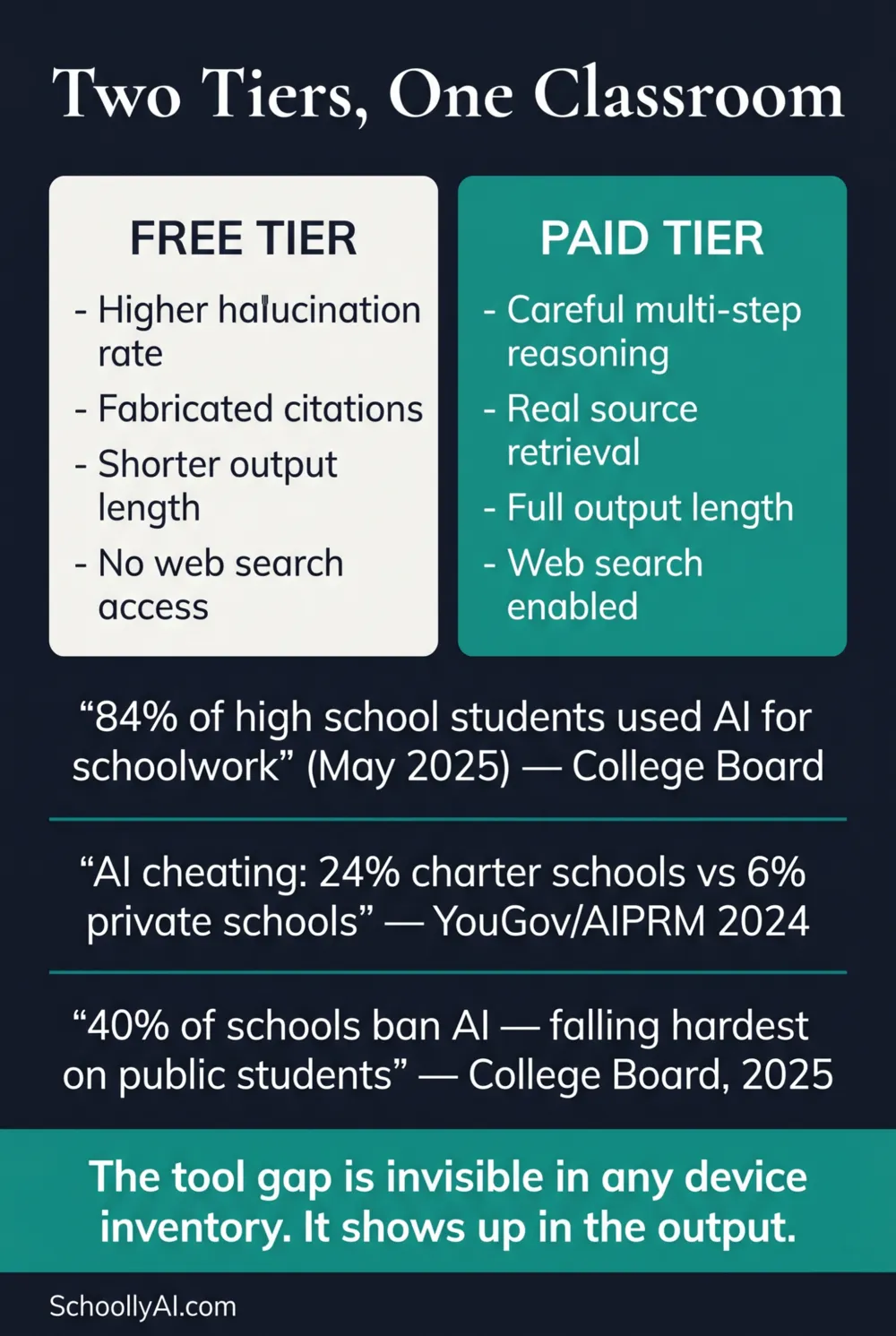
The access gap is invisible in any device inventory. It shows up in output quality, hallucination rates, and which students produce obviously AI-generated work versus polished, edited submissions.
Two Tiers, One Classroom
Students sitting next to each other in the same class are not using the same AI. One has a paid subscription with a model that reasons carefully, retrieves accurately, and produces output that requires genuine engagement to use well. The other has a free tier that fills reasoning gaps with plausible-sounding fiction and handles complex research tasks by fabricating the parts it cannot find.
That difference is not visible in the classroom. Both students have their phones out. Both are typing into a chat interface. The outputs they receive are categorically different. The teacher sees two submissions and has no way of knowing that one student was working with a tool that works and one was working with a tool that mostly works.
This is the full picture of who gets left behind in the AI equity conversation: the hardware gap, the training gap, the policy gap, and the subscription tier gap working simultaneously on the same students.
The Subscription Gap
Paid AI tiers differ from free models in ways that matter for schoolwork specifically. Reasoning quality on multi-step problems. Accuracy on research queries. Access to web search with actual citations rather than fabricated ones. Ability to handle longer, more complex tasks without degrading. Output length that can actually cover a multi-paragraph assignment without cutting off.
A student using a paid model for a history research assignment has access to a tool that can retrieve real sources, reason through a historical argument, and produce output that requires genuine editing to make their own. A student using a free tier on the same assignment is more likely to receive confident-sounding text with fabricated citations and shallower reasoning. Both students did "the same thing." The results are not comparable.
The academic integrity pattern that follows is predictable. Incidents of AI-related cheating were reported by 24.11% of charter high school students compared to just 6.44% at private high schools, according to YouGov and AIPRM data from 2024. Charter and public school students using free-tier tools are more likely to submit obviously AI-generated content because free models produce less refined output that requires less editorial effort to hide. Private school students with better tools and more scaffolding at home produce AI-assisted work that is harder to distinguish from authentic writing. The tool gap shows up directly in the academic integrity data.
What Free Models Actually Do Differently
The most important difference is hallucination rate on research tasks. Free AI models are more likely to fabricate citations, misattribute quotes, and fill gaps in their knowledge with confident-sounding invention. A student using a free model for a source-heavy assignment who does not know to verify every claim the model makes will submit work full of invented references.
The student probably does not know the source was fabricated. The model presented it confidently. Without an understanding of how language models work and why they produce plausible-sounding fiction rather than admitting ignorance, the student has no reason to doubt the output.
This is the foundational literacy problem that sits underneath the access problem. A student with genuine AI literacy knows to verify every factual claim. A student without it treats a free-tier hallucination the same way they would treat a Google result: accurate unless proven otherwise. The students who most need AI literacy instruction to use any tier of these tools safely are the students least likely to receive it in a structured, school-supported way.
The Racial Bias in the Training Data
Large language models are trained on historical internet data. That data reflects existing cultural patterns. Dominant dialects, Western cultural frames, and standard academic register are overrepresented. Minority dialects, non-Western perspectives, and neurodivergent communication styles are underrepresented.
For a student whose natural writing voice does not match the dominant patterns the model was trained on, this creates two compounding problems. First, the model's output in response to their prompts may not reflect their cultural context accurately. Second, if the student's own authentic writing is evaluated by any AI-assisted system, it is more likely to be misread or undervalued.
The Pew Research Center found in March 2026 that 40% of Americans believe White adults' views are well-represented in AI design. Only 19% say the same for Black adults and 17% for Hispanic adults. Ken Shelton, educational equity scholar and author, named the problem directly in 2024: "In an age where AI promises to transform education, bias remains an insidious threat, potentially exacerbating discrimination against already marginalised students. To mitigate this, we have an obligation to exercise caution."
That caution needs to be built into how teachers assign AI-assisted work and how they evaluate the outputs students produce with these tools.
How Homework Design Is Picking Winners
A complex take-home project that a paid-tier AI can complete with minimal editing is not testing academic proficiency. It is testing household income. A student who can afford a premium subscription will produce a more polished AI-assisted submission than a student who cannot, and a teacher grading on output quality alone has no way to distinguish the two.
Sophia Romee, General Manager at College Board GenAI Studio, described the underlying problem in 2025: meaningful AI implementation must be "grounded in safeguarding authentic student learning and enhancing student-teacher relationships," not in deployments that substitute one student's resources for another's effort.
The homework design problem compounds with the racial bias problem. A student from a lower-income household using a free tool that also underrepresents their cultural context is facing two simultaneous disadvantages in a single assignment. They are not starting from the same place as the student with a premium subscription and a tool that reflects their background more accurately.
The adoption rate disparity between districts provides the institutional context for what happens at the classroom level: high-poverty districts are less likely to have the policy or training infrastructure to address these gaps systematically, which means the classroom teacher is often the only person in a position to catch them.
What Teachers Should Audit This Week
Take your last three major homework assignments. Open a free-tier AI account if you do not have one. Run each assignment through it exactly as a student would, using the assignment instructions as the prompt. Read the output carefully.
If the output would earn a B or higher without any student input, the assignment has a socioeconomic access problem. A student with a premium AI and a student with a free tier are being graded on different tools, not different thinking. The student with the better tool has a structural advantage that has nothing to do with what they know.
The fix does not require removing AI from the picture entirely. It requires adding a process layer that the tool cannot complete on the student's behalf. Version history showing the assignment was built incrementally. A verbal check where the student explains a specific vocabulary choice or identifies where a source contradicts their argument. A source annotation that requires the student to have actually read the material they are citing.
None of those requirements disadvantage a student using a free tier. They require human engagement with the content regardless of which tool the student is using. That is the design principle that makes an assignment equitable: grade on the thinking, not on the output quality of the tool the student's family can afford.
FAQ
Yes. Free AI models hallucinate more frequently, reason less carefully on complex tasks, and handle research-heavy queries with less accuracy than paid tiers. A student using a free model for a research-heavy assignment is more likely to receive fabricated citations and lower-quality output than a peer using a premium subscription. The tools produce categorically different results, and the difference shows up in output quality and academic integrity patterns.
Run your recent major homework assignments through a free-tier AI model. If the output would earn a passing grade without any student input, the assignment has a socioeconomic access problem. Shift complex take-home tasks toward in-class formats, or add a process requirement that cannot be faked regardless of tool quality: version history, verbal check, or a source annotation that requires the student to have actually read the material.
Yes, if used without critical oversight. Large language models are trained on historical internet data that reflects existing cultural biases and underrepresents minority dialects, non-Western cultural frames, and neurodivergent communication patterns. A student whose natural writing voice does not match the dominant register the model was trained on receives lower-quality output. Pew Research Center data from March 2026 found that 40% of Americans believe White adults' views are well-represented in AI design, compared to 19% for Black adults and 17% for Hispanic adults.
Focus on AI literacy over tool access. Teaching students how to evaluate AI outputs, identify hallucinated content, and protect their data is more durable than purchasing software licenses that change pricing and terms annually. Schools that cannot afford premium tools universally should prioritise building critical evaluation habits in the classroom, shifting high-stakes tasks to in-class conditions, and auditing homework assignments for implicit premium-access bias.
Sources
- College Board. New Research: Majority of High School Students Use Generative AI for Schoolwork. October 2025. newsroom.collegeboard.org
- YouGov / AIPRM. AI in Education Statistics. 2024. aiprm.com
- Pew Research Center. Key findings about how Americans view artificial intelligence. March 2026. pewresearch.org
- Stanford Law School. How will AI Impact Racial Disparities in Education? June 2024. law.stanford.edu
- EdTrust. Navigating the Promise and Peril of AI for Students of Color. 2024/2025. edtrust.org
- OECD. Digital Education Outlook. 2026. oecd.org
- SocialLab AI. AI Equity: Why Equal Access Is Creating a New Learning Divide. 2026. sociallab.ai
- Gallup / Youngstown State University. From Homework to Higher Ed: AI Usage, Ethics and Impact in Today's Classrooms. 2024-2025. ysu.edu
The AI Literacy mini-course builds the critical evaluation habits students need regardless of which tier of tool they are using. Three free sections. No email required.
Start the AI Literacy Course →