AI Adoption in Schools: Where the Data Actually Points
The ai adoption statistics in schools between 2024 and 2026 tell a consistent story that almost nobody in education leadership wants to say plainly: teachers are not adopting AI because they have been well-trained. They are adopting it because the administrative burden of their jobs has become unmanageable without algorithmic assistance, and AI is the closest thing to relief they have found.
- 61% of teachers now use AI in their work, up from 32% in 2024. The surge is driven by administrative offloading, not pedagogical change. EdWeek Research Center, 2025.
- 84% of high school students used generative AI for schoolwork as of May 2025, up from 79% in January 2025. 55% of high school principals have not blocked AI access on the school network. College Board, October 2025.
- Only 20% of educational institutions have a formal AI policy in place, even though 56% of educators believe their institution is unprepared for AI. Coursera, February 2026.
- AI detection tool use in schools jumped from 38% to 68% in a single year. The spike reflects the policy vacuum, not a coherent institutional strategy. Gallup/YSU, 2024-2025.
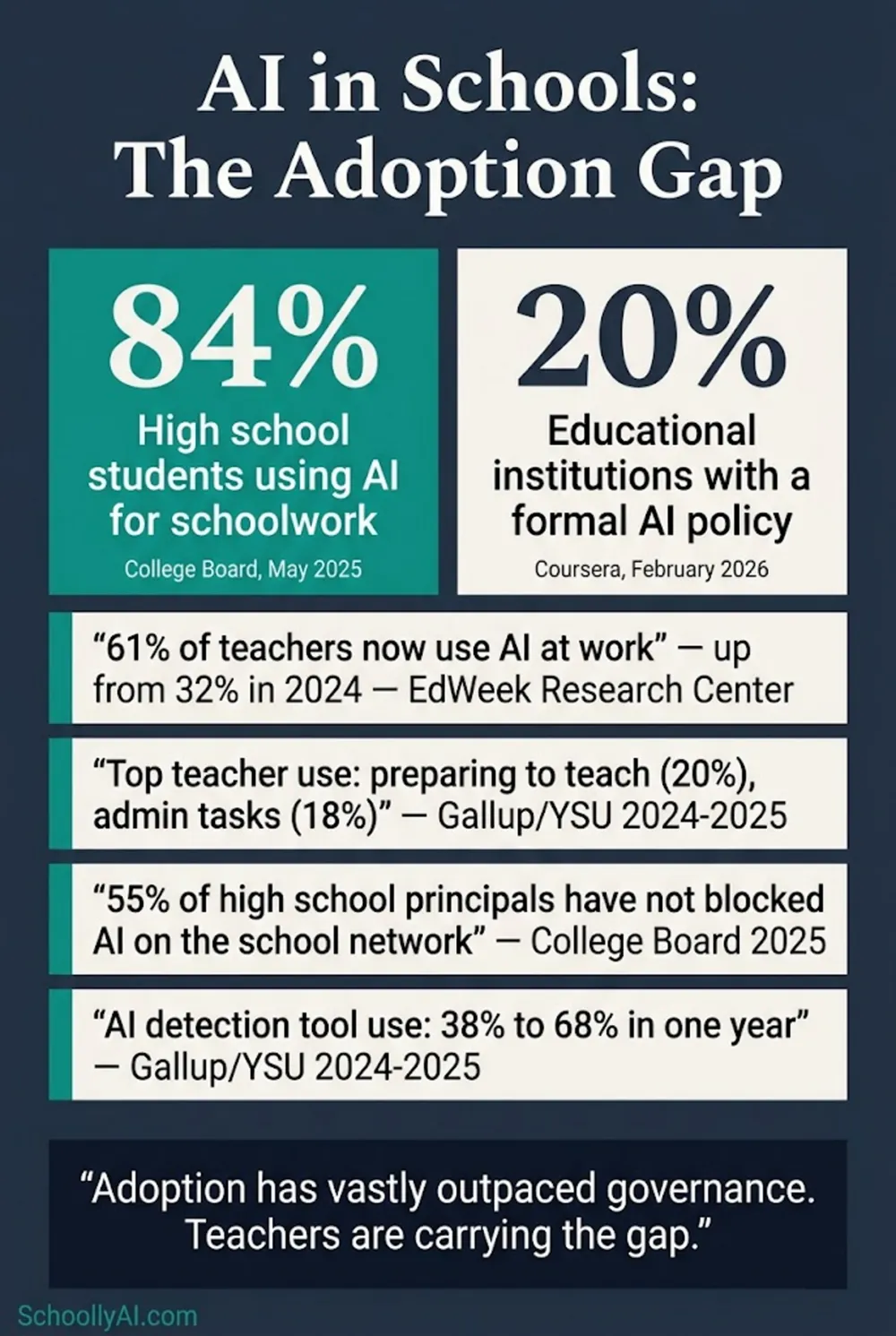
The adoption rate and the policy rate are moving in opposite directions. Schools are absorbing AI faster than any governance structure can keep up with, and the teachers are carrying that mismatch in their classrooms every day.
Adoption Is Happening Through Teacher Exhaustion
The 61% teacher adoption figure from the EdWeek Research Center represents a near-doubling in a single year. That kind of growth in any other domain would be called a revolution. In this case it looks more like a pressure valve opening.
Teachers are reaching for AI because the volume of administrative work has become unsustainable. Drafting parent emails. Writing sub plans. Generating rubric variations. Creating differentiated reading passages for students at four different reading levels. These are real, time-consuming tasks that used to take hours and now take minutes. The relief that comes from that shift is genuine and the adoption reflects it honestly.
The equity gap at the district level determines which teachers have access to that relief and which don't. A 28-percentage-point training gap between Title I and affluent districts means the teachers with the heaviest workloads, serving the highest-need students, are also the least likely to have been shown how to use these tools safely. The adoption curve is uneven in exactly the wrong direction.
Jessica Howell, Vice President of Research at College Board, noted in 2025 that the surge in AI adoption has been so rapid that educators are struggling to keep up, and that meaningful impact requires listening to stakeholders and grounding solutions in evidence rather than in reactive bans. The bans are still the first instinct. The evidence-based approach is still the exception.
The Student Side of the Data
Students adopted AI faster than institutions could respond to it. 84% of high school students reported using generative AI for schoolwork as of May 2025, up from 79% in January of the same year. The acceleration within a single academic year is striking. These are not students who were waiting for school permission. They were already using the tools when most districts were still debating whether to acknowledge they existed.
| Observation | Statistic | Source |
|---|---|---|
| Most students are using AI regardless of school policy | 84% of high school students used generative AI for schoolwork as of May 2025, up from 79% in January 2025 | College Board, October 2025 |
| Students primarily use AI for research, not wholesale assignment completion | 54% of U.S. teens use ChatGPT primarily for research, followed by 29% for solving math problems | Gallup/YSU, 2024-2025 |
| Bans fall harder on public school students who lack approved alternatives at home | 40% of schools explicitly ban AI use, while 55% of high school principals have not blocked it on the school network | College Board, October 2025 |
| AI cheating rates differ dramatically by school type | 24.11% of charter high school students reported AI-related cheating incidents vs 6.44% at private high schools | YouGov/AIPRM, 2024 |
The 54% research-use figure matters. Teachers who assume students are primarily using AI to generate complete assignments are missing the more common pattern. Most students are using it the way they used to use Wikipedia: as a starting point that they then build on (or don't). The policy response that bans AI entirely treats a research tool as a cheating tool and produces the same outcome as any other ban on something students have at home.
The subscription tier gap among students explains why the cheating incidence data looks so different between charter and private schools. Students with premium AI access produce more polished, edited AI-assisted work. Students on free tiers produce obviously AI-generated content. The gap shows up in the academic integrity numbers not because private school students cheat less, but because they have better tools.
The Teacher Side of the Data
Teachers are using AI heavily, but not for what administrators typically assume. Preparing to teach (20% of use) and administrative tasks (18%) lead the usage data from the Gallup/Youngstown State University 2024-2025 research. Real-time instruction and direct student engagement are further down the list.
That usage pattern is neither surprising nor a failure. Teachers using AI to survive the administrative requirements of the job is a rational response to an irrational situation. It is also a missed opportunity. The teachers who are most likely to produce genuine pedagogical change with AI are the ones who have had time to move past survival mode into actual experimentation with how the tools change the learning experience. Most teachers have not had that time.
Lauraine Langreo, reporter at the EdWeek Research Center, noted in 2026 that while more teachers are adopting AI, a significant faction still refuses to engage with the technology at all, creating deep inconsistencies within single buildings. A student moving from one classroom to the next encounters completely different rules about AI use, different levels of teacher competence, and different degrees of risk from being flagged for work the previous teacher encouraged.
The Policy Vacuum
Only 20% of educational institutions have a formal AI policy, while 56% of educators believe their institution is unprepared for what AI is doing in their classrooms every day. Those two numbers describe an institution-wide abdication. Teachers are not making classroom AI decisions because they prefer autonomy. They are making them because nobody else has.
The legislative picture shows some movement. State sessions in 2025 saw a shift from prohibition framing toward AI literacy framing, with several states establishing task forces and funding research into AI's impact on student learning. That is progress at the state level that has not yet reached most individual schools or classroom teachers. The policy gap between legislative intent and daily classroom reality remains large.
Only 31% of U.S. public schools had a formally written AI policy as of December 2024, according to U.S. Department of Education data. 55% of high school principals have not blocked AI access on the school network. Schools are neither governing AI use nor providing structured access. They are doing neither thing and calling it flexibility.
The AI Detection Spike
AI detection tool use in secondary schools jumped from 38% to 68% in a single year. That spike is worth reading carefully. It does not reflect a strategic decision to invest in academic integrity infrastructure. It reflects teachers improvising a response to a problem their institutions handed them without support or guidance.
The accuracy problems with those tools, and the specific equity harms they produce for ESL and formal academic writers, are covered in depth in the detection silo on this site. The pattern worth noting here is what the adoption spike reveals: teachers are reaching for whatever tool is available when institutions fail to provide a policy framework. Detection software fills the vacuum that policy is supposed to fill.
What the Data Says Schools Should Do
The pattern across every data source from 2024 to 2026 points toward two urgent needs. Not detection software. Not vendor platform rollouts. A written policy and trained teachers. Those two things, done well, address the root cause of almost every pattern the data documents.
A written policy tells students and teachers what is expected before any incident occurs. It removes the improvisation burden from the classroom. It gives teachers institutional backing when they enforce a rule. Without it, teachers are making legally and professionally exposed decisions every day that a one-page document could resolve.
Content-specific training, not general software demonstrations, produces teachers who can explain their AI decisions to students and parents with confidence. The data on teacher confidence addresses this in more detail. The practical model for building that literacy at a community level is shown in the video below.
FAQ
61% of teachers now use AI in their work, up from 32% in 2024, according to the EdWeek Research Center. The increase is primarily driven by administrative workload rather than pedagogical choice. The top uses are preparing to teach (20%) and administrative tasks (18%), not real-time instruction.
No. Only about 20-31% of educational institutions have a formal written AI policy in place, even as 56% of educators report their institution is unprepared for AI. 55% of high school principals have not blocked students or teachers from accessing AI tools on the school network. Adoption has vastly outpaced governance.
Preparing to teach is the top daily and weekly AI use at 20%, closely followed by administrative tasks at 18%, according to Gallup and Youngstown State University research from 2024-2025. Teachers are not primarily using AI for real-time instruction. They are using it to manage the administrative workload outside the classroom.
RAND research from March 2026 found a 28-percentage-point gap in AI training provision between Title I schools and affluent districts. High-poverty schools also receive less administrative support for AI experimentation, less subject-specific professional development, and have lower access to walled-garden tools with student data protections. The training gap compounds the access gap.
Sources
- EdWeek Research Center. From Our Research Center. 2025. edweek.org
- College Board. New Research: Majority of High School Students Use Generative AI for Schoolwork. October 2025. newsroom.collegeboard.org
- Gallup / Youngstown State University. From Homework to Higher Ed: AI Usage, Ethics and Impact in Today's Classrooms. 2024-2025. ysu.edu
- Coursera. AI in Education Statistics. February 2026. engageli.com
- Center for Democracy and Technology. Hand in Hand: Schools' Embrace of AI Connected to Increased Risks to Students. October 2025. cdt.org
- RAND Corporation. Student Use of AI for Homework Rises as Concerns Grow About Critical Thinking Skills. March 2026. rand.org
- Center for Democracy and Technology. States Focused on Responsible Use of AI in Education during the 2025 Legislative Session. 2025. cdt.org
- YouGov / AIPRM. AI in Education Statistics. 2024. aiprm.com
The AI Literacy mini-course gives teachers a content-first foundation for using AI in their classroom without depending on vendor training. Three free sections. No email required.
Start the AI Literacy Course →