Words AI Uses Too Much: A Teacher's Blacklist
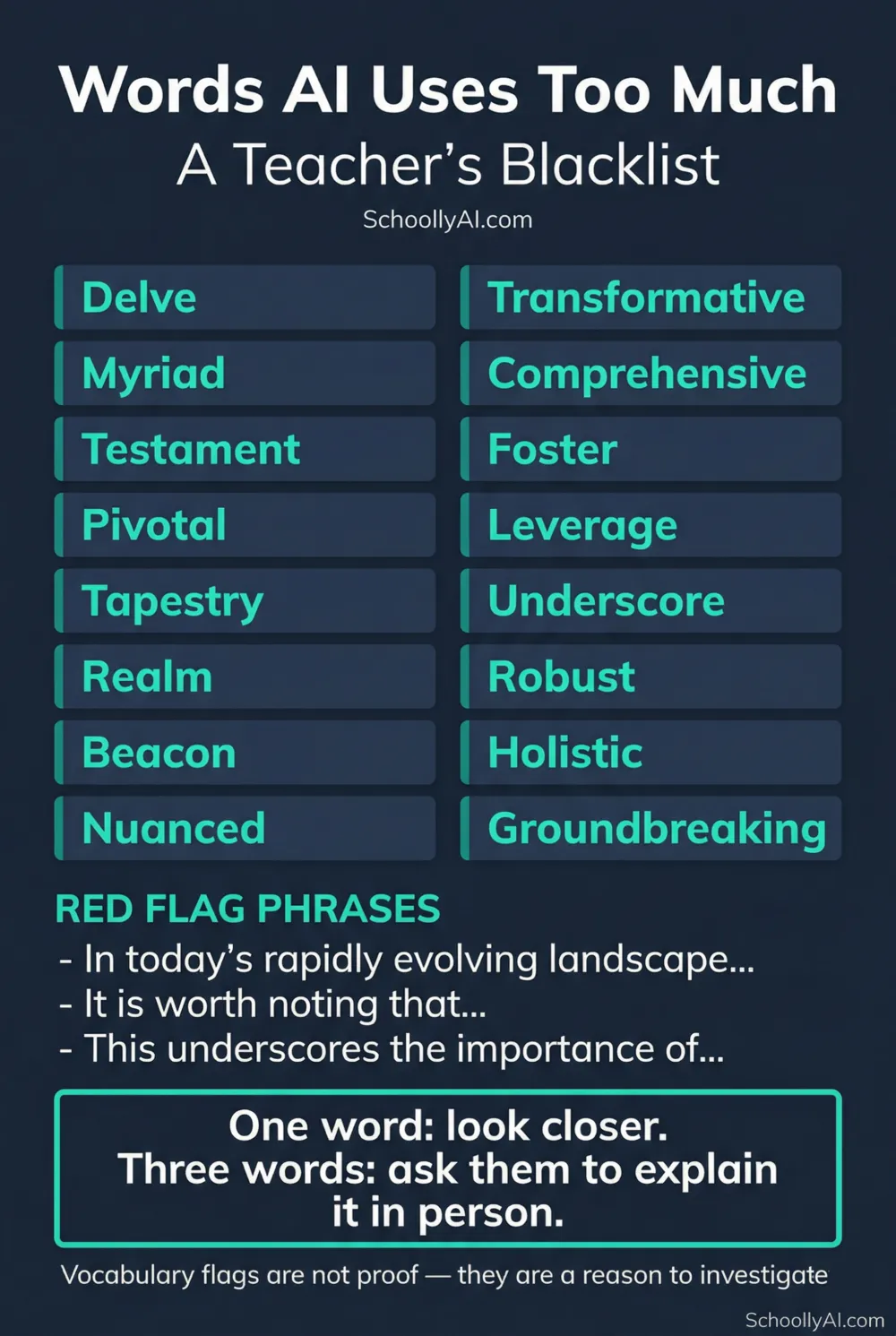
AI detection software failed a lot of teachers and students in 2025. The more reliable method is one teachers have always had: reading the work carefully. AI writing has a vocabulary fingerprint, specific words and phrases it reaches for constantly because they fit the statistical shape of formal writing. Here is the list.
- AI is trained on formal corporate and academic text, which overrepresents specific "smart-sounding" vocabulary.
- The model defaults to these words because they are statistically probable in essay-style contexts.
- Vocabulary flags are reasons to investigate, not conclusions. An oral defence is still required.
- Pattern recognition combined with a conversation is more reliable than any detector software.
Why AI Overuses Certain Words
Large language models are trained on vast amounts of text scraped from the internet, books, and academic papers. That training data is not evenly distributed. Corporate websites, formal reports, academic journals, and SEO-optimised content are heavily represented. These sources share a vocabulary, a set of words that signal seriousness, formality, and expertise in written form.
When a student prompts an AI to write an essay, the model identifies the task as formal writing and reaches for the vocabulary statistically most associated with that register. The result is prose that sounds impressively sophisticated but contains the same words every other AI-generated essay contains.
A middle school student who suddenly uses "delve" three times in one paragraph is not showing off. The AI is showing its training data.
For the full mechanical explanation of why AI defaults to statistically probable patterns, see How Does AI Work? A Teacher's Guide.
The Blacklist
These are the words and phrases that appear in AI-generated student work with disproportionate frequency. A single instance means nothing. Multiple appearances in one essay, especially combined with the structural patterns below, is worth a closer look.
High-frequency single words
| Word | Why AI defaults to it |
|---|---|
| Delve | Signals deep inquiry in formal academic text |
| Myriad | Formal alternative to "many," overrepresented in academic writing |
| Testament | Used to attribute significance ("a testament to...") |
| Pivotal | Formal importance marker common in historical and analytical writing |
| Tapestry | Metaphor for complexity, appears constantly in AI descriptive writing |
| Realm | Formal domain marker ("in the realm of...") |
| Beacon | Metaphor for guidance or exemplars |
| Nuanced | Signals analytical depth, overused as a result |
| Comprehensive | Common in formal introductions and conclusions |
| Foster | Common in education and policy writing, overrepresented in training data |
| Leverage | Business and corporate language that bleeds into academic AI writing |
| Transformative | Appears in nearly every AI essay about change or impact |
| Underscore | Used to emphasise points ("this underscores the importance of...") |
| Robust | Formal modifier, massively overused in technical and academic AI writing |
High-frequency phrases and sentence openers
| Phrase | Signal |
|---|---|
| "In today's rapidly evolving landscape..." | Classic AI scene-setting opener |
| "In the realm of..." | Domain introduction, extremely common |
| "It is worth noting that..." | Hedging filler, almost never used by student writers |
| "It is important to note..." | Same pattern, different phrasing |
| "This underscores the importance of..." | Conclusion filler, appears in nearly every AI essay closing |
| "A testament to..." | Attribution of significance, formal and uncommon in student writing |
| "Furthermore," / "Moreover," | Formal connectives. Real student writing uses "also" or just starts a new sentence |
| "In conclusion, it is clear that..." | Almost no human under 25 writes this |
Other Tells Beyond Vocabulary
Low burstiness. Read the essay aloud. Human writing has rhythm, short punchy sentences followed by longer more complex ones. AI produces sentences of similar length and structure throughout. The rhythm is monotonous in a way that becomes obvious once you have noticed it once.
No specific detail. AI writing is general. It describes the concept of something without the kind of hyper-specific detail that comes from having actually researched or experienced the topic. A human student writing about the French Revolution might remember one odd fact that stuck with them. The AI produces the statistically average account.
No texture. Real student writing contains errors, not just grammatical ones, but the errors of thinking. A clumsy metaphor. An argument that almost works. A word chosen because it sounds right but does not quite fit. AI writing is smooth in a way authentic student work rarely is.
For more on how these patterns connect to the mechanics of AI text generation, see Why AI Sounds Confident When It's Wrong.
How to Use This in Practice
A vocabulary flag is not an accusation. It is a prompt to look more carefully. If a student's essay contains three words from the high-frequency list and reads with the rhythm of a press release, that is worth a conversation, not a formal complaint.
The most effective follow-up is an oral defence. Ask the student to sit down and explain their argument. Ask them to define two or three words they used. Ask them what their strongest source says. A student who wrote the essay can do this. A student who submitted AI output typically cannot, as they have not read it closely enough to explain it.
This approach also avoids the false positive problem that has destroyed teacher-student relationships when detector software wrongly flagged original work. The oral defence is direct, proportionate, and does not require any software. See AI Cognitive Stunting: What the Research Says for why building this kind of verification into regular practice matters beyond just catching cheating.
FAQ
Common AI overuse words include: delve, myriad, testament, pivotal, tapestry, realm, beacon, nuanced, transformative, comprehensive, foster, leverage, and phrases like "in today's rapidly evolving landscape" or "it is worth noting that."
AI predicts the statistically most probable next word. In formal writing contexts, certain smart-sounding words appear frequently in the training data. The model learns that these words fit formal essay prompts and defaults to them, producing a recognisable vocabulary fingerprint.
No. A vocabulary flag is a reason to investigate further, not a conclusion. Some students naturally use formal language. The appropriate response is an oral defence, asking the student to explain their word choices in person.
Some do, but detector software has significant false positive problems. Manual vocabulary checking combined with an oral defence is more reliable and does not risk wrongly accusing a student who writes in a formal style naturally.
Sources
- OlivaCal. How to Spot AI Writing Tells (+ AI Words Blacklist for 2026). 2026. oliviacal.com
- Grammarly. Decoding AI Language: Common Words and Phrases in AI-Generated Content. 2026. grammarly.com
- RAND Corporation. More Students Use AI for Homework, and More Believe It Harms Critical Thinking. March 2026. rand.org