How to Confront a Student About AI Cheating
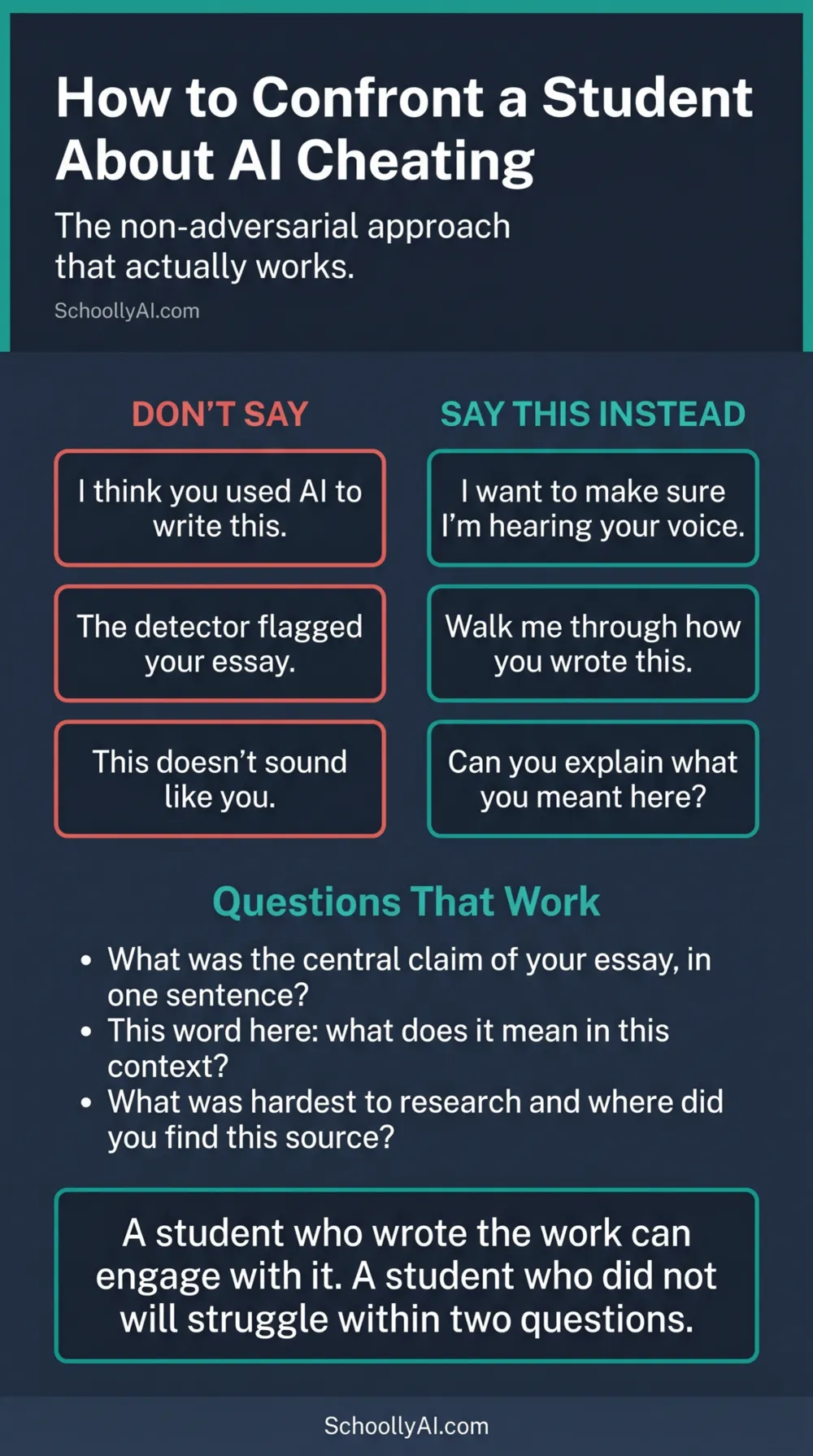
The oral defence is the most reliable tool available to teachers in 2026. A student who wrote the work can discuss it. A student who did not will struggle within the first two questions. Getting to that conversation without triggering a defensive shutdown is the skill this post covers.
- Do not use the words cheating, plagiarism, or AI in the initial meeting invitation. Lower defensive barriers before the conversation starts.
- Frame the meeting around understanding the student's writing process, not catching them in a lie.
- The viva voce questions work because they cannot be answered by someone who only skimmed the AI output. Genuine authorship shows up fast.
- For first offences, formative resolution (redo the work under supervision) is more appropriate than a formal disciplinary process built on unreliable detector evidence.
Before the Meeting: Build Your Evidence First
Before any conversation with the student, document what you are observing. Compare the suspected submission against prior in-class writing samples and previous assignments. Note specific shifts: vocabulary the student has never used before, sentence structures that do not match their established style, a level of formal coherence that is inconsistent with their history.
This stylometric comparison is your evidence. It is not a percentage score from a detector. It is the contrast between this submission and the student's own documented record, and it is something any administrator can review. AI detector scores should play no role in this preparation. For a full breakdown of why, see AI Detector False Positives: What Teachers Need to Know.
Request the document version history before the meeting if you have access. A 1500-word essay that appeared in a Google Doc in a single paste event with no revision trail is digital evidence that does not require a detector to interpret. A document with extensive revision history spread across multiple sessions is evidence in the other direction.
Going into the meeting with documented evidence of a stylometric discrepancy, or the absence of a process trail, gives the conversation a factual grounding that is hard to dispute.
The Invitation: What Not to Say
The initial message matters. Students who receive a meeting request that mentions cheating, plagiarism, or AI arrive in a defensive state and the conversation becomes an interrogation rather than an assessment. Defensive students do not answer questions honestly. They look for exits.
Two invitation approaches recommended by university teaching centres consistently produce better outcomes.
The University at Albany recommends: "Your work is good, but I want to make sure I'm really hearing your voice. Our meeting isn't about me punishing you, but about making sure you can succeed." University at Albany, 2026
Alternatively: "Your recent submission represents a shift from your previous work. I'd like to meet to discuss your writing process and how your ideas developed for this assignment."
Both framings lower barriers and keep the meeting pedagogical. The student who did the work will welcome a chance to talk about it. The student who did not will be uneasy before a single question is asked. That unease is information.
Viva Voce Questions That Work
The purpose of the meeting is not to extract a confession. It is to establish whether the student understands what they submitted. The questions below are designed to do that quickly and without accusation. They work because they cannot be answered by someone who only read the AI output superficially after it was generated.
On the argument:
"Can you walk me through how you connected the idea in paragraph two to the one in paragraph four? I want to understand your thinking there."
"What was the central claim you were making in this essay? Tell me in one sentence, in your own words."
"If you had to disagree with one thing you wrote here, what would it be and why?"
On the vocabulary:
"You used the word [specific word from the submission] here. What does that mean in this context, and what made you choose that word over others?"
"This sentence uses [specific phrasing]. Can you explain what you meant by it?"
On the research:
"What was the hardest part of researching this topic, and where did you find the source you referenced in paragraph three?"
"If you were going to extend this argument further, what would you look into next?"
On the process:
"Walk me through how you started this assignment. What did you do first?"
"What changed between your first draft and this final version?"
"Where did you get stuck, and how did you work through it?"
A student who wrote the work, even with legitimate AI assistance at the planning stage, can answer all of these. They made choices. They remember the reasoning. They encountered difficulties and resolved them. A student who outsourced the work entirely cannot engage with specific arguments, define specific word choices, or describe a process that did not happen.
As one educator put it directly: "A student who wrote the work will be able to engage with it. A student who did not will struggle quickly." Structural Learning, 2026
The clarity usually comes within the first two or three questions. You do not need to run through all of them.
What to Do After the Conversation
If the student engaged confidently and demonstrated genuine understanding of the submitted work, the conversation has served its purpose. Note that it occurred. Return the assignment with feedback. The stylometric signal you noticed may reflect growth, legitimate AI scaffolding at the planning stage, or a one-off stretch of effort. None of those is misconduct.
If the student struggled to explain their own arguments, could not define words they used, and had no account of their research or writing process, you have evidence that the submission does not represent their own understanding of the material. State this plainly, without anger: "Based on our conversation, this work doesn't demonstrate your own understanding. Because my goal is for you to learn this, I can't accept it for credit."
For a first offence, require the work to be completed under supervised conditions. Written by hand during office hours. Completed as an in-class oral assessment. Produced in a supervised session with you present. This enforces a high standard, directly addresses the conduct, and produces the learning outcome the assignment was designed to generate. It does not require triggering a formal disciplinary process built on unreliable detector evidence.
For the parent communication that should follow this kind of incident in a K-12 setting, see AI Academic Integrity: What to Tell Parents. For the full six-step framework covering everything from the initial stylometric check through to parent communication, see AI Didn't Cheat. Your Student Did.
FAQ
Invite a private meeting without using the words cheating, plagiarism, or AI in the initial message. Frame the conversation around understanding the student's writing process. In the meeting, ask the student to explain specific arguments in their own words and define specific terms they used. A student who wrote the work can engage with these questions. A student who did not will struggle immediately.
Ask them to explain a specific argument in their own words. Ask them to define a specific term they used and explain why they chose it. Ask what was hardest to research and where they found a specific source. Ask them to describe their writing process from the first idea to the final draft. These questions cannot be answered by someone who only read the AI output superficially.
Keep the framing pedagogical rather than punitive. Return to the specific text: ask the student to read a paragraph aloud and then explain what it means. A student who did not write the work will struggle to explain it regardless of their defensive posture.
For a first offence, prioritise the learning outcome. State clearly that the submission does not demonstrate the student's own understanding and cannot be accepted for credit. Require the work to be completed under supervised conditions: handwritten during office hours or as an in-class oral defence. This enforces a high academic standard without triggering a formal disciplinary process.
Sources
- University at Albany. Respond to Suspicions of Student Cheating with AI. 2026. albany.edu
- Structural Learning. AI and Academic Integrity: A Teacher's Guide. 2026. structural-learning.com
- RAND Corporation. More Students Use AI for Homework, and More Believe It Harms Critical Thinking. March 2026. rand.org