AI Academic Integrity: What to Tell Parents
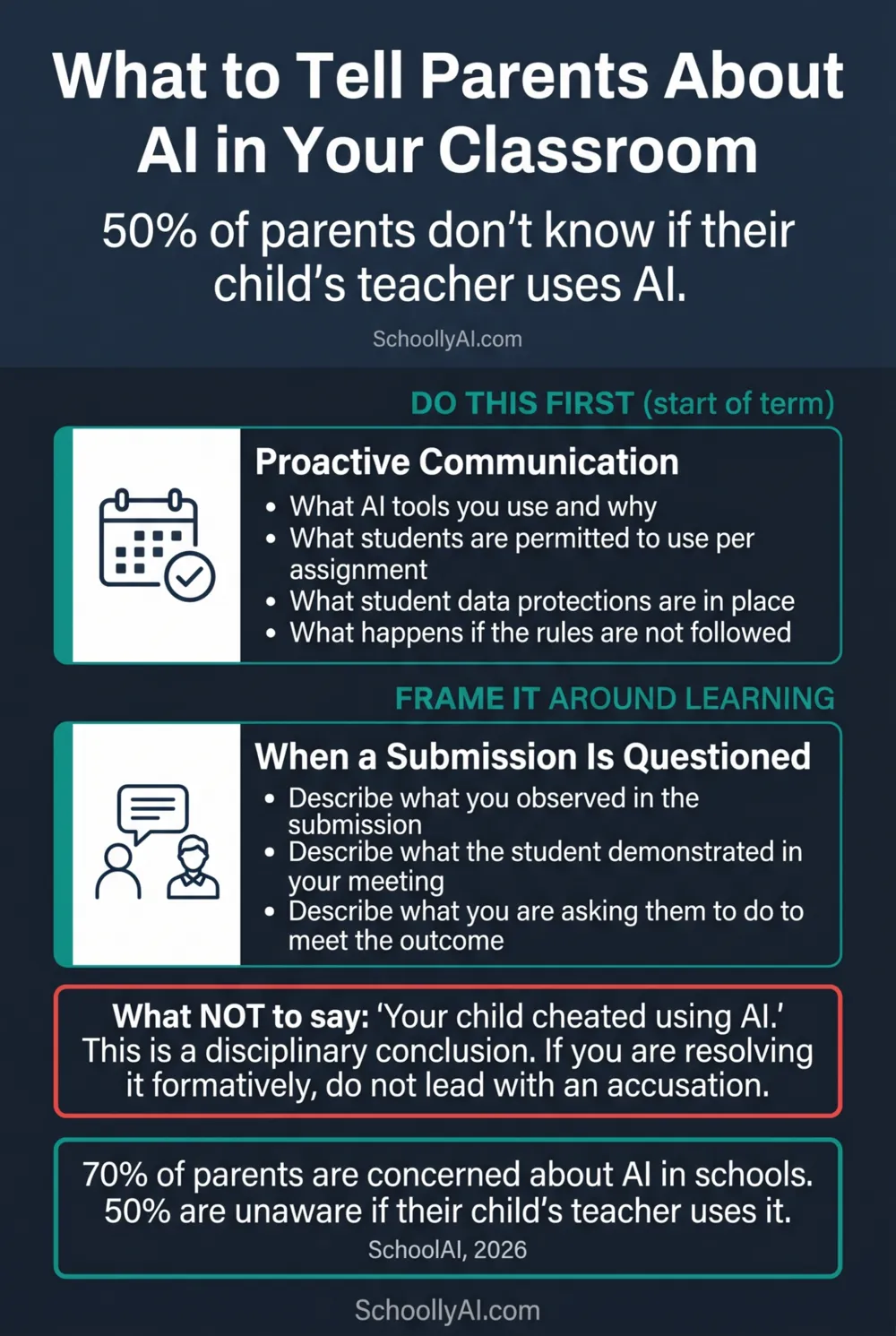
In 2026, over 70% of parents express deep concern about student AI use in schools, and 50% are entirely unaware whether their child's teachers are even using the technology. SchoolAI, 2026 That information gap is not parents being disengaged. It is schools failing to communicate. Here is what to say, when to say it, and how to frame it so it lands as support rather than suspicion.
- Proactive communication before any incident is far more effective than reactive communication after one. The defensive parent reaction happens when the first AI conversation is about their specific child.
- Frame all communication around protecting the student's learning, not around catching a cheater. These are very different conversations and produce very different outcomes.
- Parents need four things: what tools are permitted, what the rules are, what the privacy protections are, and what happens if the rules are not followed.
- When a specific submission is questioned, describe what you observed and what the student demonstrated in your meeting. Do not lead with accusation.
What Parents Actually Know
The data on parent awareness of AI in schools is stark. Over 70% of parents in 2026 are worried about AI use. Fewer than half know what policies are in place at their child's school. A majority are unaware whether their child's teachers are using AI tools at all. SchoolAI, 2026
This is not a failure of parental interest. Parents are deeply interested in how technology is affecting their children's education. It is a failure of communication. Schools have moved fast enough on AI adoption to generate widespread parent concern but not fast enough to brief parents on what is actually happening in classrooms.
The consequence is predictable. When a parent first encounters the topic of AI in the context of their specific child's work being questioned, they arrive with no prior framework for the conversation. They do not know what the rules were, whether the rules were communicated clearly to their child, or what the evidence actually consists of. A defensive reaction in that situation is entirely rational.
The fix is straightforward: brief parents before any incident occurs.
Proactive vs Reactive Communication
Proactive communication is a brief message at the start of term covering four things: what AI tools the teacher uses and why, what students are permitted to use and under what conditions, what student data protections are in place, and what the consequence is for using AI in ways that violate the stated policy.
That message takes a teacher about twenty minutes to write once and can be reused with minor updates each term. It prevents the most common failure mode of parent-teacher AI conversations: a parent who is blindsided by a specific accusation and has no prior context for evaluating it.
Reactive communication happens after an incident. The parent receives contact from a teacher, or from administration, about their child's specific submission. If the only prior context the parent has for AI in that classroom is this message, the conversation starts on the worst possible footing. Every claim the teacher makes about the rules is unverifiable. Every piece of evidence the teacher presents is arriving in a vacuum.
A parent who received the start-of-term communication knows what the rules were. They know what AIAS Level 2 means because it was explained to them. They know the teacher does not rely on detector scores because that was stated explicitly. When the subsequent conversation happens, it is between two informed parties who share a common reference point.
Start-of-Term Letter Template
The template below covers the four essential areas. Adapt the specifics to your classroom context.
Subject: AI in [Subject] This Term — What You Need to Know
Dear Parents and Guardians,
I want to take a few minutes at the start of this term to explain how I am approaching AI tools in [subject] this year, what your child is and is not permitted to use on assessed work, and what the privacy protections look like.
How I use AI in my teaching: I use [specific tool(s)] for [specific purpose, e.g., generating differentiated versions of reading materials and creating practice quiz questions]. All student data remains anonymous when I use these tools and no personally identifying information is entered.
What students are permitted to use: Each assignment in this course will be labelled with a clear AI use level. Level 1 means no AI assistance of any kind. Level 2 means AI may be used for brainstorming and planning, but all writing must be the student's own. I will explain each level to students when the assignment is given. If your child is unsure whether a specific use is permitted, I encourage them to ask me directly before submitting.
Student data and privacy: [Describe what tools students may use and what tier/agreement covers those tools. E.g., "Students using the school-provided Google Workspace are covered by our district's Data Processing Agreement with Google. Students should not enter their full name, student ID, or any personal details into any consumer AI tool outside of school-provided platforms."]
What happens if the rules are not followed: If I believe a student has used AI in a way that violates the assignment level, my first response is always a private conversation with the student to understand their writing process. I do not rely on AI detection software, which has well-documented accuracy problems. If a submission cannot be connected to the student's own understanding, I will ask them to redo the work under supervised conditions. My goal is always to ensure the student learns the material, not to punish the use of a tool.
If you have any questions about any of this, please reach out. I am happy to discuss the classroom AI policy in more detail at any time.
Regards,
[Your name]
This template is intentionally plain. Parents do not need a primer on how AI works. They need four clear facts and a sense of the teacher's approach. The section on what happens when rules are violated is the most important. A parent who knows the teacher will start with a conversation and require supervised redo rather than an immediate disciplinary referral is far less likely to respond defensively when that conversation is requested.
When a Specific Submission Is Questioned
When a student's submission has led to a meeting and formative resolution, the parent communication should follow the same framing as the student meeting: pedagogical rather than adversarial.
Describe what you observed in the submission. Describe what you asked the student in your meeting and what they were or were not able to demonstrate. Describe what you are asking the student to do to meet the learning outcome. This is a factual account of what happened, not an accusation.
What not to say: "Your child cheated using AI." This is a conclusion that requires institutional disciplinary process to support. If you are handling the situation with a formative response, you have not concluded that the student cheated in a disciplinary sense. You have concluded that the submission did not demonstrate the student's own understanding, and you are addressing that pedagogically.
What to say instead: "In my meeting with [student name] on [date], I asked them to explain specific arguments from their submission. They were not able to do so. Based on that conversation, I've asked them to redo the assignment during office hours next week. My goal is to make sure they understand the material before the unit ends."
That framing is accurate, defensible, and keeps the conversation focused on the learning outcome rather than on a legal determination of whether cheating occurred.
For the full framework covering everything from the initial stylometric check through to formative resolution, see AI Didn't Cheat. Your Student Did. For the student-facing conversation itself, see How to Confront a Student About AI Cheating.
FAQ
Parents need to know which AI tools are permitted in your classroom, what the rules are for each assignment type, what the privacy protections are for student data, and what will happen if the rules are not followed. A brief start-of-term communication covering these four points prevents the defensive reactions that occur when a parent first hears about AI policy in the context of their child being questioned.
Frame the conversation around the student's learning, not around catching a cheater. Describe what you observed, what you asked the student in your meeting, and what the student demonstrated or could not demonstrate. Explain what you are requiring the student to do to meet the learning outcome.
Yes. In 2026, over 70% of parents express concern about student AI use in schools and 50% are entirely unaware whether their child's teachers are using AI tools. Parents have a legitimate interest in knowing how AI is being used in instruction, what student data protections are in place, and what the rules are for student AI use on assessed work.
A brief written communication at the start of each term. Cover what AI tools the teacher uses and why, what students are permitted to use and under what conditions, what student data protections are in place, and what the consequence is for violations. Proactive communication before any incident prevents the defensive reactions that occur when parents first encounter the topic in the context of a specific accusation.
Sources
- SchoolAI. Parent Letter AI Policy: How to Communicate Classroom AI Use to Families. 2026. schoolai.com
- TeachAI. Sample Letter to Parents and Guardians: AI Guidance for Schools Toolkit. 2026. teachai.org
- OpenEduCat. AI Email Templates for Teacher-Parent Communication. 2026. openeducat.org
- RAND Corporation. More Students Use AI for Homework, and More Believe It Harms Critical Thinking. March 2026. rand.org