Process Verification: The Detection Alternative That Actually Works
Every researcher who has studied AI detection carefully arrives at the same place. MIT Sloan EdTech put it plainly in 2025: AI detectors don't work. Here's what to do instead. The "what to do instead" part is where the guidance usually stops. This post covers the actual workflow, scoped for a teacher with 30 students and limited time.
- Following the documented failure of text-based detection, a significant segment of tier-1 institutions adopted process-based assessment protocols for 2026, according to the Opus Pro EdTech Report, April 2026.
- Turnitin itself is evolving its dashboard to prioritise authorship metadata (typing speed, copy-paste flags) over AI probability scores, confirming that even the dominant vendor knows process evidence is more reliable than text analysis.
- Studies consistently show that when assessments are broken into scaffolded phases (outlines, drafts, version history), academic dishonesty drops significantly without any detection software involved.
- A micro-viva takes two to three minutes. A disputed detection result takes hours. Process verification front-loads a small amount of teacher time and removes the back-end dispute almost entirely.
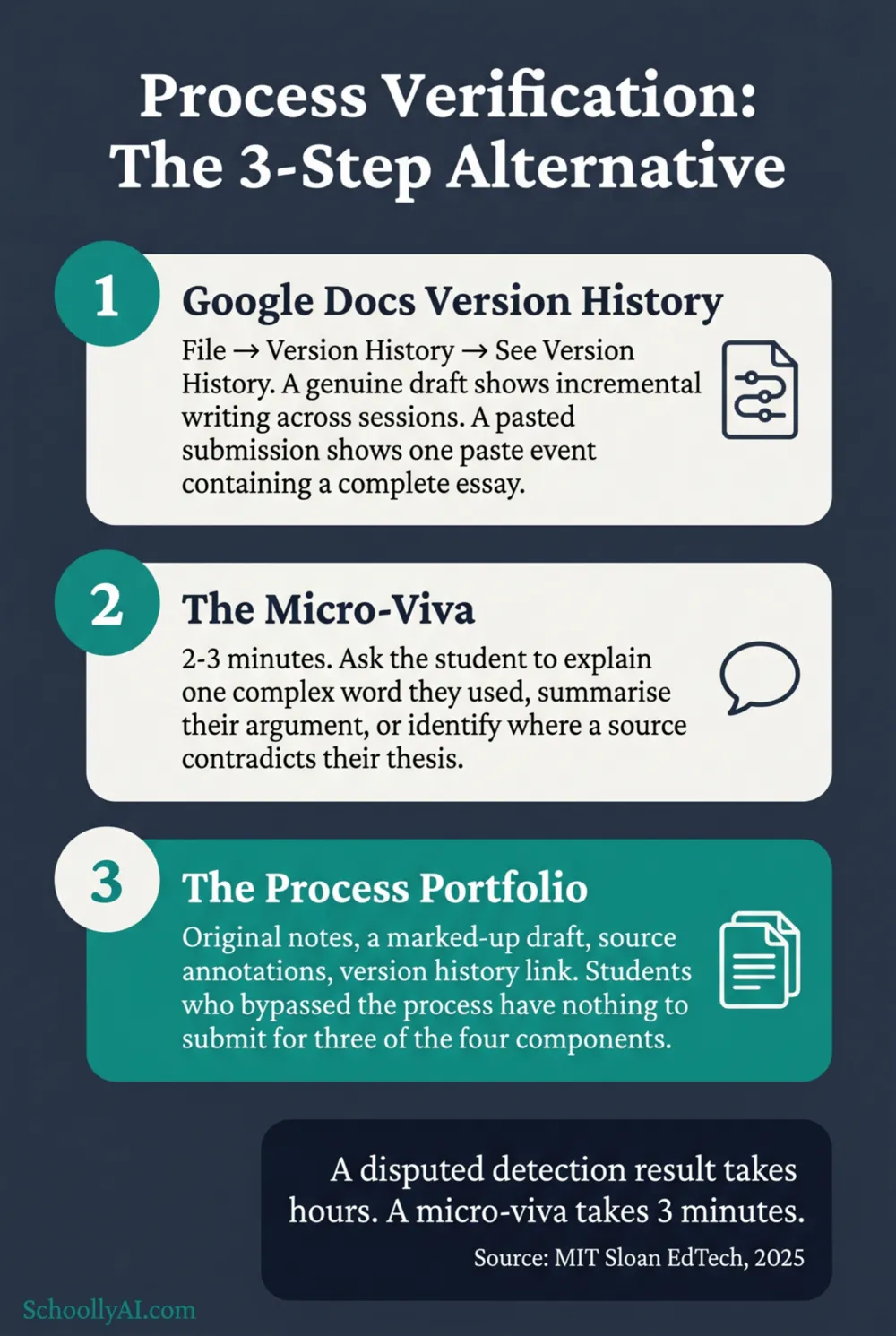
Process verification replaces probabilistic text analysis with observable evidence. Version history, portfolios, and brief verbal checks produce documentation that holds up in any formal process.
Why Process Beats Text Analysis Every Time
A detection tool analyses the finished product and asks whether it statistically resembles AI output. A process check analyses how the product was made and confirms whether the student did the work. One produces a probability estimate. The other produces observable evidence.
In any formal academic misconduct proceeding, observable evidence beats a probabilistic estimate. Turnitin's own documentation acknowledges this by stating the tool should not be used as the sole basis for punitive action. That disclaimer implicitly acknowledges that a detection score alone is not evidence. Process verification produces what the detection score cannot.
The legal exposure this avoids is documented in the pillar. Schools that take disciplinary action based solely on a detection score are exposed to procedural fairness challenges, and student defense firms are actively building caseloads around exactly those situations in 2026. A process portfolio removes that exposure by providing an evidentiary record that does not depend on a vendor's probabilistic classifier.
Google Docs Version History: What to Look For
File. Version History. See Version History. The document opens a timestamped log showing every edit from the first keystroke to the final save.
A genuine drafting process has a specific look. Text appears in sections across multiple sessions over several days. Paragraphs get restructured. Sentences get deleted and rewritten. A thesis that appears in session one gets refined by session three. The document shows a student thinking through a problem over time.
A pasted AI submission has a completely different look. A blank document. Then a single paste event containing a complete, fully formed essay. Then minor formatting changes. Then submission. The timestamp often shows the entire "drafting" process took under fifteen minutes.
That difference is unambiguous and requires no interpretation. It is timestamped, logged by Google, and cannot be retroactively altered by the student. It is the strongest single piece of process evidence available to a classroom teacher.
Make the version history link a required submission component. Same status as a bibliography. A submission without it is incomplete. The student pastes the link from File, Version History, Copy Link. It takes ten seconds. Requiring it signals that the process matters as much as the product.
The Micro-Viva
Two to three minutes. No advance notice required. Three questions, or fewer.
Explain one complex word you used in your submission. Summarise your argument in two sentences. Tell me where your primary source contradicts your thesis, or where you had to qualify a claim because the evidence was weaker than you expected.
A student who wrote the paper can answer all three without any preparation. They were in the document for five days. The vocabulary choices are theirs. The argument is something they worked through. The source is one they actually read.
A student who submitted AI output without engaging with the content typically cannot. They can often summarise vaguely. They struggle with the specific vocabulary question because the word was chosen by a language model, not by them. They cannot identify the source contradiction because they did not read the source.
The micro-viva is also virtually impossible to fake in real time with an LLM. Answering a verbal question from a standing teacher in a classroom requires immediate spoken knowledge of specific content. It cannot be delegated to a phone under the desk in the thirty seconds available.
Run micro-vivas selectively. Any submission that triggers a detection flag, teacher intuition, or portfolio inconsistency gets one. That targeting keeps the workload manageable without losing the coverage.
The Process Portfolio
Require the following alongside the final submission for major writing assignments.
The original brainstorm or notes. This can be handwritten and photographed, a bullet-point list in the document, or a mind map. It shows what the student knew and was thinking before they started writing.
A draft with visible revision marks. Not a clean second draft. A working draft with deletions, additions, and structural changes that show a student negotiating between what they wanted to say and what the evidence supports.
A source annotation: one sentence per source explaining how that specific source was used and what it contributed to the argument. A student who Googled citations after writing the paper cannot produce specific annotations. A student who read the sources as part of the research process can.
The version history link. As described above.
Students who complete this process cannot plausibly claim they did not write the work. Students who bypassed the process have nothing to submit for three of the four components. That gap is immediately visible before any detection tool is consulted.
How to Make This Fit a Class of 30
The portfolio does not require the teacher to grade every component on every submission. It requires students to produce them. That distinction matters.
Spot-check 25-30% of portfolios fully on each major assignment. Any submission that triggers a detection flag, strikes the teacher as inconsistent with the student's established writing level, or arrives without a complete portfolio gets a full review. That targeting concentrates teacher time on the submissions that actually warrant it.
Building this into a classroom AI policy makes the portfolio requirement structural rather than ad hoc. When it appears on the course outline on day one, it is not a surprise when a submission is returned for an incomplete portfolio. The expectation was set before the first assignment opened.
Teachers who have adopted process verification report a consistent outcome: the number of submissions that warrant close review drops after the first assignment. Students who might have been tempted to submit AI output without engagement make a different decision when they know the version history link is required. The portfolio requirement changes behavior before any detection tool is consulted.
What This Looks Like in Practice
Two concrete scenarios.
Scenario A: a submission gets flagged by a detector. The teacher requests the version history link and schedules a two-minute verbal check. The student produces a clear drafting history spanning six sessions over four days and explains their thesis without hesitation. The case is closed. The detection score is irrelevant. The process evidence is definitive.
Scenario B: a submission arrives without a version history link. The teacher marks it incomplete and requests the link before grading proceeds. The student produces a history showing the complete essay was pasted in a single event the night before the deadline. The teacher schedules a micro-viva. The student cannot explain two of the three vocabulary choices they used. The process violation is documented with timestamps and a record of the verbal check. That documentation holds up in any formal process in a way that a detection percentage never does.
In both scenarios the detection tool is optional. The process evidence is what matters.
Is My Assignment AI-Resistant?
Answer five questions about an existing assignment to find out whether it requires process verification to be defensible, or whether the design already produces enough evidence on its own.
Is My Assignment AI-Resistant?
Answer yes or no for the assignment you are evaluating.
1. Does the assignment require the student to reference specific content from class discussions, assigned readings, or your particular framing of the question?
2. Does the rubric require a drafting process (outline, rough draft, revision) rather than just a final submission?
3. Is the student required to submit a version history link or process portfolio alongside the final work?
4. Does the assessment include an in-person or verbal component (presentation, oral defence, lab work, timed in-class writing)?
5. Would a student need to have done the assigned reading to produce a passing answer, or could they answer from general knowledge alone?
FAQ
Process verification evaluates how a student's work was produced rather than analysing the final text for statistical AI patterns. It uses document version history, submission portfolios, and brief verbal checks to confirm that the student engaged in the thinking process the assignment was designed to produce. It requires no software and produces observable, documentable evidence rather than a probabilistic score.
Open the document, click File, then Version History, then See Version History. This shows a timestamped log of every edit. A genuine drafting process shows text added incrementally across multiple sessions with revisions and deletions. A pasted AI submission shows a blank document followed by a complete essay appearing in a single paste event, often with only minor formatting changes after.
A micro-viva is a two to three minute verbal check where a teacher asks a student to explain their own work. Effective questions include: explain one complex word or phrase you used, summarise your argument in two sentences, and identify one place where your primary source contradicts your thesis. A student who wrote the paper can answer all three without preparation. A student who submitted AI output without reading it carefully typically cannot. The micro-viva takes less time than reviewing a detection report.
The portfolio requirement takes the student more time, not the teacher. Spot-checking 20-30% of version histories takes minutes per submission. A micro-viva takes two to three minutes. A disputed detection result, by contrast, takes hours: the initial review, the parent communication, the formal documentation, the appeal. Process verification front-loads a small amount of teacher time and removes the back-end dispute almost entirely.
Sources
- MIT Sloan EdTech. AI Detectors Don't Work. Here's What to Do Instead. 2025. mitsloanedtech.mit.edu
- Opus Pro. AI in Education News: April 2026. April 2026. opus.pro
- Turnitin. AI writing detection model updates. Release Notes. 2026. guides.turnitin.com
- Research.com. The Impact of Generative AI on Research Integrity in Higher Education. 2026. research.com
- Bassett, M. A., et al. Heads we win, tails you lose: AI detectors in education. International Journal for Educational Integrity / Taylor and Francis. 2026. tandfonline.com
- EduSageAI. Best AI Tools for Teachers in 2026: The Complete Guide. 2026. edusageai.com
The AI Literacy mini-course covers how to design assignments that don't depend on detecting the final text. Free. No email required.
Start the AI Literacy Course →