How to Build an AI Detection Policy That Doesn't Punish Your Best Students
An AI detection policy at the classroom level does two things a district guideline cannot. It puts the teacher in a defined, defensible position before a flag ever appears. And it tells students exactly what is expected before they start, which is the only moment that information is actually useful. Most teachers are working without either of those things. The legal exposure section in the pillar explains exactly what that gap costs when a detection result gets challenged.
- When realistic guardrails are in place, 80% of student AI interactions fall within approved parameters, according to Securly usage analysis reported in EdWeek, March 2026.
- Nearly 90% of students use AI in their academic workflows. A blanket ban does not reduce that number. It drives use underground and removes teacher visibility.
- 68% of students admit to some form of academic dishonesty, with contract cheating up 196% since 2019. Disclosure-based policies reduce misconduct more effectively than prohibition.
- Only 13% of districts have a clear formal AI policy for students and staff. In the absence of district guidance, classroom policy is the only protection a teacher has.
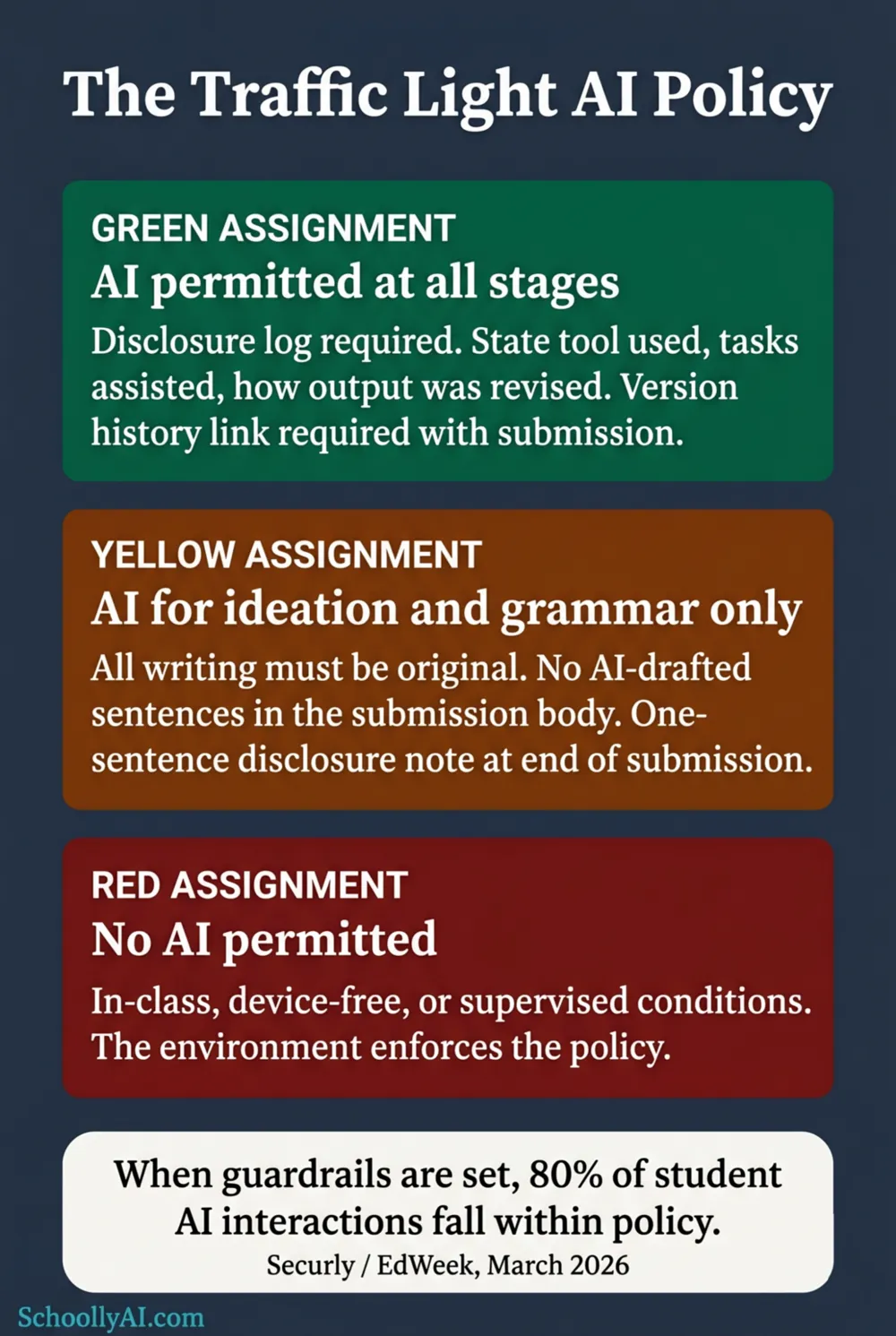
The Traffic Light framework assigns Green, Yellow, or Red status to each assignment and prints it on the rubric. Students know before they start. The teacher has a documented position before a flag ever appears.
The Problem a Blanket Ban Creates
A ban communicates that AI use is shameful, hidden, and unmentionable. That is exactly the wrong message for a generation that will use these tools in every professional environment they enter. It also creates a practical enforcement problem: a rule the teacher cannot enforce, in a room full of students with smartphones, is not a rule. It is a wish.
The more important issue is what happens to trust. A student who uses AI in good faith on an assignment that didn't clearly prohibit it, then gets flagged, has a legitimate grievance. A student who knows the tool exists and chooses not to use it on a Red assignment because the rule was clear has made a meaningful decision. The policy is what makes the second student possible.
Nearly 90% of students are already using AI in some form. When Securly analysed actual student network usage data in March 2026, they found that when districts set clear guardrails, 80% of student AI interactions fell within approved parameters. Students follow clear rules. They fill ambiguity with whatever serves them.
What Disclosure-Based Policy Actually Means
A disclosure-based policy is not a free-for-all. It requires students to state what AI they used, how they used it, and what they did with the output. The grade reflects the student's critical thinking on top of the AI's work. Not the AI's work alone.
The disclosure log is also evidence. If a student claims they didn't use AI and their disclosure log is blank, that is a verifiable fact. If a student says they used AI for brainstorming but the version history shows the entire draft was pasted in a single event, that is a policy violation with documentation. The disclosure requirement shifts the evidentiary burden back to the student in a way that a detection score never does.
Disclosure-based policy also gives teachers visibility into how students are actually using AI. A teacher who discovers that 80% of the class used AI for the outlining stage on a Yellow assignment can adjust future instruction accordingly. A teacher whose students are hiding their use learns nothing.
The Traffic Light Framework
Three colours. Three clear rules. One designation per assignment, printed on the rubric before the student begins.
Green means AI is permitted at all stages. Brainstorming, drafting, editing, formatting. The student must submit a disclosure log stating what tool they used, which parts of the work it touched, and what they did to revise or extend that output. The grade reflects their critical thinking on top of the AI's first pass.
Yellow means AI is permitted for ideation, outlining, and grammar checking only. All writing is original. No AI-drafted text in the submission. A process portfolio is submitted alongside the final draft showing the outline, the brainstorm notes, and the version history link.
Red means no AI at all. In-class timed writing, oral presentations, lab reports completed under supervised conditions, device-free assessments. When the environment is controlled, the policy enforces itself.
The framework works because it is specific per assignment, not a global position. A Green project in Term 1 teaches students to use AI responsibly. A Red exam in Term 2 assesses whether they can produce independent work under pressure. Both are legitimate instructional goals. Neither requires a detector.
How to Write Green, Yellow, and Red Assignments
A Green assignment is well-suited for research projects, multi-draft essays, and any task where the thinking process matters more than the final document. The requirement is a disclosure log and a process portfolio: notes, drafts, version history link. Students who did not use AI submit the same portfolio. The absence of AI use in the log is a legitimate and accepted disclosure.
A Yellow assignment suits tasks where you want the student to do all the writing but you are realistic that they may use AI for outlining and structure. An analytical essay where the argument must be original is a Yellow task. The rubric specifies that AI-drafted sentences in the body of the submission constitute a policy violation, regardless of whether a detector flags them.
Red assignments are where the evidence of independent work is the point of the task. Timed in-class writing. The live oral presentation. The experiment that requires the student to be physically present at a bench. Any assessment where the process is the product. These require no detection and no disclosure. The conditions do the work.
What to Put in Your Syllabus Right Now
Three paragraphs cover the essentials. Here is the structure with the language that matters most.
First paragraph: the general AI position. "AI tools including ChatGPT, Claude, and Gemini are permitted in this class on designated Green assignments with a required disclosure log. They are restricted to ideation and grammar checking on Yellow assignments. They are prohibited on Red assignments, which are completed under in-class conditions."
Second paragraph: the disclosure requirement. "Any use of AI at any stage of a Green or Yellow assignment must be disclosed in the submission. The disclosure log states the tool used, the task it assisted with, and how the student revised or extended that output. Submissions without a disclosure log on Green assignments will not be graded until one is provided."
Third paragraph: the consequence statement. This is the one that protects the teacher legally. "An AI detection score is not sufficient evidence to initiate a grade penalty or academic misconduct finding. Where AI use is suspected outside the terms of this policy, I will request the document version history and schedule a brief verbal check with the student before taking any action."
That third paragraph is the most important one. It removes the detection score from the evidentiary chain and replaces it with observable process evidence. It also signals to students that a false flag will not result in an automatic penalty, which reduces the anxiety that drives students to degrade their own writing to avoid detection.
How to Handle the Cases the Policy Doesn't Cover
Three scenarios come up repeatedly. Each one has a single next step.
A student submits a Green assignment with no disclosure log. The submission goes back ungraded with a request for the log. No accusation. No grade penalty until the process requirement is met. This is administrative, not adversarial.
A Red assignment gets flagged by a detector. The teacher requests the version history and schedules a two-minute verbal check. The student explains their thesis and identifies two sources. If they can do that, the case is closed regardless of what the detector said. If they cannot, the version history is the evidence, not the score.
A detection score contradicts the teacher's own judgment. The teacher's judgment is more reliable than a probabilistic classifier for students they know. A student who has been writing consistently at a particular level all term and produces work that matches that level is not a detection case. Document the decision and move on. The process verification steps are the evidence structure when a finding does need to be documented formally.
Traffic Light Syllabus Generator
Select the AI functions you want to permit in your class. The tool generates a copy-pasteable policy paragraph for your syllabus.
Build your classroom AI policy paragraph
Check every function you want to permit. Leave unchecked what you want to prohibit.
FAQ
No. A blanket ban that cannot be enforced is worse than no policy at all. It trains students that stated rules are optional. When realistic guardrails are set, 80% of student AI interactions fall within approved parameters, according to Securly usage analysis reported in EdWeek, March 2026. Disclosure-based policies with explicit assignment-level rules produce better compliance than prohibition.
The Traffic Light framework assigns Green, Yellow, or Red status to each assignment based on how much AI use is permitted. Green means AI is allowed at all stages with a disclosure statement. Yellow means AI is permitted for ideation and grammar checking only. Red means no AI is permitted, typically in-class or device-free conditions. The designation is printed on the rubric before the student begins.
Enforcement shifts from text analysis to process verification. If a student cannot produce their Google Docs version history or explain their thesis verbally in two minutes, they have failed to meet the process requirements of the policy regardless of authorship. That violation is documentable and defensible in a way that a detection score alone is not.
Focus the conversation on learning outcomes, not the technology. The policy exists to ensure the student develops the thinking skills the assignment was designed to build. Explain that AI is permitted on Green assignments because using it responsibly is a skill the student needs. On Red assignments it is prohibited because independent work under pressure is a different skill they also need.
Sources
- Securly / Wincup, T. Real-Time Data Shows Exactly How Students Use AI on School Technology. Education Week. March 2026. edweek.org
- Evelyn Learning. The Cheating Evolution: How Advanced AI Detection Tools Are Reshaping Academic Integrity. March 2026. evelynlearning.com
- Copyleaks. What Educators Should Know About AI Detection in 2026. 2026. copyleaks.com
- National Association of State Boards of Education. States Take Next Steps on Governing AI Use in Schools. 2026. nasbe.org
- Structural Learning. Creating an AI Policy for Schools 2026. 2025. structural-learning.com
- Center for Democracy and Technology. Schools' Embrace of AI Connected to Increased Risks to Students. October 2025. cdt.org
The AI Literacy mini-course covers how to build assessment approaches that work with AI rather than against it. Free. No email required.
Start the AI Literacy Course →