The Bypass Problem: Why Students Who Cheat Beat the Detector Every Time
The students who know why formal writing gets flagged and how to exploit that knowledge are not getting caught. The students writing carefully in formal academic register are. That inversion is not a bug in the system. It is the predictable output of a tool that measures text predictability rather than authorship. The bypass problem has been documented thoroughly in 2026. What is less documented is what teachers should do about it.
- Over 150 commercial AI humanizer services existed by 2026, all designed specifically to inject mathematical variance into AI-generated text to defeat detection. Turnitin released a major update in August 2025 reacting to this market.
- Humanizer tools drop the accuracy of premier AI detectors from the 90th percentile to 60-80%, according to the RAID Benchmark analysis from 2026.
- UCLA, Vanderbilt, Yale, and Curtin University disabled Turnitin's AI detection features entirely in 2026. These are not small institutions making a casual decision.
- 70.4% of students oppose having ChatGPT write an entire essay, according to Taylor and Francis research from 2026. The bypass problem is about a motivated minority, not the majority.
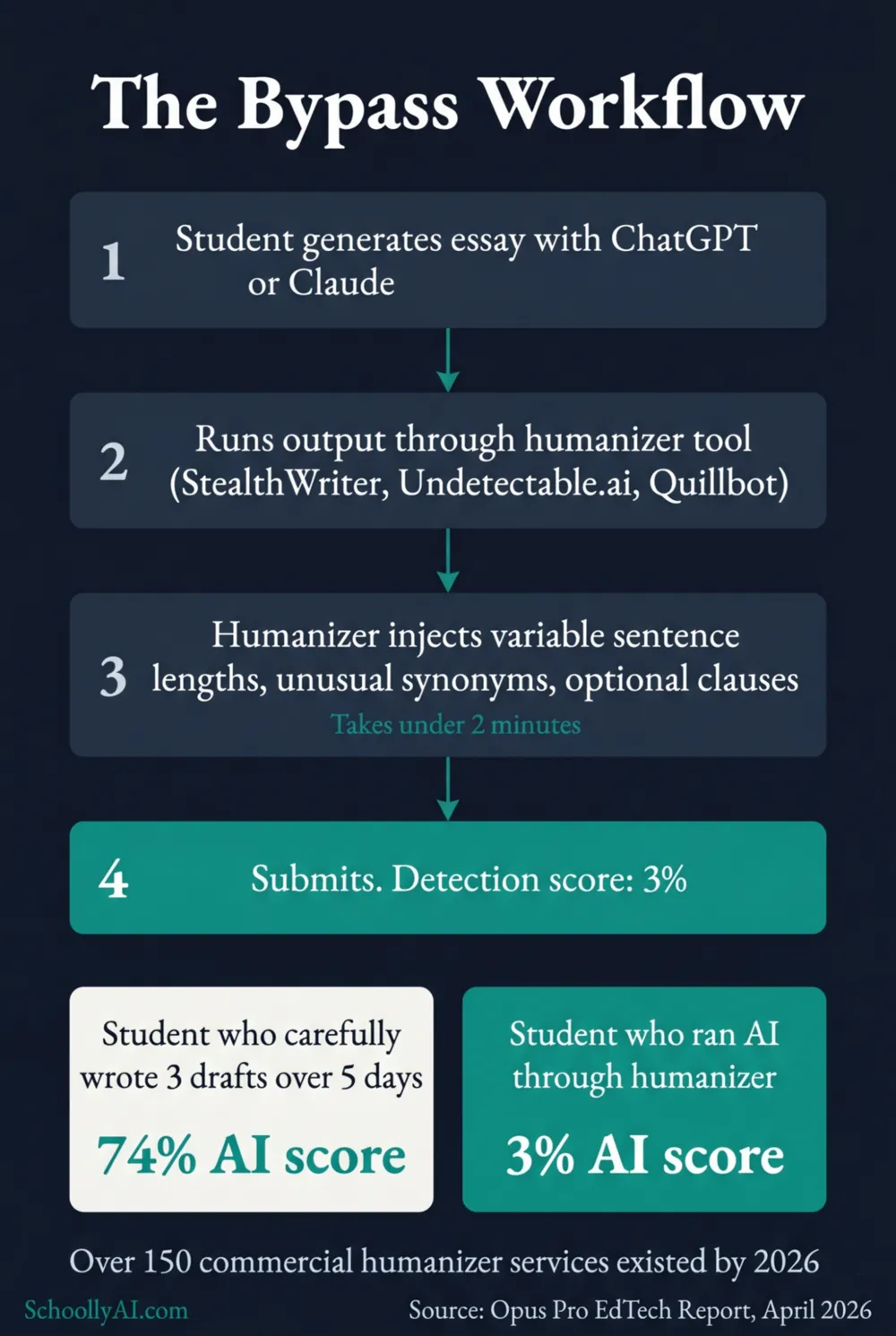
The bypass workflow takes under two minutes: AI generates the draft, a humanizer injects variance, the submission passes detection. The students most at risk of being caught are those who didn't use AI at all.
The Students Getting Caught Are the Wrong Ones
ESL students. Formal academic writers. Students who followed the rubric carefully and structured every paragraph the way they were taught. These are the profiles that generate low perplexity and low burstiness, the same statistical signatures detectors associate with AI output.
The student who ran their essay through StealthWriter before submitting gets a 2% AI score. The student who wrote three careful drafts over five days gets flagged at 74%. That inversion is not theoretical. Teachers on r/Professors and r/Teachers have documented it repeatedly: "Turnitin flags my best writers while the actual cheaters pass."
54% of students who use AI for schoolwork use it primarily for research and information gathering, according to Pew Research Center data from February 2026. These are not students trying to cheat. They are students using a tool the way they use every information tool, uncritically, because nobody has taught them to do otherwise. The bypass problem is a smaller population within that much larger group.
How Humanizer Tools Work
Detection tools flag text by measuring perplexity (how predictable the word choices are) and burstiness (how uniform the sentence lengths are). AI output scores low on both. Humanizer tools reverse that by introducing deliberate variation.
StealthWriter, Undetectable.ai, and Quillbot at high settings all work through variations of the same mechanism. They substitute less common synonyms for standard vocabulary choices. They break uniformly structured sentences into irregular-length fragments. They insert optional clauses, parenthetical asides, and transitional phrases that disrupt the mathematical rhythm detection tools are trained to flag.
The output is not better writing. It is often noticeably worse. Bizarre synonym substitutions that don't fit the academic register. Sentences that feel structurally off without any single obvious error. That quality degradation is the tell, and it is something a teacher reading the paper can often sense even when the algorithm cannot measure it.
A teacher reading a submission full of stilted phrasing and oddly formal synonym choices does not need a detection score to know something is off. The quality of the work makes the case on its own merits.
What Bypass Looks Like in a Submission
There are specific tells that humanized AI text leaves in a submission. None of them are definitive on their own. Together they are a pattern worth knowing.
Synonym substitution artifacts: a student who writes "ameliorate" in a sentence where "improve" would be more natural, or uses "subsequently" where "then" fits better, has often run their text through a vocabulary randomiser. The word technically works. It just does not sound like that student.
Structural inconsistency: paragraphs that alternate between two-word sentences and sprawling 45-word constructions without any apparent rhetorical purpose. Humanizers inject burstiness mechanically, not meaningfully. The rhythm is varied but not deliberate.
Content that is confident but hollow: arguments that are grammatically correct and structurally sound but make no specific reference to class content, the teacher's framing of the question, or anything learned in the specific unit. AI output generalises. A student who did the reading writes specifically.
None of these signals require a detection tool. They require reading the paper.
The Arms Race That Schools Are Losing
Detection models improve. Bypass models improve faster. That asymmetry is structural, not a temporary lag that better software will close.
The bypass market had over 150 commercial services by 2026. Turnitin's August 2025 update added a new category specifically to flag AI-paraphrased text. That update confirms the problem it was trying to solve. The category exists because the previous detection was already being defeated reliably. The bypass tools will adapt to the new detection category. They always do.
UCLA, Vanderbilt, Yale, and Curtin University all disabled Turnitin's AI detection features in 2026, according to the Opus Pro EdTech Report from April 2026. The decisions were made independently by separate institutions in different countries. They arrived at the same conclusion: the tool was producing more false accusations against honest students than it was catching actual academic misconduct. That calculus does not improve as bypass tools become more sophisticated.
What the Research Shows
The RAID Benchmark from ACL 2024 is the most rigorous independent test of bypass vulnerability across major detection tools. The finding is consistent: any tool that performs well on clean AI output degrades significantly when the text has been processed through a humanizer. Accuracy drops from the 90th percentile to 60-80% on adversarially modified text.
At 60-80% accuracy on modified text, a flagged paper in a class where 10% of students are genuinely cheating has less than a coin-flip probability of being AI-generated. The base rate math from the Taylor and Francis International Journal for Educational Integrity (2026) makes this concrete: in a class of 30 students where three are actually cheating, even a technically accurate detector produces more false accusations than true findings. With bypass-modified text, those numbers get worse.
The research consensus from 2024 to 2026 is consistent. AI detection of adversarially modified text is not a solved problem. It is not close to being solved. Schools that build their academic integrity systems around detection are building on ground that shifts every time a new humanizer tool ships.
What This Means for How You Grade
Assume any student truly motivated to cheat and avoid detection will succeed. Grade accordingly.
A submission full of bizarre synonym substitutions and structurally disjointed paragraphs earns a poor grade on academic merit alone. Clarity, coherence, argument quality, specific engagement with class content. A teacher does not need to prove AI use to grade poor work poorly. That reframe removes the detection tool from the equation entirely.
The student who submitted humanized AI output and received a D on academic merit has learned something. The student who submitted humanized AI output, received a D, and was then accused of cheating based on a detection score that the tool's own vendor says should not be used as sole evidence has experienced something different entirely.
Building version history requirements into assignments closes the gap the detector cannot. A student who cannot produce a drafting history for a submission that claims five days of work has a process violation that does not require any probabilistic inference to identify.
FAQ
A humanizer is commercial software designed specifically to rewrite AI-generated text to evade detection. It injects irregular sentence lengths, less common synonyms, optional clauses, and structural variation into AI output. The result is not better writing. It is strategically degraded writing that falls below the perplexity and burstiness thresholds that detectors flag. Over 150 such commercial services existed by 2026.
Yes. Humanizer tools reduce the accuracy of premier AI detectors from the 90th percentile to 60-80%, according to the RAID Benchmark and Thesify analysis from 2026. A student who runs AI-generated text through a humanizer tool before submitting defeats detection in under two minutes. UCLA, Vanderbilt, Yale, and Curtin University disabled Turnitin's AI detection features in 2026 in response to this reality.
Yes. Intentionally adding typos, grammatical quirks, and irregular sentence lengths disrupts the mathematical uniformity that AI detectors look for. This is also what makes detection counterproductive: students are learning to write worse specifically to avoid a tool that claims to measure writing quality. The tool is incentivising the production of lower-quality work.
Detectors can still catch lazy cheating, specifically direct copy-pasting from a language model without any editing. For that narrow use case they retain some value as a screening signal. But they should be treated as a prompt for further investigation, not as evidence. For students genuinely trying to evade detection, the tool provides no protection. Process verification is the only approach that works regardless of how the text was produced.
Sources
- Peng, et al. RAID: A Shared Benchmark for Robust Evaluation of Machine-Generated Text Detectors. ACL. 2024. arxiv.org
- Turnitin. AI writing detection model updates. Release Notes. August 2025. guides.turnitin.com
- Opus Pro. AI in Education News: April 2026. Opus Pro Blog. April 2026. opus.pro
- Thesify.ai. How Professors Detect AI Writing: 2026 Guide. 2026. thesify.ai
- Taylor and Francis Online. Ethics in the time of Artificial Intelligence: Rethinking Integrity in the Classroom. 2026. preprints.org
- Evelyn Learning. The Cheating Evolution. March 2026. evelynlearning.com
- Pew Research Center. How Teens Use and View AI. February 2026. pewresearch.org
- Bassett, M. A., et al. Heads we win, tails you lose: AI detectors in education. International Journal for Educational Integrity / Taylor and Francis. 2026. tandfonline.com
The AI Literacy mini-course covers how to build assessment design that doesn't depend on detecting the final text. Free. No email required.
Start the AI Literacy Course →