AI Tool Overload Is Making Teacher Burnout Worse
The percentage of students who feel genuinely supported by AI-assisted learning dropped from 29% to 13% between 2024 and 2026, even as AI tool adoption surged. Jobs for the Future, 2026 More tools did not produce better outcomes. For teachers, they produced more work. Here is why, and what the practical fix looks like.
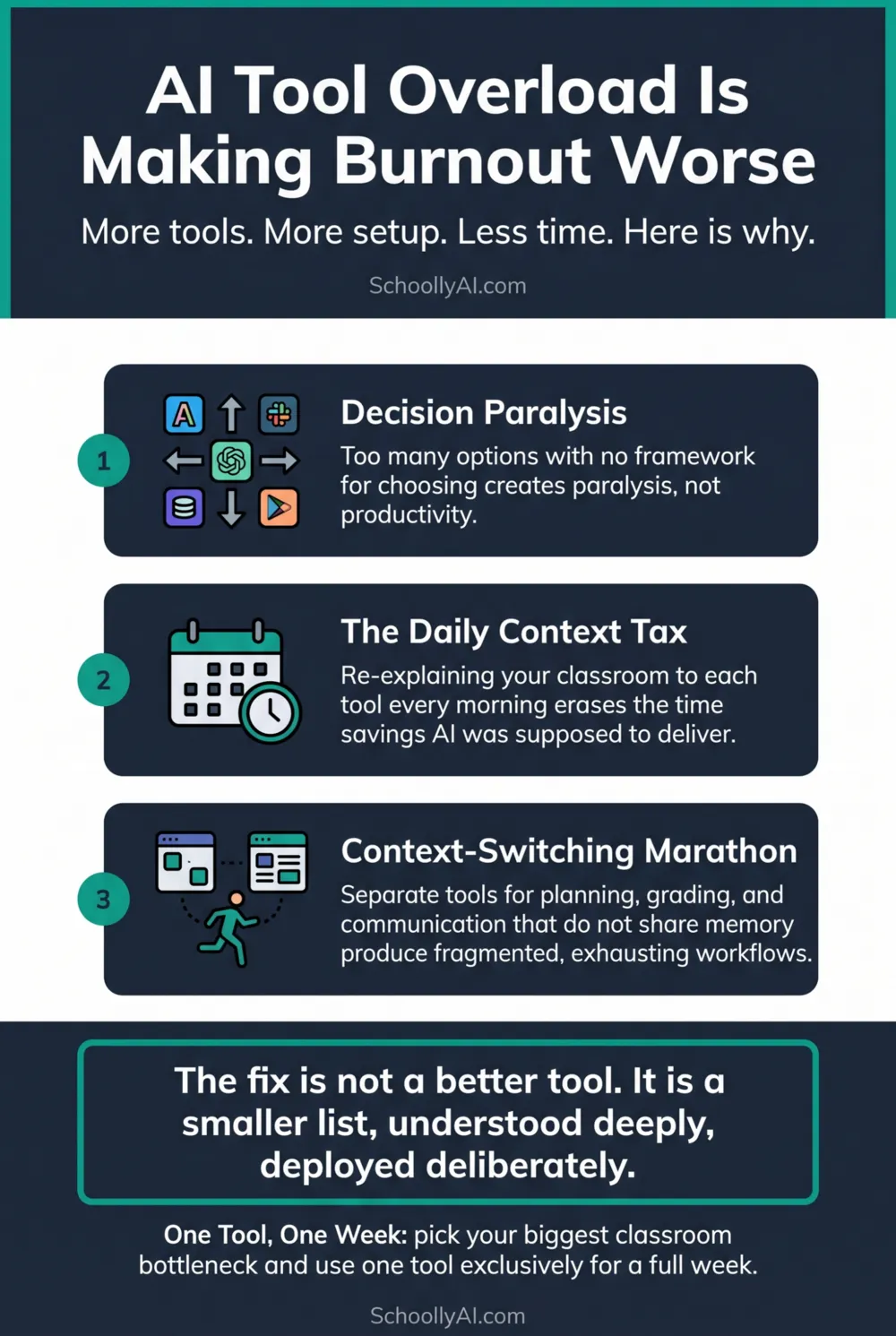
- AI tool overload is a selection problem, not a technology problem. Too many options create paralysis, not productivity.
- Adoption fatigue is real and well-documented: teachers are mandated to modernise without training, time, or strategic guidance.
- The daily context-switching marathon between fragmented tools eliminates every efficiency gain AI was supposed to deliver.
- The fix is not a better tool. It is fewer tools, understood deeply, deployed deliberately.
The Productivity Paradox
The promise behind AI tools in education was straightforward: automate the repetitive administrative work so teachers can focus on teaching. Lesson plan templates. Rubric generation. Email drafts. Parent communication. The hours per week spent on these tasks would shrink, and the hours available for students would grow.
The reality in 2025 and 2026 classrooms was the opposite for many teachers. The tools multiplied faster than the capacity to learn them. New platforms arrived before the previous ones were understood. District administrators forwarded newsletters about tools that had not been evaluated. Professional development sessions introduced five new applications in sixty minutes with no follow-up support. The time cost of evaluating, learning, and switching between tools exceeded the time those tools were supposed to save.
Researchers at Jobs for the Future describe this as the "messy middle" of technological adoption: institutions have moved fast enough to mandate tools but not fast enough to build the infrastructure that makes those tools genuinely useful. Jobs for the Future, 2026 The cognitive and operational burden of navigating that gap lands on individual teachers.
What Adoption Fatigue Looks Like
Adoption fatigue is not the same as being resistant to technology. Most teachers who report it are not opposed to AI tools in principle. They are exhausted by the specific conditions under which those tools are being deployed.
The pattern looks like this: a district mandates integration of AI into instruction. No professional development time is allocated. No guidance on which tools are appropriate for which tasks is provided. Teachers are expected to experiment on their own time, evaluate options independently, and produce results. Meanwhile, class sizes have not shrunk, marking loads have not decreased, and the administrative paperwork that was supposed to be automated by AI has, in many cases, increased because the tools require setup, maintenance, and verification.
A RAND Corporation report from March 2026 found that middle schoolers, high schoolers, and college students are increasingly using AI for homework, yet both students and teachers report substantial ambiguity about how to navigate this usage safely and effectively. RAND, March 2026 The ambiguity itself is a form of burden.
The financial dimension adds a further layer. When districts mandate tools but do not fund them, teachers pay out of pocket for subscriptions. When new model versions release, the pressure to upgrade is immediate. The cycle of testing, paying, abandoning, and testing again is its own form of fatigue.
What Teachers Are Actually Saying
The most useful data on AI tool overload does not come from formal surveys. It comes from the unfiltered language of educator communities, where the frustration is specific and unvarnished.
The most common complaint centres on the amnesia problem. As one teacher described it in an educator forum: "It feels like managing five junior assistants who all had amnesia every morning. AI was supposed to save time. Instead, I felt busier than ever. I was drowning in AI tool overload while still doing everything manually." The context tax, re-explaining your classroom to each tool at the start of every session, is not abstract. It is felt daily.
The financial fatigue is equally direct: "I'm paying a premium to be gaslit and lectured the moment a new one drops." The pressure to upgrade, to evaluate, to stay current with a market that moves faster than any teacher can reasonably track, is a source of genuine stress rather than professional growth. r/ClaudeAI, 2026
And at the broadest level, the exhaustion is simple: "Sick and tired of AI. AI has become the norm for students. Teachers are playing catch-up." r/Teachers, 2026 This is not technophobia. It is the predictable response to being asked to run faster without being given better shoes.
The Minimalist Fix
The practical response to tool overload is not a better tool. It is a smaller, more deliberate list of tools, understood deeply and deployed with specific intent.
Educational taxonomy research from 2026 makes the point directly: teachers do not have a tool problem, they have a selection problem. Jobs for the Future, 2026 The same research points toward a "One Tool, One Week" framework: select one tool based on your most pressing instructional need, commit to it exclusively for a full week, and learn its failure modes before adding anything else.
This constraint-based approach works because it forces the deliberate learning that makes any tool genuinely useful. The reason most teacher AI experiments fail is not that the tools are bad. It is that the teacher never got past the setup phase before something newer arrived and reset the cycle.
Three to five tools, each chosen for a specific job, each understood well enough to be used without re-reading a tutorial, outperform a rotating list of dozens tried superficially. The teacher who knows Claude deeply will save more time than the teacher who has accounts with fifteen platforms and expertise in none.
For a curated starting point, see The 5 AI Tools I Use in My Classroom. For the specific fix to the amnesia and context-switching problem, see How to Stop AI Amnesia in Lesson Planning.
FAQ
AI tool overload creates burnout through three compounding mechanisms: decision paralysis from too many options, the daily context tax of re-explaining your classroom to each tool every session, and the psychological cost of constant tool-switching between applications that do not integrate with each other.
Adoption fatigue is the exhaustion that comes from being mandated to use new AI tools without adequate training, guidance, or time to learn them. Teachers are asked to modernise instruction while managing classes, grading, and administration simultaneously. The net result is more work, not less.
Research and practitioner experience from 2025 and 2026 point toward a minimalist toolkit of three to five tools, understood deeply, rather than a rotating list of dozens tried superficially. The One Tool, One Week framework recommends selecting one tool based on your most urgent classroom need and using it exclusively for a full week before evaluating whether to keep it.
Context-switching is the mental and operational cost of moving between multiple AI tools that do not share memory or integrate with each other. A teacher using one tool for lesson planning, another for grading, and a third for communication must re-establish their classroom context in each tool separately. This fragmentation eliminates the efficiency gains AI was supposed to provide.
Sources
- Jobs for the Future. AI in Education: Learner Perspectives 2026. 2026. jff.org
- RAND Corporation. More Students Use AI for Homework, and More Believe It Harms Critical Thinking. March 2026. rand.org
- r/ClaudeAI. Claude Pro feels amazing, but the limits are a joke. 2026. reddit.com
- r/Teachers. Sick and Tired of AI. 2026. reddit.com