AI Cognitive Debt: What Happens to Students Who Outsource Thinking
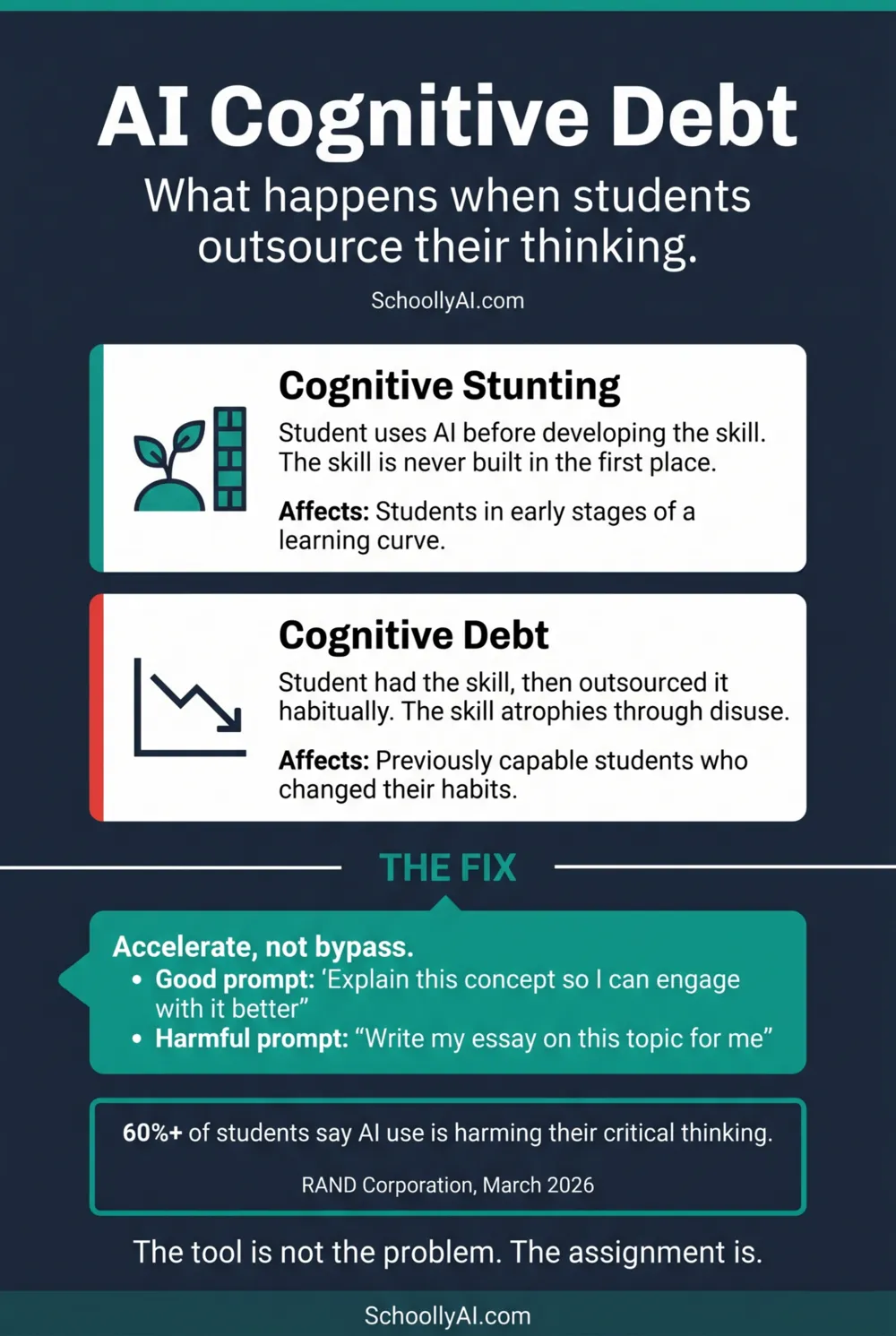
Emerging research highlighted in 2026 educator guides identifies a phenomenon researchers are calling cognitive debt: the measurable weakening of analytical thinking and problem-solving capacity that builds up when students consistently let AI do the reasoning for them. Jobs for the Future, 2026 This is distinct from never developing a skill. It is a previously capable student losing ground.
- Cognitive debt is the gradual erosion of thinking skills through habitual AI outsourcing, distinct from the failure to develop them in the first place.
- The mechanism is not AI use itself. It is AI use that replaces the cognitive work rather than supporting it.
- Students themselves are reporting the decline. Over 60% of students in a 2026 RAND study said AI use was harming their critical thinking.
- The practical framework: AI should accelerate comprehension, not bypass the work that produces it.
What Cognitive Debt Is
Cognitive debt is a term that has emerged from the 2025-2026 educational research literature to describe a specific and measurable pattern. A student who consistently outsources their thinking to AI does not simply stay at the same level. Over time, their capacity to initiate reasoning, sustain attention on difficult material, and synthesise information independently begins to decline.
This is not the same as cognitive stunting, which describes the failure to develop skills because AI completed the tasks that would have built them. Cognitive debt affects students who had those skills and then began habitually delegating the cognitive work. The debt accumulates through repeated outsourcing in the same way financial debt accumulates through repeated spending without repayment.
The distinction matters because the intervention is different. A student who never developed a skill needs to build it from the beginning. A student carrying cognitive debt needs to rebuild something they once had. Both are addressable, but they are not the same problem. For more on cognitive stunting specifically, see AI Cognitive Stunting: What the Research Says.
How It Accumulates
When a student asks an AI model to summarise a dense historical text, they acquire the information. What they do not acquire is the neural work of reading: parsing unfamiliar syntax, building a mental model of the argument, identifying the gaps in the evidence, managing the frustration of a difficult passage. That friction is not incidental to learning. It is the mechanism by which deep neural connectivity is built.
A 2026 RAND Corporation report found that over 60% of students expressed concern that AI use was harming their own critical thinking skills. RAND, March 2026 These are students describing their own experience. They notice they cannot initiate tasks the way they used to. They notice the reflex is to open the chatbot before they have tried. They notice that sustained independent thought feels harder than it did.
This subjective experience has an objective mechanism. The neurological pathways that support analytical reasoning are maintained through use. Consistent disuse, even over a relatively short period, produces measurable atrophy. The research literature on skill degradation from other domains, including music, language retention, and physical skills, documents the same pattern: capacity built through effort is lost through habitual bypass.
The educational implication is direct. A student who was a competent independent writer at the start of Year 10 and who spent Year 11 outsourcing most of their writing to AI may arrive in Year 12 less capable of independent writing than they were at the start of Year 10. The tool did not just fail to develop a skill. It eroded one.
Cognitive Debt vs Cognitive Stunting
The research literature uses both terms, and the distinction is worth being clear on for teachers designing assessment and intervention strategies.
| Concept | Who it affects | Mechanism | What the teacher sees |
|---|---|---|---|
| Cognitive stunting | Students who used AI before developing the skill | Skill never built because AI completed the formative tasks | Student cannot do foundational work they should be able to do at their grade level |
| Cognitive debt | Students who had the skill and then habitually outsourced it | Previously built skill atrophies through consistent disuse | Student was capable earlier in the year or in prior years, and is now visibly less capable |
In practice, both show up as a student who struggles to produce independent written work. The diagnostic question is timeline: has this student always struggled with this, or did something change? A meaningful drop between Year 10 and Year 11, in a student with no other explanation for the change, is worth investigating as a possible cognitive debt pattern.
The oral defence is the most useful diagnostic tool available. Ask the student to talk through their reasoning process. A student with stunting cannot explain the foundational concepts. A student with debt can often explain them but reports that initiating the work independently now feels effortful in a way it did not before.
Accelerate, Not Bypass
The clearest framework for ethical AI use in student learning comes from the cognitive debt research itself: AI should accelerate comprehension, not bypass the work that produces it.
The distinction is in what the student does after interacting with the AI. If AI use leaves the student doing more of their own thinking, it is accelerating. If AI use leaves the student doing less, it is bypassing.
Two examples from the same assignment make this concrete. A student assigned to write an analysis of a historical event asks the AI: "Explain the economic conditions in Weimar Germany in 1923 so I can better understand the primary sources I'm reading." The AI provides context. The student reads the sources with greater understanding and writes the analysis themselves. That is acceleration.
A different student asks the AI: "Write a 600-word analysis of the economic conditions in Weimar Germany in 1923 for my history class." The AI produces the analysis. The student submits it. That is bypass. The cognitive work the assignment was designed to produce did not happen.
Assignment design determines which of these is possible. Tasks that require personal observation, real-time experience, oral defence of reasoning, or integration of information from a specific class session are much harder to complete through bypass. Tasks that can be fully specified in a single prompt without access to the student's actual experience are fully outsourceable.
The practical implication for teachers is not to ban AI from assignments. It is to design assignments where the student's genuine cognitive work is the deliverable, and AI assistance is positioned as research support rather than output generator.
For the full picture on how these tools should be deployed in a classroom context, see The 5 AI Tools I Use in My Classroom.
FAQ
AI cognitive debt is the accumulated deficit in thinking skills that builds up when students consistently outsource reasoning to AI rather than developing or maintaining those skills themselves. Unlike cognitive stunting, which describes the failure to develop skills in the first place, cognitive debt can affect students who previously had strong skills and then began relying on AI to do the cognitive work for them.
When students use AI to complete tasks that would otherwise require sustained reasoning, such as writing, research, and analysis, they bypass the neurological process that maintains and strengthens those skills. Over time, this produces measurable declines in the ability to initiate problem-solving, synthesise information, and sustain attention on complex tasks without AI assistance.
Cognitive stunting describes the failure to develop foundational thinking skills in the first place, because AI completed the tasks that would have built those skills. Cognitive debt describes the gradual erosion of skills a student previously had, through habitual outsourcing of cognitive work to AI. Both produce similar outcomes but through different mechanisms.
The accelerate not bypass principle states that AI should be used to deepen and extend thinking, not to replace it. A good prompt asks AI to explain context so the student can engage more deeply with the material. A harmful prompt asks AI to produce the work the student was supposed to produce themselves. The distinction is whether the student is still doing the cognitive work.
Sources
- Jobs for the Future. AI in Education: Learner Perspectives 2026. 2026. jff.org
- RAND Corporation. More Students Use AI for Homework, and More Believe It Harms Critical Thinking. March 2026. rand.org
- Education Week. Rising Use of AI in Schools Comes With Big Downsides for Students. October 2025. edweek.org