Turnitin vs. GPTZero vs. Originality.ai: Which AI Detector Is Least Wrong?
Turnitin, GPTZero and Originality.ai produce outputs that can look comparable but are evaluated using different datasets, thresholds and versions. Independent benchmarks show variation, especially when AI-generated text is edited. Before using any score in an academic-integrity decision, teachers need to know what the tool measures and what the reported accuracy actually means.
- Turnitin reported an approximately 4% sentence-level false-positive metric in 2023, distinct from its document-level measure; neither should be generalized to all writing or later model versions.
- GPTZero is calibrated specifically for educational environments. Its sentence-level heatmaps show which specific sentences triggered the flag, not just an aggregate score.
- Originality.ai results depend on the specific benchmark and tested version; the unsourced 76–94% range cannot serve as a general accuracy estimate.
- No tool provides definitive proof of authorship. The research question has shifted from finding the best detector to identifying the least harmful diagnostic option.
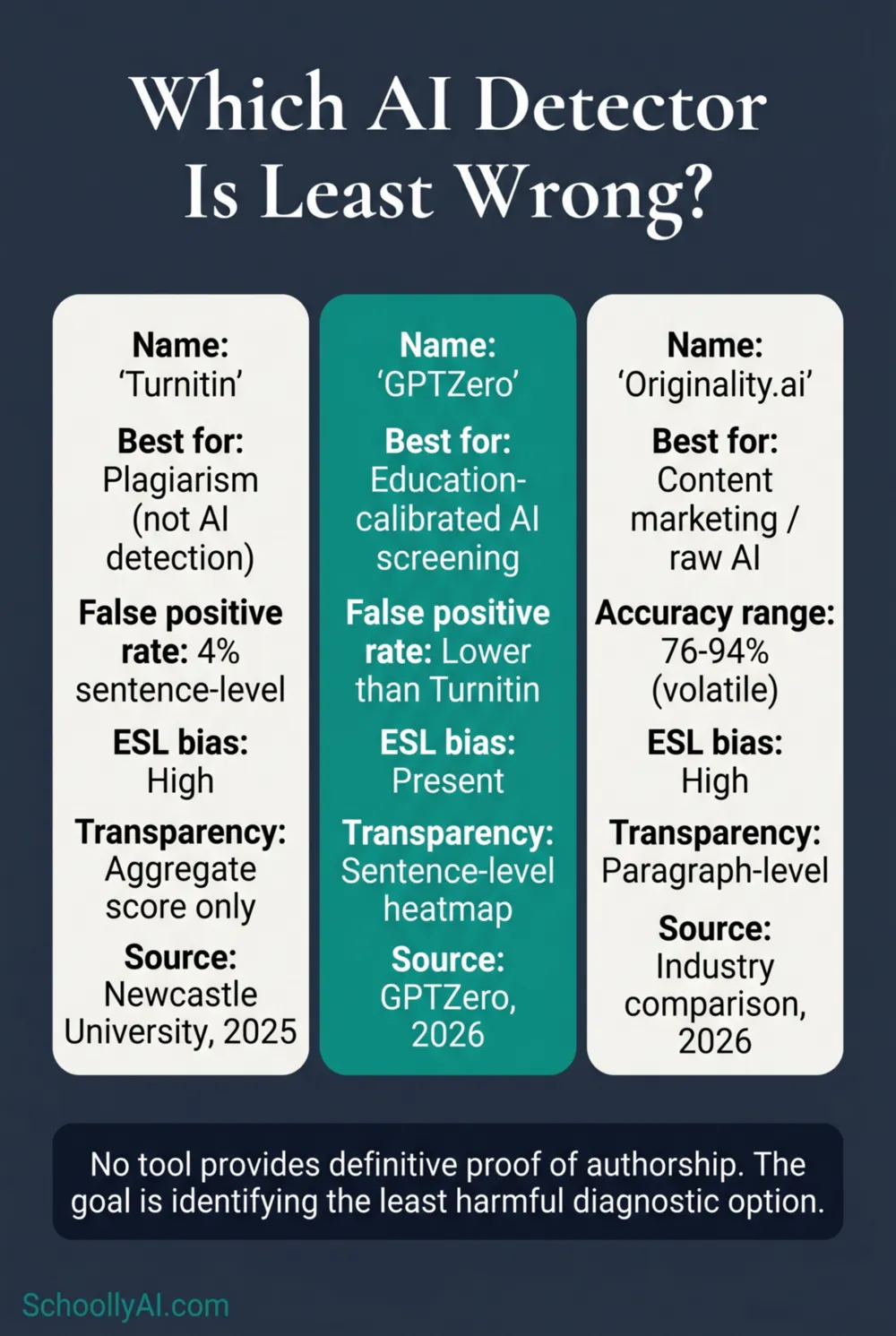
Infographic retained for revision: the values and comparative rankings shown should be read only after source, dataset, model-version and measurement checks.
Why the Tool You're Using Might Be the Wrong One
Most K-12 schools landed on Turnitin through institutional inertia. It was already integrated. The contract renewal included AI detection. Nobody ran an accuracy comparison before deploying it for academic integrity decisions. That is not a criticism of the administrators who made the call. It is the reality of how ed-tech adoption works in most districts.
The 2026 landscape has changed enough that staying with a default is now an active choice with real consequences. Teachers are flagging ESL students at rates that do not hold up to scrutiny. Detection scores are being challenged by parents who have read the same JISC and Newcastle University findings the vendor would prefer they hadn't. The question of which tool is most appropriate for which context is one worth answering before a dispute lands on a vice principal's desk.
How Independent Testing Differs From Vendor Claims
Vendor accuracy figures are generated under controlled lab conditions. Clean AI output is tested against clean human writing, matched for length and domain, with no revision or editing. Those conditions do not describe a real classroom.
Real classroom populations include ESL students writing formally in a second language, students who used AI for brainstorming and then wrote their own drafts, students who ran their work through Grammarly before submitting, and students who revised their AI-generated content manually. Every one of those populations produces text that looks different to a detector than clean human writing does.
Jisc's June 2025 review summarizes multiple studies with different datasets and evaluation methods. In one 2024 study in its table, Copyleaks scored 100% while DupliChecker scored 0% at identifying AI-generated text; these were different tools, not the same product before and after a minor edit. Results must be read in the context of the exact test and software version.
Turnitin: The Contract Default
Turnitin's core strength is its plagiarism database. Decades of student submissions give it an unmatched resource for detecting copied text. That strength does not extend to AI detection.
Turnitin's AI Writing Report provides an overall percentage of qualifying text estimated to be AI-generated and also highlights passages it identifies as likely AI-written. The percentage is not a probability that a student cheated, and the tool does not establish who authored the work.
In June 2023, Turnitin disclosed an approximately 4% false-positive metric for individual highlighted sentences and a different document-level measure of less than 1% under specified test conditions. These metrics are not interchangeable or guarantees for current releases. Turnitin has since updated its detection models and reporting categories, so any head-to-head comparison must identify the release tested.
Turnitin's own documentation states the tool should not be used as the sole basis for punitive action. That disclaimer matters for liability. It does not filter through to the teachers receiving the alert in their LMS dashboard.
GPTZero: The Education-Calibrated Option
GPTZero was built specifically for academic use, which makes it structurally different from tools adapted from content marketing or plagiarism detection. The sentence-level heatmap can help a teacher identify passages for discussion, but Turnitin also provides highlighted text and neither system can identify authorship with certainty.
That granularity changes the conversation. A teacher can use highlighted passages to frame a fair question about the writing process. Turnitin also highlights passages, and neither product's markers constitute definitive proof of AI authorship.
GPTZero provides highlighted spans that can help an educator ask targeted questions, but those markings do not establish authorship. Claims about comparative false-positive rates require independent tests of the same kinds of student writing under comparable conditions.
Vendor-published accuracy figures should be attributed to their own tests and dated. They cannot be compared directly with a different company's sentence-level false-positive rate or with independent benchmarks using other samples.
Originality.ai: The Commercial Contender
Originality.ai was designed for content marketing use cases and adapted for academic integrity. That origin matters. Its training prioritises detecting raw AI content from platforms like ChatGPT and Claude. It performs better on unedited AI output than on student writing that mixes AI drafting with human revision.
The 76–94% range previously presented here does not identify a consistent test, version or dataset. Jisc's 2025 review reports results from specific earlier studies instead. Those findings can inform a comparison only when we identify the precise benchmark and avoid claiming the figures apply to every current classroom scenario.
Originality.ai has been evaluated in commercial and independent testing, but the results do not establish a universal best detector for schools or content teams. Educational decisions should depend on documented error rates for a relevant student population, not a broad product ranking.
Head-to-Head: What the Independent Research Shows
| Criterion | Turnitin | GPTZero | Originality.ai |
|---|---|---|---|
| False positive rate on structured academic writing | About 4% per highlighted sentence (Turnitin disclosure, 2023; not a current independent benchmark) | Not directly comparable without a shared dataset and version | Not established by a comparable dataset in this article |
| ESL bias | Bias requires testing for the specific release and student population | Needs current, population-specific validation | Needs current, population-specific validation |
| Bypass vulnerability | Results vary by evasion method and model version | Results vary by evasion method and model version | Results vary by evasion method and model version |
| Sentence-level transparency | Yes. Overall percentage and highlighted passages | Yes. Sentence-level heatmap | Partial. Paragraph-level highlighting |
| LMS integration | Canvas, Schoology, Google Classroom | Limited direct LMS integration | API access; limited native LMS integration |
| Best use case | Plagiarism detection (not AI detection) | Classroom AI integrity conversations | Content marketing / unedited AI output |
Evasion tests do not establish that every edit bypasses every detector. The relevant question for schools is whether a particular tool has adequately documented false-positive and false-negative rates for the writing and students actually being assessed.
Which Tool Fits Which Classroom Context
ESL-heavy classroom: avoid using AI-detector scores as primary evidence. The 2023 study by Liang and colleagues found that 89 of 91 TOEFL essays were flagged by at least one of seven tested detectors; that statistic does not describe any single current detector. Use student work history and a fair conversation instead.
General high school with mixed writing ability: a highlighted report can sometimes help frame a conversation, but it cannot prove misconduct. Avoid using a second detector as a substitute for actual process evidence or for a chance to hear the student's explanation.
College-prep or university-bound cohort: process verification should replace tool reliance entirely. These students are producing the most sophisticated writing and are most likely to be falsely flagged. Version history and a brief verbal check produce better evidence than any detector.
Students may be able to evade detection, but success varies by tool, text and method. Because both false positives and missed AI use are possible, schools should not rely on detector output as the decisive evidence.
Which detector fits your classroom?
FAQ
The research cited here does not establish a single most accurate tool for K–12. Accuracy depends on the dataset, model version and error metric; none proves authorship.
Turnitin provides an overall AI-writing percentage and highlighted text. Its approximately 4% sentence-level figure comes from its 2023 disclosure under specified conditions and should not be treated as a current independent classroom error rate.
AI-detection results cannot reliably establish whether or how a specific editing tool was used. Ask students to disclose permitted editing assistance as required by the assignment.
Tools use different models, thresholds and training data. In a study summarized by Jisc (2025), Copyleaks scored 100% and DupliChecker scored 0% at identifying AI-generated text; these were two different products in a specific benchmark.
Sources
- Grundy, D. The Unfairness of AI-Flagged Academic Misconduct Investigations in UK Universities. Newcastle University. August 2025. blogs.ncl.ac.uk
- Jisc. AI Detection and Assessment: An Update for 2025. National Centre for AI. June 2025. Jisc review
- Turnitin. Understanding the false positive rate for sentences of our AI writing detection capability. June 2023. Turnitin disclosure
- Turnitin. Using the AI Writing Report. Product documentation
- GPTZero (vendor-authored comparison). Best AI Content Detectors Compared. 2026. gptzero.me
- Turnitin. AI writing detection model updates. Release notes, 2025–2026. guides.turnitin.com
- Thesify.ai. How Professors Detect AI Writing: 2026 Guide. 2026. thesify.ai
- Reddit / r/BestAIDetectors. Best AI Detector Tools of 2026. 2026. reddit.com/r/BestAIDetectors
- Liang, W., et al. GPT detectors are biased against non-native English writers. Patterns. 2023. hai.stanford.edu
The tool comparison only matters in the context of what the scores mean. The AI Literacy mini-course covers how to read detection results, when to act on them, and what to do instead. Free. No email required.
Start the AI Literacy Course →