ESL Students and AI Detection Bias: The Algorithm Penalty
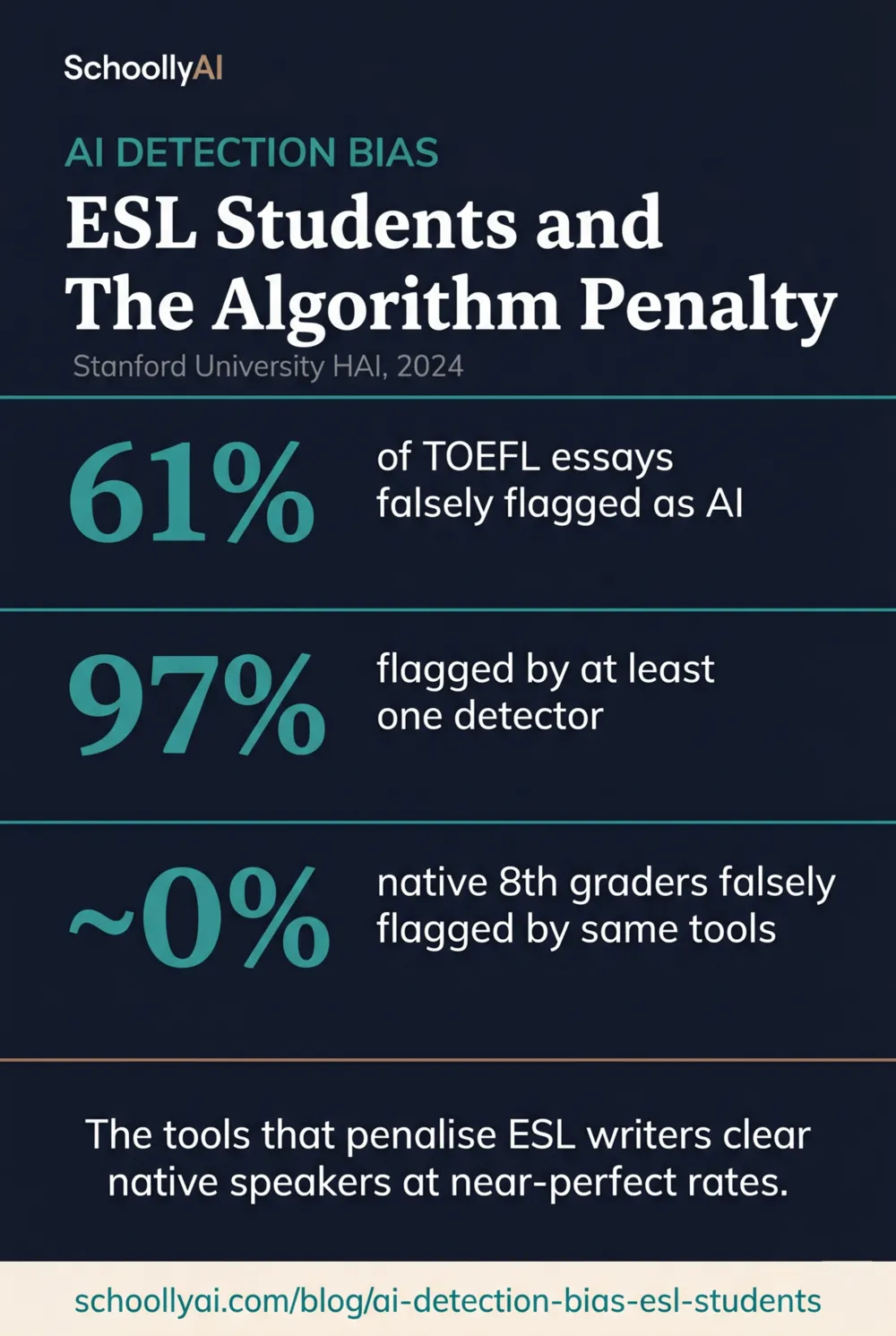
If your school runs AI detection on ESL student work, you should question whether it can be used fairly. A 2023 study by Liang and colleagues tested seven detectors on 91 human-written TOEFL essays and 88 U.S. eighth-grade essays. The detectors incorrectly flagged an average of 61.3% of the TOEFL essays, but rarely misclassified the U.S. student sample. These findings reveal a serious risk of biased accusations in the tested conditions; they do not establish that every current detector performs identically.
- In the 2023 study, the seven tested detectors had an average false-positive rate of 61.3% across 91 human-written TOEFL essays.
- All seven tested detectors incorrectly flagged 18 of 91 essays (19.8%). This result concerns the particular detectors and sample in the study.
- At least one of the seven tested detectors flagged 89 of 91 essays (97.8%); that is a combined result across tools, not a single detector's individual false-positive rate.
- The study linked the misclassification pattern in part to text predictability (perplexity), a feature that can overlap between some human and AI-generated writing.
- Schools should not treat detector scores as proof of misconduct, especially for English-language learners. Draft histories, supervised writing samples, and student conversations provide additional context.
The algorithm that flags AI writing uses the same statistical signals that ESL instruction teaches students to produce. The two are indistinguishable to the tool.
The Built-In Trap: Why ESL Students Can't Win
Learning to write in a second language means learning to be predictable. You lean on standard vocabulary because it's safe. You construct sentences using patterns you've been taught work. You avoid unusual phrasing because unusual phrasing gets misunderstood. This is not a failure of creativity. It is exactly what good ESL instruction looks like.
Some AI detectors use text predictability, often described as perplexity, while others combine multiple statistical or machine-learning signals. Burstiness describes variation in patterns such as sentence length. The exact features and model designs vary between products.
Some second-language writing may use relatively predictable vocabulary or sentence structures. In the 2023 Stanford-led study, that overlap contributed to misclassification of many human-written TOEFL essays. The findings do not mean every ESL student writes alike or that all current detectors use the same scoring method. For the technical breakdown, see What AI Detectors Actually Measure (And Don't).
What Stanford Found
The evidence gives teachers a concrete reason to be cautious about AI detection with non-native English writing. Its measured error rates apply to the seven detectors and essay samples tested, rather than to all products and student populations.
In 2023, Weixin Liang and colleagues, including James Zou, published a study in Patterns comparing 91 TOEFL essays written by non-native English writers with 88 U.S. eighth-grade essays. Seven GPT detectors were evaluated.
| Finding | Data Point |
|---|---|
| TOEFL essays flagged as AI by at least one detector | 97.8% (89 of 91 essays) |
| ESL essays unanimously misidentified by all seven detectors | 19.8% (18 of 91 essays) |
| Native eighth-grade essays wrongly flagged | Near zero (described as "near-perfect" clearance) |
| Average false-positive rate across the seven detectors | 61.3% |
The 18 unanimously misclassified essays show why checking the same paper with more than one detector is not necessarily a safeguard. The result concerns these seven tools in 2023 and should not be extrapolated to all detector versions.
Research from D-Lab at UC Berkeley confirmed the pattern from a different angle. Ramírez-Castañeda and colleagues found in 2024 and 2025 that the same tools calling ESL students cheaters were performing competently on native-speaker writing. The problem is not detection quality overall. The problem is unequal accuracy across student populations.
Why ESL Writing Gets Flagged: The Technical Reason
Non-native speakers score lower on measures of lexical richness, syntactic complexity, and grammatical diversity. These are not failures of intelligence or effort. They reflect where a student is in their language acquisition process.
AI text generators also score low on lexical richness and syntactic complexity. They are optimised to produce text that is clear, coherent, and unsurprising. The result is text that sits in the same statistical space as the writing of a careful, rule-following language learner.
The study warns that a detector relying heavily on predictability can disadvantage writers with more restricted linguistic variation. It does not prove that every future detector must have the same bias.
The Double Penalty: When Instructors Reinforce the Algorithm
The algorithmic bias is bad enough on its own. What the MDPI Information Journal's qualitative synthesis found in 2025 is that it gets compounded by human judgment: ESL instructors themselves often judge grammatically accurate, sophisticated writing from second-language learners as AI-generated.
So an ESL student can produce genuinely good work, have it flagged by the detection tool, and then have that flag confirmed by a human reviewer who intuitively associates formal writing quality with AI output. The student faces an algorithmic accusation and a human accusation simultaneously, both based on the same faulty premise.
The Center for Innovative Teaching and Learning at Northern Illinois University documented the resulting atmosphere in 2024: the algorithmic bias against marginalized student groups "could foster an atmosphere of distrust between faculty and students, discourage academic participation, and undermine the perception of fairness." They observed the same impact on neurodivergent students, whose non-standard linguistic patterns also produce detection flags.
What ESL Students Are Actually Doing to Survive This
University and high school forums from 2024 to 2026 show a consistent and disturbing pattern. ESL students have started deliberately introducing grammatical errors, misused idioms, and awkward phrasing into their essays just to introduce enough "burstiness" to pass the school's AI detector.
Let that sink in. Students are making their writing intentionally worse to prove they wrote it themselves.
This destroys the core purpose of the writing assignment. A task meant to develop communication skills is now optimised for defeating a flawed algorithm. The student submits a degraded version of their best work. The teacher grades it. Both of them spend energy on a process that has nothing to do with learning.
The chilling effect extends beyond writing assignments. ESL students report participating less in class, deeply distrusting faculty, and experiencing significant psychological anxiety about disciplinary processes they cannot defend against through any approach that doesn't involve compromising their own work.
What Teachers and Schools Must Do
The study authors cautioned against using these detector results in evaluative settings where mistaken flags could harm non-native writers. Schools should review the limitations of their chosen tools and avoid relying on detection scores alone in any disciplinary decision.
If a school is not prepared to disable detection for ESL students, it should not use detection at all. Selective, population-aware application of a tool that produces systematically different error rates across student demographics is not a partial solution. It is a structured form of inequity.
The practical alternative for ESL contexts is supervised baseline writing. Conduct an in-class supervised writing task early in the course. Keep it. When out-of-class work is submitted, compare it to that baseline rather than running a detection algorithm. A student whose in-class and out-of-class writing share voice, vocabulary level, and structural approach is demonstrably consistent. A student whose supervised and submitted work show dramatic divergence is worth a conversation.
Build AI literacy programs that teach all students how to use AI tools transparently rather than teaching them to hide their use. A student who knows how to cite AI assistance, who understands what AI can and cannot do, and who sees transparent use as acceptable in defined contexts is much less likely to use AI deceptively. The broader framework is at AI Detectors Are Failing Honest Students.
The researchers warned that the results raise fairness concerns for non-native writers and call for careful validation before using these systems for high-stakes decisions. Their published 2023 paper is the appropriate source for the figures above.
The 2023 results are a warning, not a permanent benchmark for every detector. Teachers and school leaders should seek current, population-relevant evidence before adopting or relying on any such tool.
Frequently Asked Questions
A 2023 study by Liang and colleagues found substantial bias in seven tested detectors: an average 61.3% false-positive rate on 91 TOEFL essays, compared with very few false flags on 88 U.S. eighth-grade essays. Results cannot automatically be generalized to every modern detector.
Some detection methods rely partly on how predictable a text is. The 2023 study found that relatively predictable language could contribute to misclassification of human-written TOEFL essays. Products differ in their methods and error rates.
Schools should avoid treating AI-detector scores as evidence of misconduct on their own, especially for English-language learners. They should evaluate current tools for bias and use student conversations and authentic process evidence instead of automatic accusations.
Establish a baseline by conducting supervised in-class writing assignments early in the course. This gives you a reference point for each student's authentic voice. When subsequent out-of-class assignments are submitted, compare them to the supervised baseline rather than running a detection algorithm.
Bias against different writing populations deserves careful investigation, but the 2023 TOEFL study does not directly quantify false positives for neurodivergent writers. Schools should not infer misconduct from atypical or highly formal writing styles.
Sources
- Liang, W., et al. GPT detectors are biased against non-native English writers. Patterns 4(7), 100779 (2023). Published study
- Ramírez-Castañeda, V., et al. The Creation of Bad Students: AI Detection and Non-Native English Speakers. D-Lab Berkeley. 2024/2025. dlab.berkeley.edu
- Northern Illinois University CITL. AI Detectors: An Ethical Minefield. December 2024. citl.news.niu.edu
- MDPI Information Journal. Evaluating the Effectiveness and Ethical Implications of AI Detection Tools in Higher Education. 2025. mdpi.com
- arXiv. AI Detectors Fail Diverse Student Populations: A Mathematical Framing of Structural Detection Limits. 2026. arxiv.org
Defending Academic Integrity in 2026
The AI Literacy mini-course covers how to build equitable, detection-free integrity practices that serve all students in your classroom. Free. No email required.
Start the AI Literacy Course →