AI Cognitive Stunting: What the Research Says
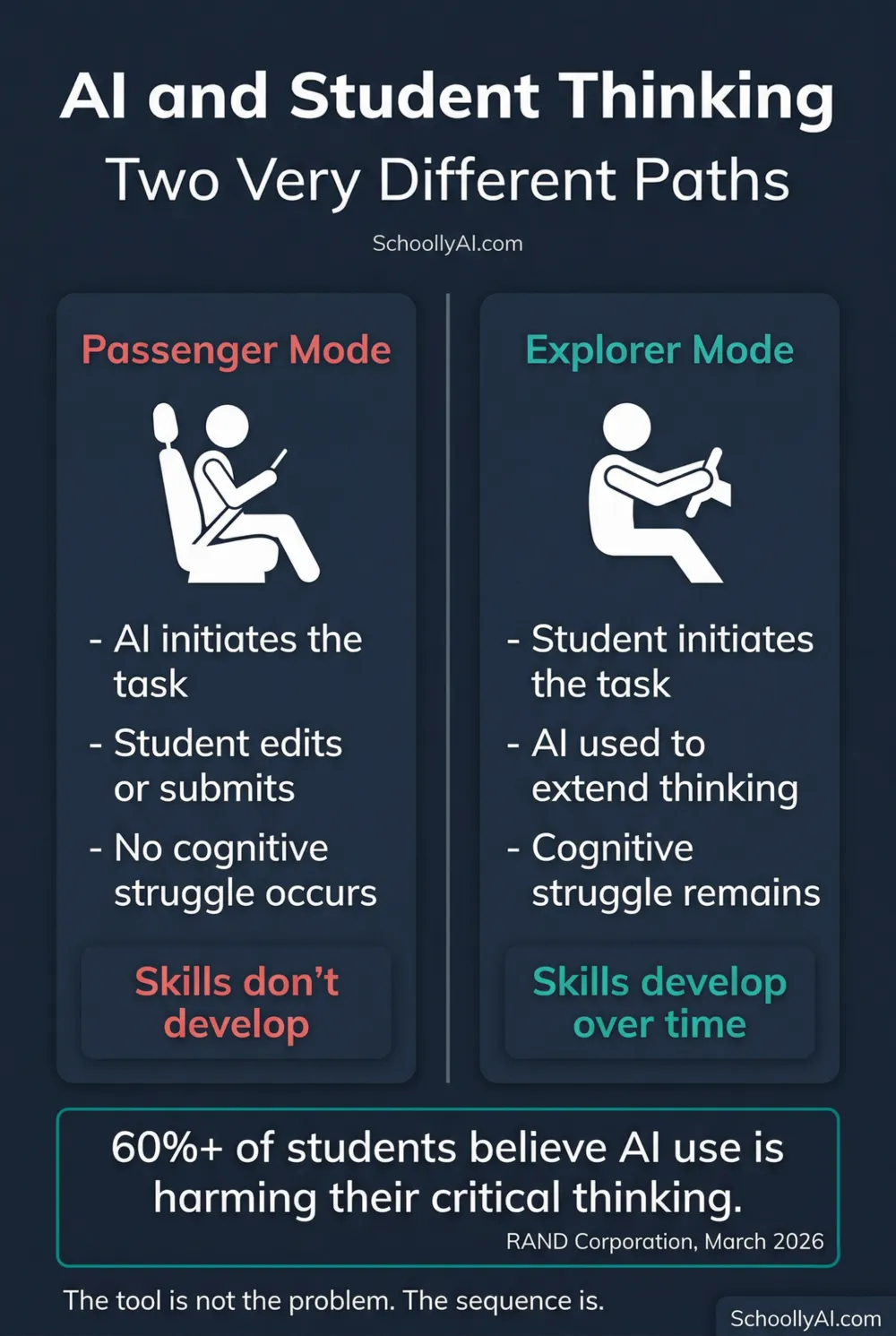
In a March 2026 RAND survey, 67% of respondents agreed that greater AI use for schoolwork would harm students' critical-thinking skills. This measured a belief about potential harm—not a test of students' actual cognitive decline. The concern merits attention without treating an opinion survey as neurological evidence.
- “Cognitive stunting” is an educational shorthand for a possible risk: students may miss skill-building practice when AI completes the work for them. It is not a diagnosis or a demonstrated universal effect.
- “Passenger mode” describes a useful classroom scenario in which AI does most of the task; it is a teaching analogy, not a validated clinical category.
- The calculator analogy holds: we do not give students calculators to learn arithmetic because it undermines the learning process.
- The sequence matters more than the tool. AI used after skills are developed is different from AI used instead of developing them.
What Cognitive Stunting Means
“Cognitive stunting” is not a clinical diagnosis. Here it describes the concern that students may miss opportunities to develop foundational skills when they repeatedly delegate learning tasks to AI. Existing studies do not establish a fixed level of long-term harm for every student.
The pedagogical concern is straightforward: constructing an argument, reading sources and drafting prose all provide opportunities to practise thinking. If an AI system produces the entire assignment, the student may not complete that practice. That is a plausible educational risk, not proof of neurological damage.
This is not a new problem. The calculator debate in mathematics classrooms covers similar ground. We do not give students calculators during the phase when they are learning arithmetic because the computational struggle builds the numerical intuition that later makes calculators useful. AI in writing, research, and analysis raises the same question at a much larger scale.
One teacher on r/Teachers put it plainly: "We don't give students calculators to learn arithmetic because it undermines the learning process and learning outcomes. This is the same for AI tutoring."
What the Research Shows
The RAND Corporation documented growing use of AI in education. Its March 2026 youth survey reported that 67% agreed with the statement that the more students use AI for schoolwork, the more it will harm critical-thinking skills. The survey measured attitudes, not changes in cognitive performance.
Students' concerns deserve to be heard, but the RAND questionnaire did not show that respondents had personally lost skills. Whether particular patterns of AI use cause measurable improvement or decline requires direct learning assessments and longer-term evidence.
Research into AI-assisted learning is evolving. For example, a 2025 MIT Media Lab preprint observed differences in EEG activity and writing-related measures across experimental conditions. It involved 54 participants in three sessions, with 18 in a fourth, and cannot establish permanent neural damage or effects across all school settings.
Passenger Mode Learning
For classroom discussion, it can be useful to distinguish two patterns: explorer mode, where students use AI to test or extend their own ideas, and passenger mode, where AI produces most of the intellectual work. These are practical labels in this article, not diagnostic research categories.
Passenger mode describes something different. The student is present but not engaged. They paste the prompt, receive the output, make minor edits if any, and submit. The machine initiated the problem-solving. The machine synthesised the material. The student rode along. These two labels can help frame a lesson, but this article does not have a representative survey establishing how many students fall into either group.
The distinction helps educators ask whether a student is practising the targeted skill. The research does not establish that one labelled “mode” guarantees learning while another always prevents it.
This also connects to why AI-generated text feels slightly off to experienced teachers. It is not wrong in any obvious way. It is smooth in a way authentic student work never quite is, because authentic student work contains the evidence of struggle. See Words AI Uses Too Much: A Teacher's Blacklist for the vocabulary patterns that mark AI output specifically.
What Teachers Can Do
The most direct response is assignment design. Tasks that require specific personal experience, local knowledge, or real-time observation are harder to outsource to AI. Asking a student to connect the material to something that happened in their community this week, or to argue against their own stated position, or to interview someone and integrate what they said: these are harder to delegate to a prediction engine.
The oral defence remains the most reliable verification tool currently available. If a student cannot explain their argument in person, the source of the written version is apparent. Building oral defence into regular assessment practice, not just as a response to suspected cheating, but as a normal part of demonstrating learning, reduces the incentive to outsource in the first place.
Teaching students what AI actually does is also worth the time. A student who understands that the model is producing statistically probable text, not thinking, not understanding, not checking, is better positioned to decide when using it serves them and when it does not. The AI Literacy mini-course covers this directly in Section 1. How Does AI Work? A Teacher's Guide is a good starting point for the conversation in class.
The goal is not to ban AI. That is both impractical and probably counterproductive. The goal is to ensure that students develop the foundational skills that make any tool, including AI, genuinely useful to them. You cannot use a tool effectively to extend capabilities you have not built.
FAQ
It is a non-clinical teaching term for the possible failure to practise or build foundational skills when AI completes the work. It is a concern, not a proven neurological condition.
The effect depends on task and use. A 2026 RAND survey found that 67% of students believed greater schoolwork AI use could harm critical thinking; it did not measure actual decline.
Passenger mode describes students who are physically present but mentally disengaged, relying on AI to initiate problem-solving and synthesise information on their behalf. They are in the vehicle but not driving. Researchers contrast this with explorer mode, where students use AI to deepen genuine curiosity.
No. AI can support explanations, practice and feedback. The important question is whether students still do the thinking required by the learning objective.
Sources
- RAND Corporation. AI Use in Schools Is Quickly Increasing but Guidance Lags Behind. 2025. rand.org
- RAND Corporation. More Students Use AI for Homework, and More Believe It Harms Critical Thinking. March 2026. rand.org
- Education Week. Rising Use of AI in Schools Comes With Big Downsides for Students. October 2025. edweek.org
- Kosmyna, N., et al. Your Brain on ChatGPT: Accumulation of Cognitive Debt when Using an AI Assistant for Essay Writing Task. MIT Media Lab preprint. June 2025. MIT Media Lab