AI Cognitive Debt: What Happens to Students Who Outsource Thinking
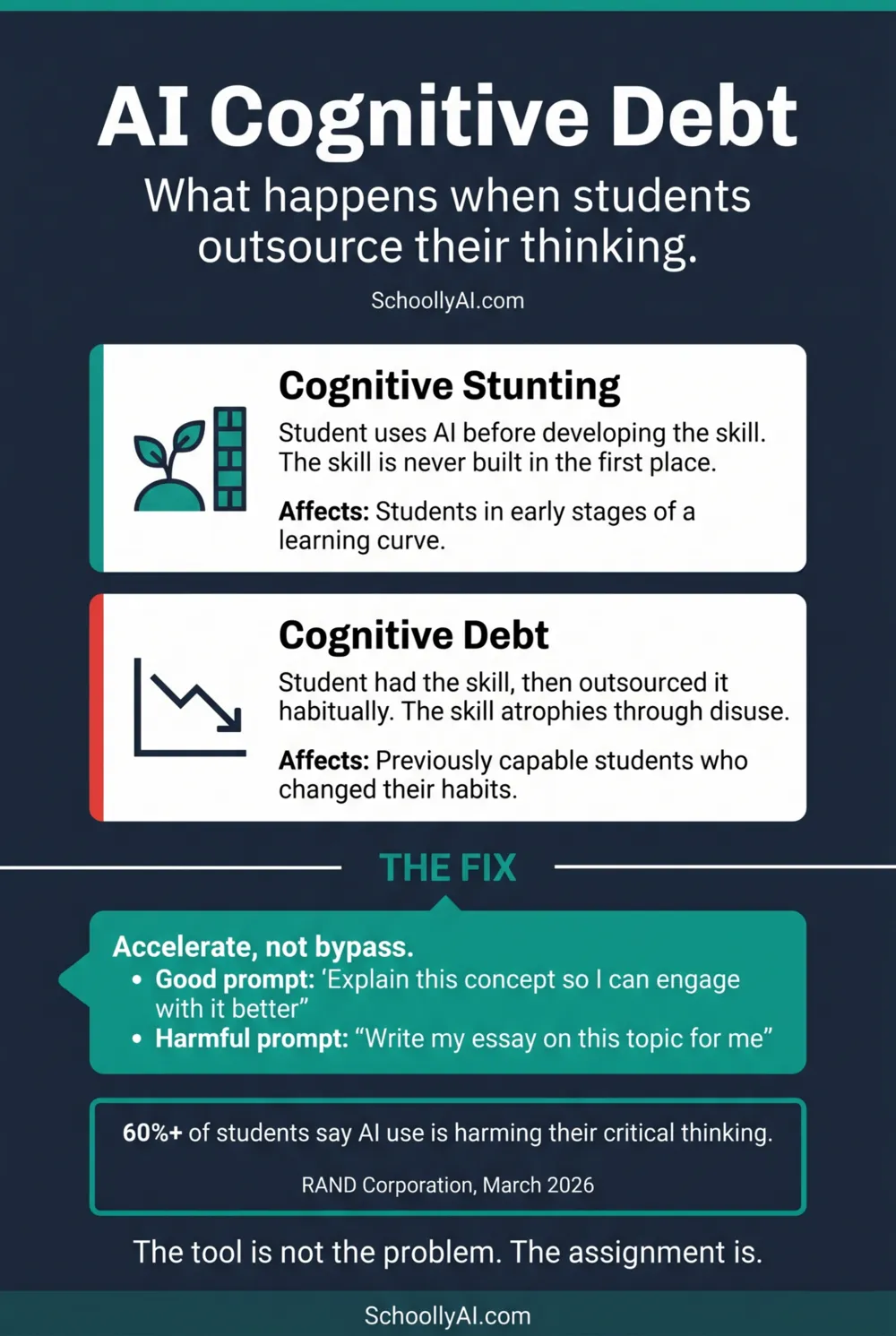
“Cognitive debt” is a term used in 2025 exploratory research on AI-assisted essay writing to discuss possible costs of outsourcing mental work. It should not be treated as a diagnosis or proof that students who use AI suffer lasting declines in analytical ability. For teachers, the useful question is which parts of the learning task a student actually completes.
- Cognitive debt is a proposed way to discuss possible costs of offloading thinking to AI, not an established measurement of long-term skill loss.
- The mechanism is not AI use itself. It is AI use that replaces the cognitive work rather than supporting it.
- In a 2026 RAND survey, 67% of students agreed that greater AI use for schoolwork could harm students' critical thinking; this was an attitude measure, not evidence of individual decline.
- The practical framework: AI should accelerate comprehension, not bypass the work that produces it.
What Cognitive Debt Is
Researchers used the term “cognitive debt” when reporting preliminary differences in AI-assisted essay writing, including EEG and behavioral measurements. These short-term experimental findings do not establish that a student inevitably loses previously mastered skills through AI use.
In this article, stunting refers to a concern about skills a student has not yet developed, while debt refers to concerns about becoming dependent on assistance for skills previously practised. This is a practical teaching distinction, not a validated diagnostic division between student groups.
The distinction can guide questions about what support a student needs. Teachers should examine actual work over time, give opportunities for independent practice, and avoid diagnosing the cause of a performance change from AI use alone.
How It Accumulates
Reading and analysing a difficult text can give students opportunities to interpret syntax, evaluate evidence and build an argument. When AI provides the whole analysis, a learner may miss some of that practice. The research does not show that every AI-supported summary prevents learning or changes neural pathways in a predictable way.
A March 2026 RAND report found that 67% of surveyed students agreed that greater schoolwork AI use would harm students' critical-thinking skills. Respondents were evaluating a general proposition; the survey did not demonstrate their own cognitive deterioration.
A 2025 MIT Media Lab preprint compared EEG measures and essay-writing behaviors across LLM, search-engine and unaided groups. Fifty-four participants completed three sessions and 18 completed a fourth. These observations are preliminary; they do not establish measurable neurological atrophy or permanent loss of thinking skills among AI users.
A student who frequently delegates writing to AI may be getting less independent writing practice. Teachers can check that possibility through comparable assignments and work samples over time, without assuming that AI caused any observed difference.
Cognitive Debt vs Cognitive Stunting
The research literature uses both terms, and the distinction is worth being clear on for teachers designing assessment and intervention strategies.
| Concept | Who it affects | Mechanism | What the teacher sees |
|---|---|---|---|
| Cognitive stunting | Students who used AI before developing the skill | Possible missed practice when AI completes formative tasks | Needs independent evidence of foundational skill development |
| Cognitive debt | Students who had the skill and then habitually outsourced it | Possible reduced independent practice or dependence on assistance | Changes in independent performance should be investigated, not diagnosed from AI use alone |
Both concerns might prompt a teacher to review independent work from different points in the year. Differences could have many causes, including instruction, wellbeing and language development. The table is an educational framework rather than a validated diagnostic tool.
A short, supportive conversation about a student's reasoning can provide useful assessment evidence, but it cannot clinically distinguish “stunting” from “debt”. Oral performance may also be affected by anxiety, disability or language proficiency.
Accelerate, Not Bypass
A useful teaching principle is to let AI accelerate comprehension rather than bypass thinking. This is a practical recommendation, not a finding that separates students into neurologically distinct categories.
The distinction is in what the student does after interacting with the AI. If AI use leaves the student doing more of their own thinking, it is accelerating. If AI use leaves the student doing less, it is bypassing.
Two examples from the same assignment make this concrete. A student assigned to write an analysis of a historical event asks the AI: "Explain the economic conditions in Weimar Germany in 1923 so I can better understand the primary sources I'm reading." The AI provides context. The student reads the sources with greater understanding and writes the analysis themselves. That is acceleration.
A different student asks the AI: "Write a 600-word analysis of the economic conditions in Weimar Germany in 1923 for my history class." The AI produces the analysis. The student submits it. That is bypass. The cognitive work the assignment was designed to produce did not happen.
Assignment design determines which of these is possible. Tasks that require personal observation, real-time experience, oral defence of reasoning, or integration of information from a specific class session are much harder to complete through bypass. Tasks that can be fully specified in a single prompt without access to the student's actual experience are fully outsourceable.
The practical implication for teachers is not to ban AI from assignments. It is to design assignments where the student's genuine cognitive work is the deliverable, and AI assistance is positioned as research support rather than output generator.
For the full picture on how these tools should be deployed in a classroom context, see The 5 AI Tools I Use in My Classroom.
FAQ
“Cognitive debt” is a research term and educational metaphor for possible costs of offloading work to AI. Short-term experiments do not establish permanent skill loss in students.
AI may replace opportunities to practise reasoning or writing when it completes a task. Researchers have observed short-term differences under particular experimental conditions, but long-term causal effects remain uncertain.
This article uses “stunting” for missed opportunities to develop a skill and “debt” for possible dependence after previous practice. These are teaching distinctions, not validated diagnostic conditions.
The accelerate not bypass principle states that AI should be used to deepen and extend thinking, not to replace it. A good prompt asks AI to explain context so the student can engage more deeply with the material. A harmful prompt asks AI to produce the work the student was supposed to produce themselves. The distinction is whether the student is still doing the cognitive work.
Sources
- Jobs for the Future. AI in Education: Learner Perspectives 2026. 2026. jff.org
- RAND Corporation. More Students Use AI for Homework, and More Believe It Harms Critical Thinking. March 2026. rand.org
- Education Week. Rising Use of AI in Schools Comes With Big Downsides for Students. October 2025. edweek.org
- Kosmyna, N., et al. Your Brain on ChatGPT: Accumulation of Cognitive Debt when Using an AI Assistant for Essay Writing Task. MIT Media Lab preprint, June 2025. MIT Media Lab